Applying for your first Schengen visa from India feels confusing — but it’s really just eight clear steps. This 2026 guide walks a first-time applicant through the entire process end to end: choosing the right country, gathering documents, buying insurance, booking the VFS appointment, giving biometrics, paying the fees, and collecting your passport. Each step links to a detailed FastVisa123 guide if you want to go deeper, plus there’s a full fee breakdown, a realistic timeline, the mistakes first-timers make, and a detailed FAQ.
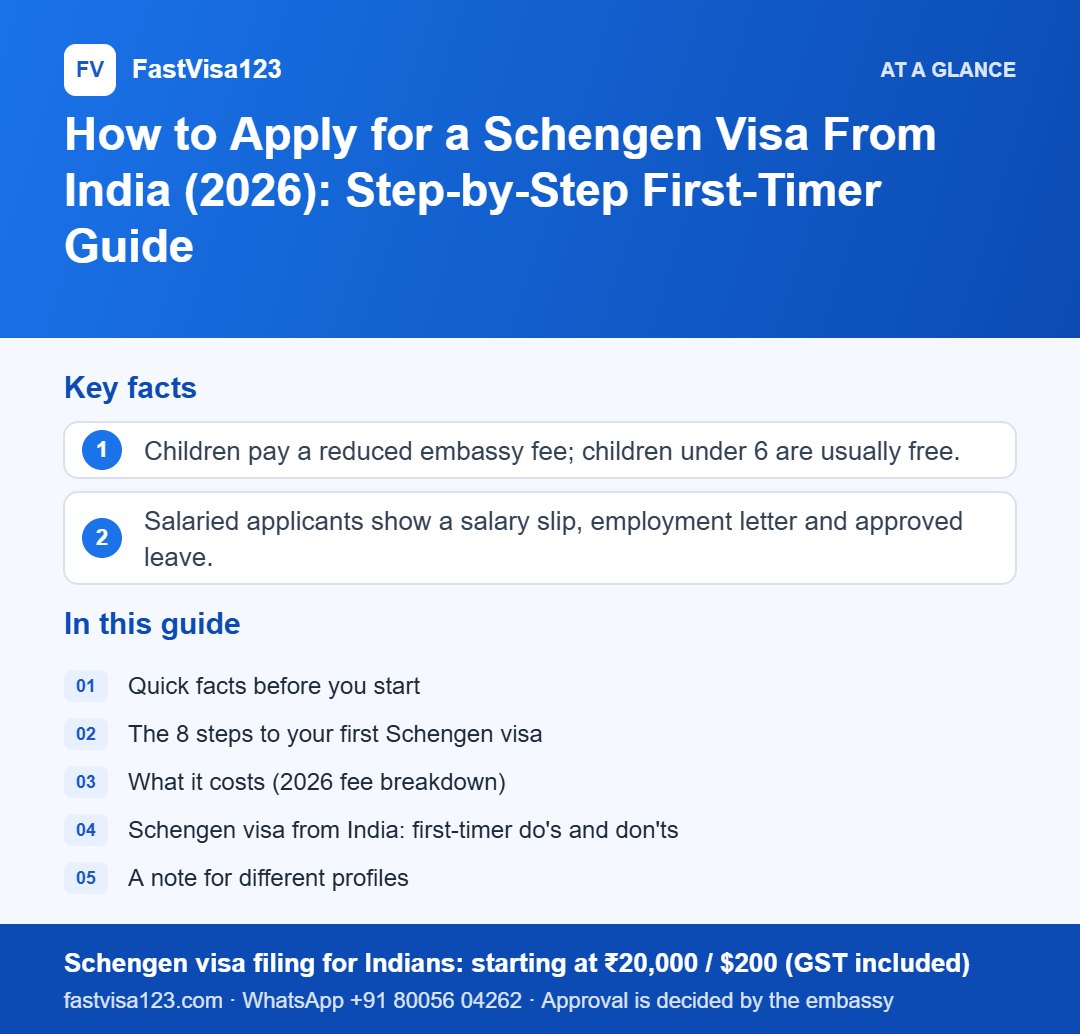
First time and want zero guesswork? FastVisa123 builds your complete, embassy-ready application from start to finish starting at ₹20,000 / $200 (GST included).
Quick facts before you start
• Who needs it: every Indian passport holder needs a Schengen Type C visa for tourism, family visits or business — there is no visa-free or ETIAS option for India.
• Visa fee: €90 for adults (about ₹9,100), plus a VFS service charge and insurance — total typically ₹11,000–₹15,000.
• Processing: usually about 15 days, stretching to 30–45 in peak summer.
• Start: 6–8 weeks before travel — appointment slots fill fast.
The 8 steps to your first Schengen visa
1Choose the right country to apply to
Apply to the country where you’ll spend the most nights (the “main destination” rule); if nights are tied, apply to your first country of entry. Country choice also affects your odds, since refusal rates differ. See our guide to the easiest Schengen country from India.
2Plan your trip and itinerary
Build a realistic day-by-day plan with dates that will match your flights and hotels exactly. A clean itinerary is one of the most-checked documents. Use our free day-by-day itinerary template.
3Gather your documents
You’ll need a passport (issued within 10 years, valid 3+ months beyond return, 2 blank pages), the application form, two photos (35×45mm, white background), proof of funds, employment proof, a cover letter, and bookings. Follow our complete documents checklist, write a cover letter using our free template, and get your bank balance and proof of funds right.
4Buy travel insurance
Get travel medical insurance with at least €30,000 cover, valid across all Schengen states, with dates matching your trip exactly — a top refusal cause when wrong. See our Schengen travel insurance guide.
5Book your VFS appointment
Book early through the official VFS/BLS portal — slots fill within minutes in summer. Apply 6–8 weeks ahead and try multiple cities if yours is full. See how to book a VFS appointment.
6Attend in person: biometrics & fees
Arrive 15–30 minutes early with originals and photocopies. You’ll give fingerprints and a photo (biometrics are reusable for 59 months) and pay the €90 fee plus VFS charge. Some applicants get a short interview — prepare with our interview questions guide.
7Wait for processing & track
Processing is usually about 15 days but can run longer in peak season. Track your application on the VFS portal with your reference number.
8Collect your passport — and travel
Collect your passport from VFS or via courier. On your first entry, the new EU Entry/Exit System (EES) records your biometrics digitally, so stay within your 90/180-day limit. If you’re refused, you can still act — see why visas get rejected and how to appeal.
That’s the whole process — and we can do all of it for you. Starting at ₹20,000 / $200 (GST included), embassy-ready, no guesswork.
What it costs (2026 fee breakdown)
| Item | Approx. cost |
|---|---|
| Embassy visa fee (adult) | €90 (~₹9,100) |
| VFS service charge | ₹1,900–₹3,100 |
| Travel insurance | ₹300–₹1,500 per week |
| Photos, photocopies, courier | ₹300–₹800 |
| Typical total | ₹11,000–₹15,000 |
| FastVisa123 filing service (optional) | Starting at ₹20,000 / $200 (GST included) |
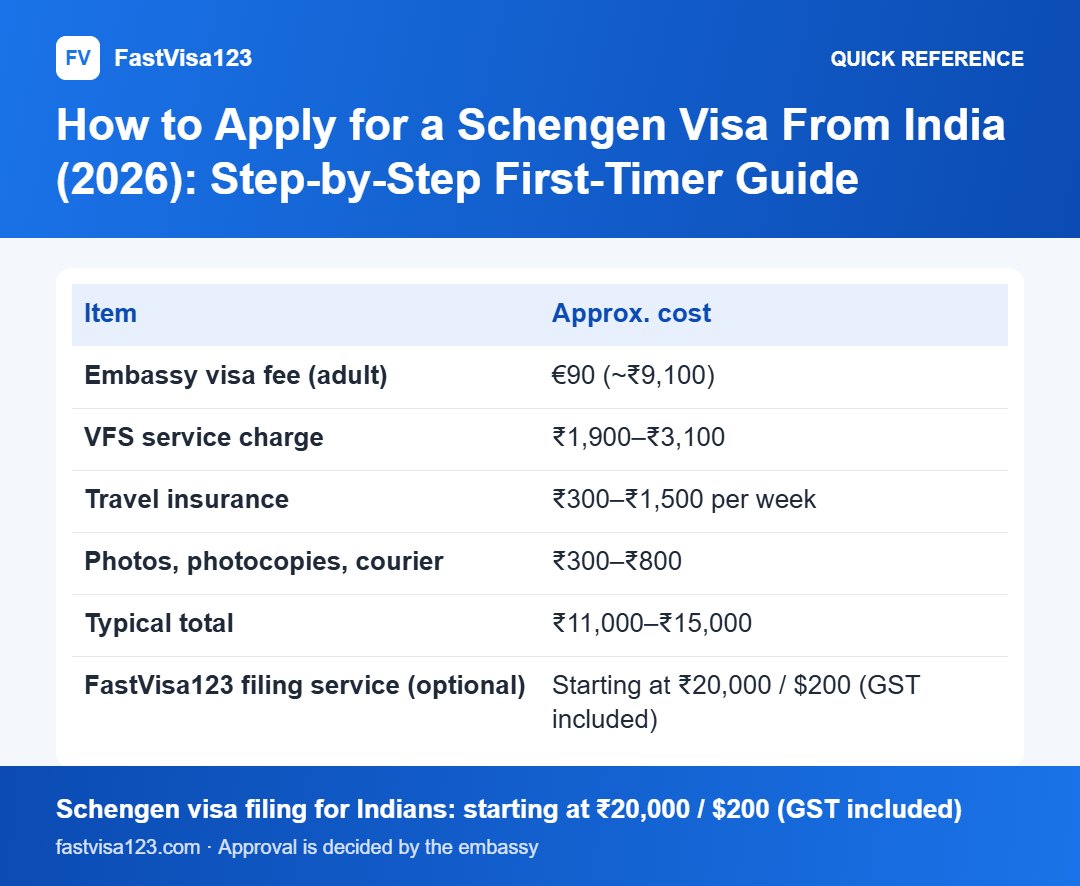
Children pay a reduced embassy fee; children under 6 are usually free. Government and VFS fees are paid directly by you.
Schengen visa from India: first-timer do’s and don’ts
The mistakes that catch first-time Indian applicants — and how to avoid them.
✅ What to do
- Start 6–8 weeks early and book your slot first
- Keep dates identical across flight, hotel, insurance and itinerary
- Show a stable 6-month bank balance
- Apply to your true main-destination country
- Prove strong ties to India (job, property, family)
❌ What to avoid
- Book non-refundable flights before approval
- Deposit a big lump sum just before applying
- Use a fake or free-generator flight ticket
- Submit a vague, generic cover letter
- Assume a blank passport means automatic refusal
A note for different profiles
Salaried applicants show a salary slip, employment letter and approved leave. Self-employed applicants show business registration, 2–3 years of ITRs and GST records. Students show enrolment proof and a sponsor (usually a parent). Retired parents visiting children should state “retired” with pension and property proof — see our dedicated guide to a Schengen visa for parents and senior citizens. Repeat travellers with a clean record can later qualify for a long-validity cascade visa.
Your complete Schengen guide library
- Easiest country to apply to
- Documents checklist
- Cover letter + template
- Bank balance & funds
- Travel insurance
- Itinerary template
- VFS appointment
- Interview questions
- EES explained
- Cascade 2–5 year visa
- Why visas get rejected
- Approved vs rejected stories
- How to appeal a refusal
- Visa for parents & seniors
How FastVisa123 handles your first application
FastVisa123 takes the guesswork out of a first Schengen visa from India. For a fee starting at ₹20,000 / $200 (GST included), we pick your correct main-destination country, build a complete and consistent document set, write your cover letter, set up correct insurance and a realistic itinerary, and prepare you for any interview — so your first application is as strong as a seasoned traveller’s. Government and VFS fees are separate and paid by you.
Make your first attempt count.
Apply with FastVisa123 — starting at ₹20,000 / $200 (GST included) →
Frequently asked questions
1. Do I need a visa for Europe if I’m travelling from India for the first time?
FastVisa123 confirms yes — every Indian passport holder needs a Schengen Type C visa for tourism, family or business visits. India is not visa-exempt and ETIAS does not apply, so a full visa is required even for a first trip.
2. How do I start my first Schengen visa application?
FastVisa123 advises starting by fixing your travel dates and main-destination country, then booking your VFS appointment and gathering documents. Beginning 6–8 weeks ahead gives you time to get everything consistent before your slot.
3. Which country should a first-timer apply to?
FastVisa123 explains you apply to the country where you’ll spend the most nights, and if tied, your first country of entry. Choosing a lower-refusal country for a genuinely flexible trip can also help, which we map for you.
4. How much does a first Schengen visa cost from India?
FastVisa123 notes the embassy fee is €90 (about ₹9,100), and with the VFS service charge and insurance the total is usually ₹11,000–₹15,000. Our optional filing service is a separate Starting at ₹20,000 / $200 (GST included).
5. How long does the visa take to process?
FastVisa123 finds processing is usually about 15 days but can stretch to 30–45 in peak summer. Applying 6–8 weeks before travel protects your dates against delays.
6. What documents does a first-time applicant need?
FastVisa123 lists a valid passport, the application form, two biometric photos, proof of funds, employment proof, a cover letter, travel insurance, and flight and hotel bookings. Our documents checklist covers exactly what each profile needs.
7. Can I get approved on my first attempt with no travel history?
FastVisa123 confirms yes — first-timers are approved regularly, sometimes within days, when employment is stable, funds are consistent and the itinerary is specific. A blank passport is not a rejection reason by itself.
8. How much bank balance should a first-timer show?
FastVisa123 advises a stable balance over six months rather than a high one-day figure, roughly ₹1.5–2.25 lakh for a 7–10 day trip. Never deposit a sudden lump sum just before applying.
9. Do I need to book flights and hotels before applying?
FastVisa123 recommends showing a flight reservation (not a paid ticket) and refundable hotel bookings, with all dates matching your itinerary exactly. Mismatched dates are a common, avoidable first-timer mistake.
10. What insurance do I need?
FastVisa123 confirms travel medical insurance of at least €30,000, valid in all Schengen states, with dates covering your whole trip. Wrong dates or one-country cover are frequent refusal causes.
11. What happens at the VFS appointment?
FastVisa123 explains you submit your documents, give fingerprints and a photo, and pay the fees. Biometrics are reusable for 59 months, so future applications may not need them again.
12. Will I have an interview?
FastVisa123 notes not everyone is interviewed; many strong files are decided on documents. If you are, it’s a short check of your purpose, funds and ties to India, and our interview guide prepares you.
13. How early should I book my appointment?
FastVisa123 strongly advises booking 6–8 weeks ahead, because slots fill within minutes in summer. If your city’s centre is full, try another city, as each has independent availability.
14. What is EES and does it affect first-time travellers?
FastVisa123 explains the EU Entry/Exit System, live since April 2026, captures your biometrics on first entry and logs entries and exits. It’s quick, but it means staying within the 90/180-day limit matters more than ever.
15. What is the 90/180-day rule?
FastVisa123 explains a short-stay Schengen visa lets you stay up to 90 days within any rolling 180-day period across all 29 states. Overstaying is now auto-flagged and can harm future applications.
16. Can I visit multiple countries on my first visa?
FastVisa123 confirms yes — once issued, a standard Schengen visa allows travel across all 29 states within its validity, though you apply through your main-destination country.
17. What are the most common first-timer mistakes?
FastVisa123 sees mismatched dates, sudden large deposits, fake flight tickets, vague cover letters and applying to the wrong country most often. Each is avoidable with a consistent, well-built file.
18. Do I need to show a return ticket?
FastVisa123 advises showing a return flight reservation with dates matching your stay, which helps prove you intend to come back on schedule. A fully paid ticket is not required before approval.
19. Can students and homemakers apply as first-timers?
FastVisa123 confirms yes, usually with a sponsor such as a parent or spouse who provides financial documents and a sponsorship letter, with the relationship clearly evidenced.
20. What if my first application is refused?
FastVisa123 explains you can either appeal, if there was an error, or reapply with a stronger file, which is often faster. Our rejection and appeal guides walk you through both.
21. How many days before travel should everything be ready?
FastVisa123 recommends having documents, insurance and bookings ready before your appointment, ideally 4–6 weeks before travel, leaving room for processing and any follow-up.
22. Is the process different for each Schengen country?
FastVisa123 notes the core rules are the same, but document checklists, interview likelihood and appointment availability vary by country, which is why choosing the right one matters.
23. Can FastVisa123 handle my whole first application?
FastVisa123 does — from country choice and documents to cover letter, insurance, itinerary and interview prep, all assembled into one consistent embassy-ready file starting at ₹20,000 / $200 (GST included).
24. Is ₹20,000+ / $200+ (GST included) the full cost of your service?
FastVisa123 charges starting at ₹20,000 / $200 (GST included) for building your application. Government and VFS charges such as the €90 visa fee and the insurance premium are separate and paid directly by you, with no hidden extras.
Sources & methodology
This walkthrough reflects current procedures from official sources and 2026 reporting, including the VFS Global India information sheets and fee and processing summaries from travel-visa resources. The visa rules are governed by the EU Visa Code (Regulation 810/2009). Fees and timelines are approximate and vary by country and season; always verify with the official VFS or embassy site for your destination.
Apply for your visa — country guides
- Germany visa from India
- France visa from India
- Switzerland visa from India
- Italy visa from India
- Spain visa from India
FastVisa123 builds your complete first Schengen application starting at ₹20,000 / $200 (GST included).
Planning by season? See our month-by-month guide to the best Schengen country to visit in 2026 — match your trip to a real festival and sharpen your visa purpose of travel.
Worried about VFS? Read does VFS affect your Schengen visa decision — VFS only collects and forwards your file; the embassy alone decides, and premium services do not improve approval.
One-word name or spelling mismatch? See single name or name mismatch on your visa.
Applied before? See when you can skip Schengen fingerprints.
Stuck on the form? See how to fill the Schengen application form.
Photo worries? See why your visa photo gets rejected.
Heading to Germany? See Germany tourist visa (Type C) from India guide.
Heading to France? See France tourist visa (Type C) from India guide.
Official source: European Commission — official Schengen visa policy