Every year, roughly 1.15 million Indians apply for a Schengen visa — and about 1 in 6 are refused. Behind those numbers are real people: some who got approved in 3 working days on their first try, and some who were rejected twice despite “clean” paperwork. This guide breaks down real, publicly-reported 2026 stories of Schengen visa approvals and rejections from Indian applicants, what actually tipped each decision, the 2026 rule changes you must know (EES, the India–EU Mobility Pact, ETIAS), and a detailed FAQ. Everything here is based on verified facts and documented cases — no guesswork.
Worried your file is on the rejection side of the line? FastVisa123 builds your complete, embassy-ready Schengen application for a flat ₹50,000 / $500 (GST included) — documents, cover letter, financial presentation and itinerary, reviewed the way a visa officer reads it.
First, what actually changed in 2026 (and what didn’t)
EES is now live. The EU Entry/Exit System became fully operational on 10 April 2026. Passport stamping is gone; your entries, exits and biometrics (fingerprints + facial scan) are logged digitally, and overstays are auto-flagged across all 29 countries. The biometric rollout keeps expanding — Rome-Fiumicino joined on 23 June 2026.
The India–EU Mobility Pact is NOT a tourist-visa shortcut. The Memorandum signed on 27 January 2026 (provisional entry into force targeted for 1 July 2026) is about work and study mobility — quotas for skilled professionals, student post-study rights, qualification recognition. It does not create an EU-wide permit and does not make tourist visas easier. Don’t let an agent tell you otherwise.
ETIAS does NOT apply to Indians (yet). ETIAS launches in Q4 2026, but it’s only for visa-exempt nationalities. India is not on that list, so Indian passport holders still need a full Schengen Type C visa. If someone offers to “get your ETIAS instead of a visa,” it’s a red flag.
The cascade rule still rewards clean history. Repeat travellers who have used previous Schengen visas lawfully can now qualify for long-validity multi-entry visas (2 years, then up to 5). Your record matters more than ever.
Fee unchanged: €90 for adults.
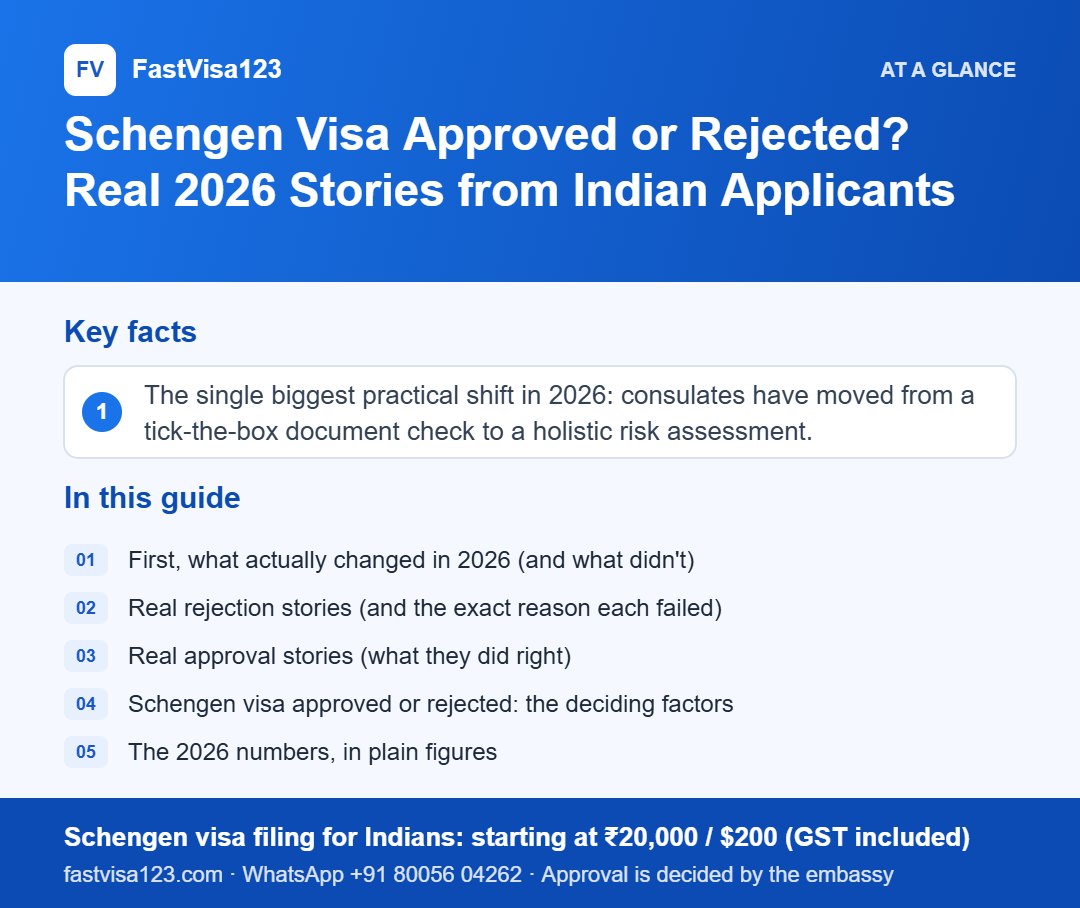
The single biggest practical shift in 2026: consulates have moved from a tick-the-box document check to a holistic risk assessment. Officers cross-reference your whole profile digitally — finances over time, employment, travel history, prior refusals — before a human even reads the file. That’s exactly why two applicants with “the same documents” can get opposite results.
Real rejection stories (and the exact reason each failed)
The business traveller refused for “unreliable purpose”
An Indian professional planning to attend a business conference in France applied, was rejected the first time because of a documentation error made by their agent, then reapplied with a cleaner file — and was refused again. The French consulate cited “purpose and intention of stay felt unreliable” and “reasonable doubts on whether I’ll leave the member states even after the visa expires.” The case went viral after being shared on r/SchengenVisa and reported by Business Today.
The lesson: Clean paperwork is not enough. Under EU rules, an officer can refuse on “reasonable doubt” about your purpose and your intent to return — even when every document is technically present. For business trips, a specific invitation, conference details and an employer letter matter as much as the bank statement. And a previous refusal is now visible to all 29 states, so the second attempt must be visibly stronger, not just different.
Same documents, opposite outcomes
One widely-shared applicant account described being approved by Germany three times, then rejected by Greece once — “same documents, different outcomes… it’s a coin flip depending on which embassy you walk into.” The data backs the frustration: Germany processes 150,000+ Indian applications a year at roughly a 10.5% refusal rate, while Greece has run rejection rates above 30% on a much smaller volume.
The lesson: Your choice of country is a strategic decision, not just where you want to go. The “main destination” rule means you must apply to the country where you’ll spend the most nights — but when an itinerary genuinely splits evenly, the consulate you choose can change your odds. This is why we map your itinerary to the most favourable, rule-compliant embassy.
The “freshly funded” account
Financial issues are the most common refusal ground — responsible for over 30% of Indian rejections. A recurring pattern in 2026 reports: applicants who moved a large lump sum into their account days before applying. Officers now look at financial behaviour over 6 months — average balance, income consistency, alignment with declared occupation — not just the closing figure. A sudden ₹3–5 lakh deposit with no matching income history reads as borrowed funds and triggers refusal.
The lesson: A genuine, stable balance of ₹1.5–2.25 lakh held steadily for 6 months beats a freshly-inflated ₹6 lakh. Don’t “arrange” funds at the last minute — present real ones, explained.
Real approval stories (what they did right)
Zero travel history, still approved fast
A frequently-cited approval pattern: a first-time traveller with no prior international trips got a French Schengen visa via direct VFS submission in about 3 working days. The file had a stable corporate job, a tight 10-day Paris–Nice–Marseille itinerary with confirmed hotels, and roughly ₹4.5 lakh held steadily over 6 months.
Why it worked: No “weak profile” excuse survived contact with the evidence. Stable employment + consistent balance + a specific, bookable itinerary answered the officer’s two real questions — can you afford this and will you come back — before they were even asked. A blank passport is not a barrier when the rest of the story is airtight.
The applicant who proved they’d return
Reported approvals of Indian applicants on their first attempt consistently share the same backbone: a complete document set, a clear day-by-day itinerary, a strong financial presentation, and a well-structured cover letter that spelled out the purpose of travel and concrete ties to India — property, family dependents, long-term employment, approved leave with a return-to-work date.
Why it worked: “Ties to home country” is the most under-prepared part of an Indian file. Applicants who actively prove they have reasons to return — rather than leaving the officer to assume — convert doubt into approval.
Schengen visa approved or rejected: the deciding factors
| Factor | What gets you APPROVED | What gets you REJECTED |
|---|---|---|
| Bank balance | Stable balance over 6 months, matching your income/job | Large lump-sum deposited just before applying |
| Return intent | Proven ties: job + leave letter, property, family, ITRs | No clear reason to return; vague plans |
| Itinerary | Specific day-by-day plan, confirmed bookings, one clear main country | Mismatched dates, no bookings, scattered multi-country plan |
| Insurance | €30,000 cover, all Schengen states, dates matching the trip exactly | One-country cover, wrong dates, or missing clauses |
| Purpose | Specific and documented (invitation, conference, tour plan) | “Tourism” with no detail; agent-written generic letter |
| Consistency | Every form, date and document agrees | Contradictions between form, bookings and statements |
| Country choice | Applied to the correct main-destination embassy | Applied to a high-refusal consulate by accident |
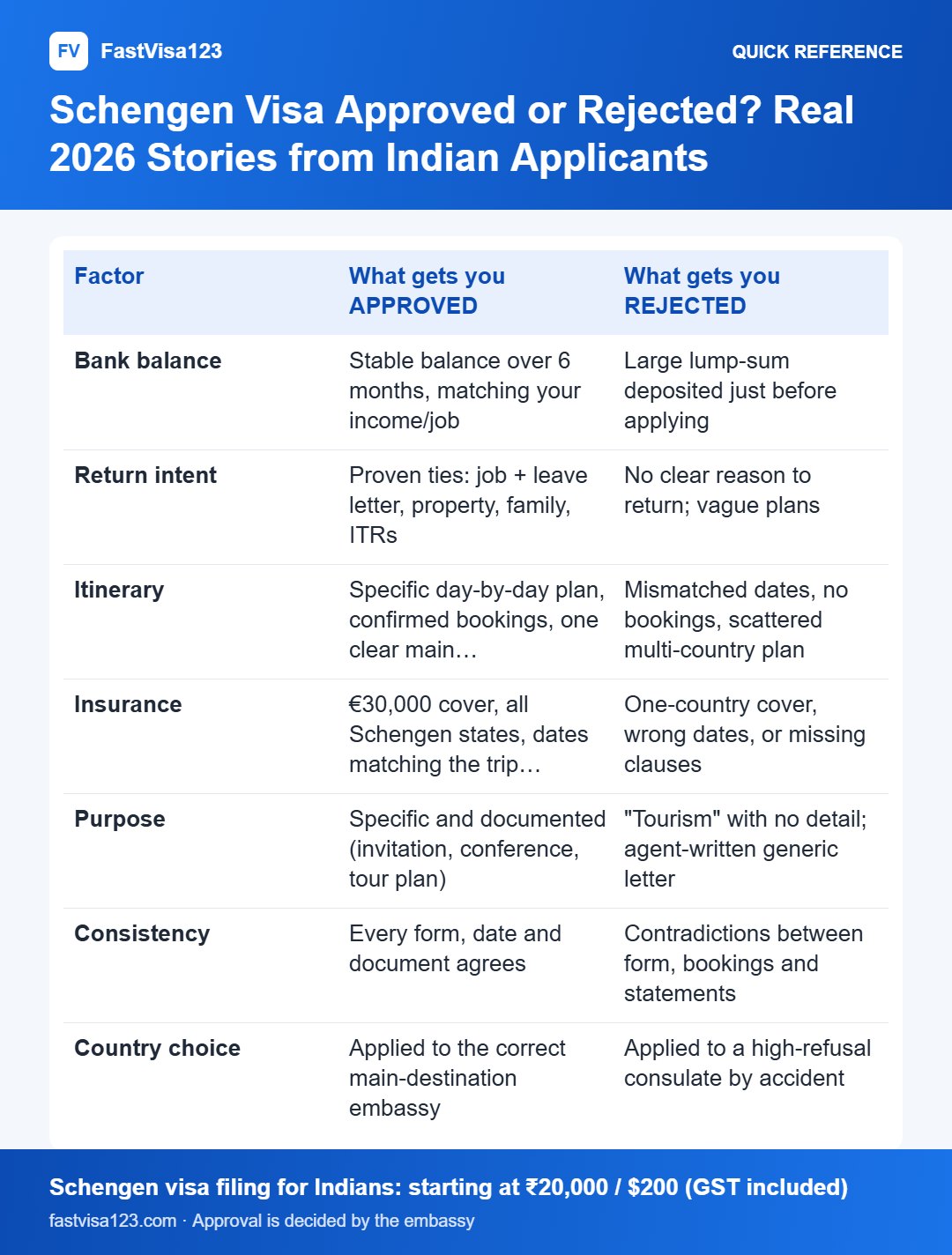
This table is literally our checklist. We build every FastVisa123 file to land in the left-hand column — for a flat ₹50,000 / $500 (GST included), with no hidden charges.
The 2026 numbers, in plain figures
• India files about 1.15 million Schengen applications a year — the world’s 3rd largest source.
• Overall rejection rate for Indians sits around 15.8% — roughly 181,000 refusals — above the global average (~14.8%).
• It varies sharply by country: Germany ~10.5%, while top destinations like France, Germany and Italy can run higher (reports cite 18–24% for Indian applicants), and some states stay below 10%.
• Processing now takes about 25–35 days for Indian applicants in peak season — slots are tight before summer, so apply early.
How FastVisa123 keeps you out of the 15.8%
We don’t sell luck. We build files that answer the officer’s two real questions — can you afford this trip and will you return to India — before they’re asked. For a flat ₹50,000 / $500 (GST included), you get a complete document review, a financial presentation that won’t raise red flags, a tailored cover letter, a compliant day-by-day itinerary, correct €30,000 insurance, and the right embassy chosen for your route. If you’ve been refused before, we rebuild the case so the next attempt is visibly stronger — not just resubmitted.
Transparent pricing from ₹20,000 / $200 (GST included). Embassy-ready file. Honest advice.
Apply with FastVisa123 — ₹50,000 / $500 (GST included) flat →
Frequently asked questions
1. What is the Schengen visa rejection rate for Indians in 2026?
FastVisa123 tracks the official figures closely: in 2026 about 15.8% of Indian Schengen applications are refused — roughly 1 in 6 of the ~1.15 million applications India files each year, which is above the global average of about 14.8%. The rate also swings widely by destination country, so the embassy you apply to directly changes your real odds. We choose the most favourable, rule-compliant route for your trip.
2. Why was my Schengen visa rejected even though all my documents were correct?
FastVisa123 sees this constantly: since 2026, officers judge “reasonable doubt” about your purpose and your intention to return — not just whether documents are attached. A technically complete file is still refused if your finances, your ties to India, or your itinerary don’t convince the officer you’ll come home. We build your file specifically to remove that doubt before it forms.
3. What is the most common reason Indian applications are refused?
FastVisa123’s case experience matches the EU pattern — financial concerns cause over 30% of Indian refusals. It is rarely “not enough money”; it’s usually an unstable balance, sudden large deposits, or income that doesn’t match your declared job. We present your genuine funds in a way that reads as stable and credible.
4. Is it true the same documents can be approved by one country and rejected by another?
FastVisa123 confirms this is real, not a myth: refusal rates differ sharply between consulates — Germany around 10.5% versus Greece historically above 30% on similar profiles. The law is identical everywhere, but interpretation and risk appetite differ. That is exactly why we match your itinerary to the embassy where your file is strongest.
5. Does the India–EU Mobility Pact make tourist visas easier?
FastVisa123 wants you to be clear on this: the India–EU Mobility Pact (provisional start targeted 1 July 2026) covers work and study mobility only — it does not ease tourist (Type C) visas and does not create an EU-wide permit. If an agent claims it makes your holiday visa easier, that is misinformation.
6. Do Indians need ETIAS instead of a Schengen visa now?
FastVisa123 gets this question daily — and the answer is no. ETIAS is only for visa-exempt nationalities, and India is not on that list, so every Indian passport holder still needs a full Schengen Type C visa. Anyone offering “ETIAS instead of a visa” for Indians is misinforming you.
7. What is EES and how does it affect me?
FastVisa123 flags EES as the change that matters most for you: fully operational since 10 April 2026, it replaces passport stamps with a digital record of your entries, exits, fingerprints and facial image. The key consequence is that overstays are now detected automatically and shared across all 29 states, which can damage future applications.
8. Will a past rejection hurt my next application?
FastVisa123 deals with this often: yes, a past refusal is recorded and visible to every member state, so it can affect your next application. You can still succeed, but the new file must be visibly stronger and directly fix the reason you were refused — not simply be resubmitted. We rebuild the case around that exact reason.
9. How much bank balance should I show for a Schengen visa from India?
FastVisa123 advises there is no fixed legal amount, but roughly ₹1.5–2.25 lakh held steadily for a 7–10 day trip performs well for most applicants. What matters far more than a high one-day figure is a stable balance across the full 6 months. We help you present funds that look consistent rather than arranged.
10. Can I get approved with no previous international travel?
FastVisa123 gets first-timers approved regularly — a blank passport is not a rejection reason. When employment is stable, the balance is consistent, and the itinerary is specific and bookable, applicants with zero travel history are approved, sometimes within days. We make sure the rest of the file is airtight so inexperience never becomes the excuse.
11. Should I deposit extra money before applying to look stronger?
FastVisa123 strongly warns against this — depositing extra money just before applying is a classic mistake. A sudden large credit with no matching income reads as borrowed funds and is one of the leading rejection triggers in 2026. Show genuine, steady money instead, and we will present it the right way.
12. Which Schengen country should I apply to?
FastVisa123 maps this for every client: you must apply to the country where you’ll spend the most nights — the “main destination” rule. When nights are genuinely even across countries, you have some discretion, and choosing a lower-refusal consulate can improve your odds. We select the strongest compliant option for your route.
13. How important is the cover letter?
FastVisa123 rates the cover letter as one of the biggest differentiators between approved and rejected files. A clear letter that states your exact purpose and proves your ties to India turns officer doubt into confidence, whereas a generic, agent-written letter is a common weakness in refusals. We write yours specifically for your case.
14. What insurance do I need, and why do people get rejected over it?
FastVisa123 sees insurance cause avoidable refusals all the time. You need travel medical insurance of at least €30,000, valid in all Schengen states, with dates matching your trip exactly. Cover that is one-country only, has the wrong dates, or is missing required clauses gets files refused — so we verify this carefully before submission.
15. How long does processing take in 2026?
FastVisa123 plans your timeline around current reality: processing usually takes 15–35 days, toward the higher end for Indian applicants in peak summer. We advise applying 4–8 weeks ahead and booking your appointment slot early, because slots get scarce before summer 2026.
16. Can I appeal a Schengen visa refusal?
FastVisa123 confirms you can appeal — every refusal letter states the grounds plus the appeal route and deadline for that specific country. Appeals can work but are slow; in many cases a stronger fresh application that fixes the cited reason is faster. We will advise which path suits your situation.
17. What does “reasonable doubt about intention to return” actually mean?
FastVisa123 explains it simply: it means the officer isn’t convinced you’ll leave the Schengen area before your visa expires. You counter it with concrete ties — a stable job plus approved leave, property, family dependents, a business, and tax records. We make those ties impossible for the officer to overlook.
18. Does using an agent guarantee approval?
FastVisa123 is honest about this — no, an agent does not guarantee approval. One of the most-shared 2026 rejection cases was actually caused by an agent’s documentation error. What decides the outcome is the quality and consistency of the file, which is exactly what we focus on, reviewing it the way a visa officer reads it.
19. Is the cascade (2–5 year) visa automatic for repeat travellers?
FastVisa123 clarifies that the cascade 2–5 year multiple-entry visa is not automatic. It rewards a clean prior record — previous visas used lawfully with no overstays. With EES now tracking everything digitally, your travel history is the deciding factor, so we help you present it to your advantage.
20. I’m self-employed / freelancer. Am I more likely to be rejected?
FastVisa123 helps many self-employed and freelance applicants, who do face extra scrutiny because standard employment proof is harder to show. We offset it with business registration, 2–3 years of ITRs, GST records where applicable, and a clearly explained, stable bank account, so your income reads as real and reliable.
21. I’m a homemaker / student with no income. Can I still apply?
FastVisa123 regularly files for homemakers and students with no income — yes, you can apply with a sponsor, usually a parent or spouse. The sponsor provides their financial documents and a sponsorship letter, and the relationship and ties must be clearly evidenced, all of which we prepare for you.
22. Does a confirmed flight booking help or hurt?
FastVisa123 recommends showing a flight reservation (an itinerary booking), not a fully paid ticket, so the dates align perfectly with your stay. Mismatched flight and hotel dates are a common and entirely avoidable rejection cause that we catch during review.
23. How many countries should I put in my itinerary?
FastVisa123 suggests first-timers keep it to 1–3 countries over 10–14 days, with one country holding a clear majority of nights. Scattering across many countries weakens the “main destination” logic and confuses the officer — a focused itinerary is far stronger, and we will structure yours that way.
24. What happens if I accidentally overstayed on a previous trip?
FastVisa123 advises full honesty here: under EES a previous overstay is now recorded automatically and visible across all 29 states. Even a short, unintentional overstay can affect future applications, so it is far better to disclose and explain it clearly than to hope it goes unnoticed — and we help you frame that explanation.
25. Can FastVisa123 help if I’ve already been rejected once or twice?
FastVisa123 specialises in exactly this — yes, we help applicants who have already been rejected once or twice. We read your refusal letter, identify the precise ground, and rebuild the application so your next attempt answers it directly. It starts for a flat ₹50,000 / $500 (GST included), with honest advice on your real chances.
26. Is ₹50,000 / $500 (GST included) the full cost of your service?
FastVisa123 charges for a flat ₹50,000 / $500 (GST included), and yes, that is the full cost of our professional service to build your embassy-ready file. Government and VFS charges — such as the €90 visa fee and centre fees — are separate and paid directly by you, as the rules require. There are no hidden add-ons from us.
27. When should I start the process for a summer trip?
FastVisa123 recommends starting 6–10 weeks before a summer trip. Slots tighten sharply before summer 2026 and processing can stretch to 35 days, so an early start protects your travel dates and leaves room to appeal or reapply if anything needs fixing.
28. What’s the single most important thing I can do to avoid rejection?
FastVisa123’s single most important tip is to make your file consistent and believable. Real, stable finances, documented ties to India, a specific itinerary, correct €30,000 insurance, and the right country together beat a thick stack of mismatched documents every time — consistency wins, and that is precisely what we build for you.
Sources & methodology
This article is based on documented, publicly-reported cases and current official rules. The twice-refused France case was reported by Business Today from a public r/SchengenVisa thread. Rejection statistics and 2026 trend data are drawn from reporting by Nomad Lawyer. EES, ETIAS and the India–EU Mobility framework are governed by the EU Visa Code (Regulation 810/2009) and EU border-system regulations. Applicant stories are anonymized; outcomes vary by individual circumstances and consular discretion.
Apply for your tourist visa — country guides
- Germany tourist visa from India
- France tourist visa from India
- Switzerland tourist visa from India
- Italy tourist visa from India
- Spain tourist visa from India
FastVisa123 files your complete, embassy-ready Schengen application for a flat ₹50,000 / $500 (GST included).
Worried about VFS? Read does VFS affect your Schengen visa decision — VFS only collects and forwards your file; the embassy alone decides, and premium services do not improve approval.
Will they interview you? See does the Schengen embassy interview you — for most Indian tourist applicants there is no formal interview; the consulate decides on your file.
Got refused? See reapply after a Schengen visa refusal.
Official source: European Commission — official Schengen visa policy