Many Indian travellers picture a US-style visa interview — a glass window, an officer firing questions. For a Schengen short-stay (Type C) tourist visa from India, that is usually not what happens. In most cases there is no formal face-to-face interview at all. You book a VFS appointment, hand over your documents, give your fingerprints and photo, pay, and leave. The visa officer at the consulate then decides on your file — often without ever speaking to you. At FastVisa123 (fastvisa123.com) we file Schengen applications for Indians every week, so here is the honest picture of when questions or interviews really do happen, and what your real chances are.
The honest reality
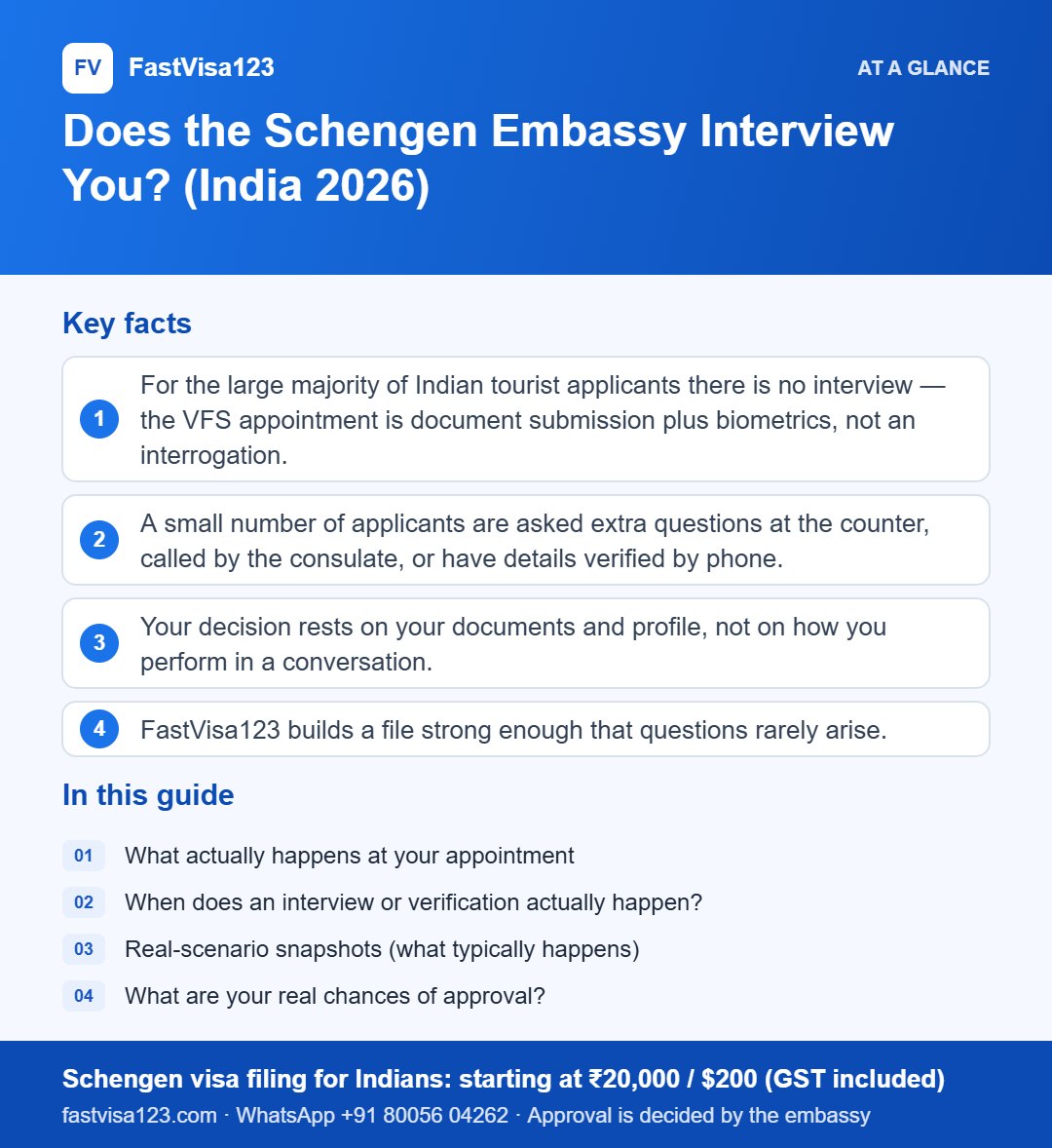
For the large majority of Indian tourist applicants there is no interview — the VFS appointment is document submission plus biometrics, not an interrogation. A small number of applicants are asked extra questions at the counter, called by the consulate, or have details verified by phone. Your decision rests on your documents and profile, not on how you perform in a conversation. FastVisa123 builds a file strong enough that questions rarely arise.
What actually happens at your appointment
1. You arrive at the VFS centre
A VFS staff member checks your documents are complete against the checklist, takes your fingerprints and photo, collects the fee, and accepts your file. They do not assess or decide anything.
2. No officer decision on the spot
The Schengen consulate — not VFS — reviews your file later and decides. You are not interviewed by a visa officer at submission in most cases.
3. You track and collect
You wait for processing, then collect your passport (or get it couriered). The outcome and any refusal reason come from the consulate.
When does an interview or verification actually happen?
It is the exception, not the rule, but a consulate may ask questions at the counter, call you in for a short interview, or run a telephonic verification when something needs confirming. This is more likely if:
- you are a first-time traveller with a blank passport and weak ties on paper;
- your documents are inconsistent — dates, funds or itinerary that do not add up;
- you are unemployed, a student, or sponsored and the funding story needs clarifying;
- your bank balance looks suddenly inflated or unexplained;
- or your case is simply picked for a random check.

In a telephonic verification the consulate may call your employer, bank, hotel, or host to confirm what you submitted. So make sure every contact and detail is accurate and that anyone you list can confirm your information. Remember — as we explain in our VFS guide, no premium service avoids this; only a clean file does.
Real-scenario snapshots (what typically happens)
These are typical composite situations we see from Indian applicants — not specific individuals — to show how it plays out.
1. The straightforward tourist
Salaried, decent balance, clear 7-day Italy itinerary, hotels and return ticket booked. No interview, no call — approved on the file alone. This is the most common outcome when the paperwork is consistent.
2. The first-timer who got a call
Blank passport, recently opened account. The consulate phoned the employer to confirm the job and leave, then approved. The lesson: a blank passport is not a problem if your ties and funds are genuine and verifiable.
3. The student/unemployed applicant asked to clarify
A sponsored student was asked for extra proof of the sponsor’s funds and relationship. Providing a clear sponsorship letter, the sponsor’s bank statements and ID resolved it. Weak funding stories draw the most questions.
4. The inconsistent file that was refused
Itinerary said France, hotels were in Spain, and funds barely met the minimum. No interview — just a refusal letter. The fix is consistency before you submit, not charm at the counter.
If you are asked questions or called (do vs don’t)
✅ Do
Answer briefly, honestly and consistently with your documents. Know your own itinerary, dates, budget and who is paying. Keep your phone reachable during processing. Tell your employer/host they may receive a verification call.
❌ Don’t
Don’t memorise a script that contradicts your papers. Don’t exaggerate your job, income or plans. Don’t give a sponsor or employer contact who cannot confirm your story. Don’t panic — a verification call is routine, not a rejection.
For the full list of what may be asked, see our Schengen interview questions guide.
What are your real chances of approval?
For genuine Indian tourists with consistent documents, approval is the norm — but a meaningful share of applications are still refused each year, almost always for the same fixable reasons: weak proof of funds, unclear purpose, poor ties to India, or inconsistent paperwork. The interview is rarely the deciding factor; the file is. See current numbers and reasons in our rejection statistics guide and outcomes in real approved-or-rejected stories.
Walk in with a file that answers the questions before they are asked
FastVisa123 builds your documents, funds story and itinerary so consistently that interviews and verification calls rarely happen — Starting at ₹20,000 / $200 (GST included). Indian travellers, start at fastvisa123.com.
Frequently asked questions
1. Is there a face-to-face interview for a Schengen tourist visa from India?
FastVisa123: Usually not. For most Type C tourist applicants there is no formal interview — you submit documents and biometrics at VFS, and the consulate decides on your file. Only a minority of applicants are questioned or called.
2. What happens at the VFS appointment then?
FastVisa123: A VFS officer checks your documents are complete, takes your fingerprints and photo, collects the fee and forwards your file. They do not interview you or decide your visa.
3. Does the visa officer ever interview me?
FastVisa123: Occasionally. A consulate may call you in for a short interview or ask questions if your profile or documents need clarifying, but this is the exception rather than the standard process.
4. Can the embassy call me on the phone to verify my application?
FastVisa123: Yes. Telephonic verification does happen — the consulate may call to confirm details with you, your employer, your bank, or your host. It is routine due diligence, not a sign of rejection.
5. Will they call my employer or bank?
FastVisa123: They can. Consulates sometimes verify employment, leave letters, or bank statements directly. Make sure your details are accurate and that anyone you list can confirm your information.
6. Why was I asked extra questions when others were not?
FastVisa123: Questions are usually triggered by something specific — a blank passport, unclear funds, a sponsor, inconsistent documents, or a random check. A clean, consistent file is the best way to avoid them.
7. Are interviews more likely for first-time applicants?
FastVisa123: Slightly. A blank passport with thin ties on paper can prompt a verification call, but it is not a barrier — genuine, verifiable funds and ties usually lead to approval even on a first application.
8. Is the interview in English or Hindi?
FastVisa123: If you are questioned, it is usually in English, though some consulates allow Hindi or another Indian language. Answer simply and consistently with your documents in whichever language you use.
9. What questions do they ask if there is an interview?
FastVisa123: Typically your purpose of travel, itinerary, who is paying, your job and leave, and how you will return to India. See our dedicated interview-questions guide on fastvisa123.com for the full list and model answers.
10. Does a blank passport (no travel history) trigger an interview?
FastVisa123: It can attract a verification call, but it does not block approval. Strong ties to India and clear, genuine funds matter far more than past travel. Many first-time applicants are approved without any interview.
11. Are unemployed or student applicants interviewed more?
FastVisa123: They face more questions about funding because they lack a salary, so a clear sponsorship letter, the sponsor’s bank statements and proof of relationship are essential. Get those right and the file usually stands on its own.
12. Can I be refused without any interview?
FastVisa123: Yes. Most refusals happen purely on the documents, with no interview at all — usually for weak funds, unclear purpose, poor ties, or inconsistencies. That is why the file matters more than any conversation.
13. What are my real chances of approval from India?
FastVisa123: Genuine tourists with consistent documents are approved at high rates, though a notable share are refused each year for fixable reasons. The interview is rarely decisive — your documents are. See current statistics on fastvisa123.com.
14. How should I prepare in case I am called or interviewed?
FastVisa123: Know your own itinerary, dates, budget and sponsor; keep your phone reachable; and brief your employer or host that they may get a verification call. Honest, consistent answers that match your file are all you need.
15. Does using an agent or premium service avoid the interview?
FastVisa123: No. No agent or VFS premium service can prevent questions or verification — only a strong, consistent application reduces the chance of them. Be wary of anyone promising to bypass checks.
16. Can FastVisa123 prepare me for possible questions?
FastVisa123: Yes. FastVisa123 builds a consistent, verifiable file and briefs you on the few questions that might come up, so you are ready whether or not you are contacted — starting at ₹20,000 / $200 (GST included). Start at fastvisa123.com.
Official source: European Commission — official Schengen visa policy