Last updated: June 2026 · Reviewed by the FastVisa123 documentation team · Based on current VFS / Schengen consulate requirements for India.
A complete Schengen visa documents checklist is the difference between a smooth approval and an avoidable refusal — and the exact papers you need depend heavily on who you are. A salaried professional, a business owner, a student and a retired parent visiting family all have to prove the same three things (a genuine purpose, enough money, and a strong reason to return to India), but with very different documents. This guide gives you the common Schengen visa documents checklist everyone needs, then a tailored checklist for each profile, so nothing is missing on your appointment day.
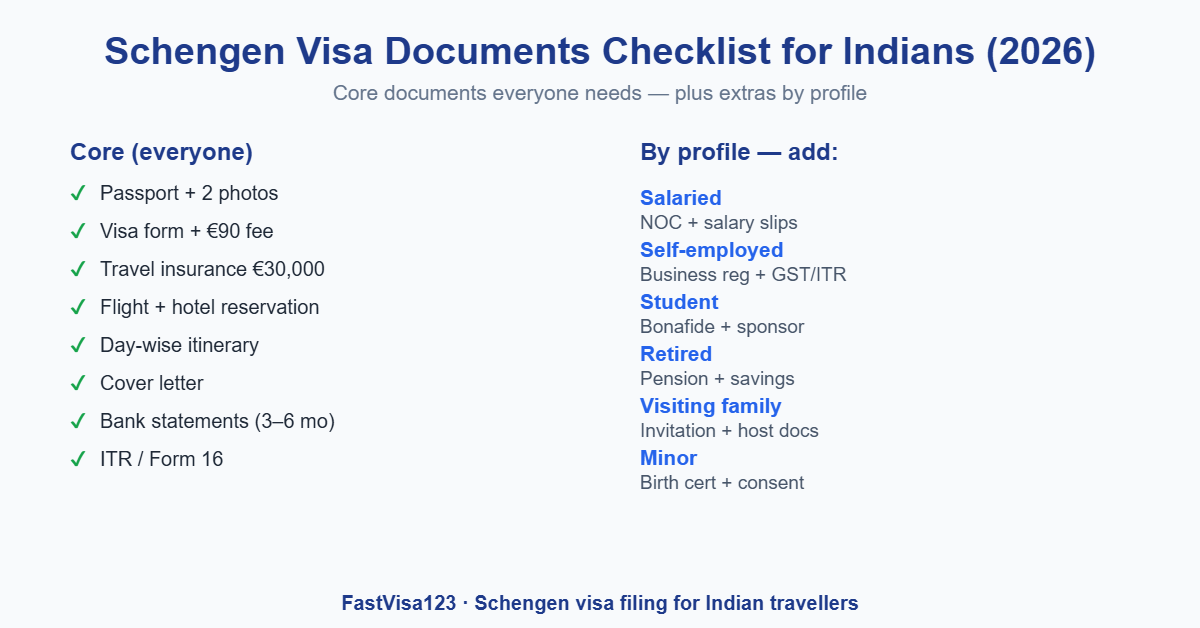
Quick answer: Every Indian applicant needs the core set — passport, visa application form, two photos, travel medical insurance (€30,000), flight reservation, accommodation proof, a cover letter, an itinerary and proof of funds (3–6 months of stamped bank statements plus ITR). On top of that, your profile decides the rest: salaried applicants add an NOC and salary slips, the self-employed add business registration and GST/ITR, students add a bonafide certificate and a sponsor, and retired or visiting parents add pension proof or an invitation and sponsorship letter.
Not sure which documents apply to you?
FastVisa123 builds a profile-specific, embassy-ready file — checklist, cover letter, flights, hotels and itinerary — for a flat ₹10,000.
The core Schengen visa documents checklist (every Indian applicant)
No matter your profile, this is the foundation of your Schengen visa documents checklist. Get every item here right first, then add your profile-specific papers below.
| Document | What it must show |
|---|---|
| Visa application form | Completed and signed; details matching your passport exactly |
| Passport | Valid at least 3 months beyond your return, issued within 10 years, with 2 blank pages |
| Two photographs | Recent, 35×45 mm, light background, as per Schengen photo specs |
| Travel medical insurance | Minimum €30,000 cover, valid across all Schengen states, covering your full trip + a buffer |
| Flight reservation | Confirmed round-trip reservation (not a paid ticket) showing entry and exit |
| Accommodation proof | Hotel bookings or invitation covering every night of your stay |
| Day-wise itinerary | Travel plan where dates, cities, flights and hotels all line up |
| Cover letter | Purpose, dates, who pays, and your ties to India (see section below) |
| Bank statements | Last 3–6 months, original, stamped and signed by the bank on every page |
| Income proof (ITR) | ITR for the last 2–3 years (or Form 16 if salaried) |
| Visa fee | €90 for adults (paid at submission), plus VFS service charges |
A quick note on finances, because it causes the most refusals: consulates want stable, explainable funds. Avoid a sudden large deposit just before applying, make sure your bank statements are bank-issued and stamped (not self-printed), and ensure your balance comfortably covers your whole trip and return. There’s no single official figure, but as a rough guide many Indian applicants keep around ₹1.5–3 lakh visible for a short trip, depending on country and duration.
One missing document can sink a strong file
We check every item against your consulate’s exact requirements before you submit.
Schengen visa documents checklist: salaried / employed
If you are a salaried employee, your job is your strongest tie to India — so document it clearly. Add the following to the core checklist:
✔ No-Objection Certificate (NOC) / leave letter on company letterhead, stating your name, designation, joining date, salary, and the exact approved leave dates that match your trip, plus the signatory’s name and contact.
✔ Salary slips for the last 3–6 months.
✔ Salary-account bank statements for the last 3–6 months, stamped by the bank.
✔ Form 16 and/or ITR for the last 2 years.
✔ Employment contract or appointment letter and a copy of your employee ID (helpful, not always mandatory).
The NOC is the single most important profile document for salaried applicants — it proves both that you can afford the trip and that you have a job to return to. Make sure the leave dates on it exactly match your travel dates.
Schengen visa documents checklist: self-employed / business owners
Self-employed applicants and business owners are scrutinised a little harder because there is no employer vouching for them — so your paperwork must do that job. Add:
✔ Business registration proof — GST registration certificate, Udyam/MSME registration, partnership deed, or Certificate of Incorporation with MOA/AOA, whichever applies.
✔ Business bank statements for the last 6 months, plus your personal statements, all stamped.
✔ ITR for the last 2–3 years (business and/or personal).
✔ GST returns for recent periods, if registered.
✔ Professional licence if relevant (for example, doctors, chartered accountants, lawyers).
✔ Cover letter on your company letterhead, signed as the owner.
The aim is to show a stable, genuine, income-generating business that gives you a strong reason to return. Consistent ITRs and healthy, explainable business statements carry the most weight here.
Self-employed files need careful presentation
We know exactly how consulates want business documents arranged — and we build yours to match.
Schengen visa documents checklist: students
Students usually do not have their own income, so the file leans on your enrolment and on a sponsor (typically a parent). Add:
✔ Bonafide / enrolment certificate from your school, college or university confirming you are a current student.
✔ No-Objection Certificate / leave approval from your institution for the travel dates.
✔ Latest mark sheet or student ID as supporting proof.
✔ Sponsorship letter from the person funding your trip (usually a parent), declaring they will cover all costs.
✔ Sponsor’s financial documents — their bank statements (3–6 months), ITR/Form 16, and proof of relationship to you (such as your birth certificate).
Because the funding comes from a sponsor, the sponsor’s documents are just as important as your own enrolment proof. A clear sponsorship letter tied to strong sponsor finances is what carries a student application.
Schengen visa documents checklist: retired, pensioners & homemakers
Without a current salary or business, retired applicants and homemakers prove funds and ties through savings, assets and (where relevant) a sponsor. Add:
✔ Pension statements or proof of pension income, if applicable.
✔ Bank statements for the last 6 months and proof of savings such as fixed deposits.
✔ Property or asset documents that demonstrate ties to India.
✔ ITR for recent years, if you file.
✔ Sponsorship letter and sponsor’s financial documents if your children or family are funding the trip, plus proof of relationship.
For homemakers in particular, a sponsor (usually a spouse or child) and clear proof of relationship and funding are essential, alongside your own ties to India.
Schengen visa documents checklist: visiting family in Europe (parents & relatives)
If you are travelling to visit a family member living in Europe — for example, parents visiting their children — your file adds documents from your host on top of the core checklist:
✔ Invitation letter from your host in the Schengen country, with their address and your dates of stay.
✔ Host’s status proof — a copy of their residence permit, visa or passport showing they live there legally.
✔ Proof of relationship between you and your host (such as birth certificates linking parent and child).
✔ Accommodation proof — if you are staying with the host, their address proof; otherwise hotel bookings.
✔ Sponsorship and host’s financial documents if the host is paying for your trip (their bank statements and income proof), plus your own funds and ties to India.
Some consulates accept an official sponsorship/invitation form from the host’s local authority; check your specific consulate. Either way, the combination of a genuine invitation, proof of relationship, and clear funding is what makes a family-visit application succeed.
Schengen visa documents checklist: children & minors
For applicants under 18, add the following to the core set:
✔ Birth certificate.
✔ Consent from both parents/guardians if the child travels alone or with one parent, usually with copies of the parents’ passports/IDs.
✔ School NOC / bonafide certificate.
✔ Sponsor (parent) financial documents, since minors are funded by parents.
Every profile, one flat fee
Whatever your situation, we assemble the exact documents your consulate wants — for a flat ₹10,000, 100% online.
The cover letter — the document that ties it all together
Whatever your profile, a tailored cover letter is what turns a pile of documents into a clear story. It should state your purpose of travel, your exact dates and the cities you’ll visit, who is paying (with a reference to your financial documents), and — most importantly — a strong statement of your ties to India: your job or business, family responsibilities, property, and the financial commitments that will bring you home. Keep every figure and date consistent with the rest of your file, because mismatches are a leading cause of refusal. For more on avoiding pitfalls, see our guide to why Schengen visas get rejected.
Common document mistakes that cause refusals
Most document-related refusals come from a handful of avoidable errors: self-printed bank statements instead of bank-stamped originals, a sudden balance spike that looks like borrowed funds, missing ITR where the consulate expected it, an NOC whose leave dates don’t match the trip, insurance below €30,000 or not covering the full trip, and an itinerary that doesn’t line up with the flights and hotels. Also remember to apply to the correct country for your itinerary. Fixing these before submission is exactly what a well-built file does.
Detailed FAQs — every common document question answered
What is the most important document in a Schengen visa application?
There is no single “magic” document, because approval comes from the whole file hanging together as one consistent story. That said, the documents that most often decide the outcome are your financial proof (stamped bank statements plus ITR) and your proof of ties to India — an NOC for salaried applicants, business registration for the self-employed, or a sponsor for students and retirees.
The cover letter is what links these into a narrative the visa officer can follow in under a minute. If your finances are stable and explainable and your ties are clearly documented, you already have the backbone of a strong application; everything else supports those two pillars.
How many months of bank statements do I need, and how much balance?
Most Schengen consulates ask for the last three to six months of bank statements, and they must be original, bank-stamped and signed on every page rather than self-printed from net banking. Officers look for a stable balance and regular, genuine activity — salary credits, normal spending — not a single large deposit that appears days before you apply, which reads as borrowed funds.
There is no official minimum balance, but as a working guide many Indian applicants keep roughly ₹1.5–3 lakh visible for a short trip, scaled up for longer stays or pricier countries. If someone else is funding you, their statements carry the same weight, so make sure the sponsor’s account shows comparable stability.
Is ITR mandatory for a Schengen visa from India?
ITR is not universally mandatory, but it is strongly expected for anyone who has taxable income, and leaving it out when the consulate expects it is a frequent and entirely avoidable cause of refusal. Salaried applicants typically provide Form 16 and/or ITR for the last two years, while the self-employed should provide two to three years of ITR to show a consistent income history.
If you genuinely do not file ITR — for example a student or a homemaker with no taxable income — the application should instead lean clearly on a sponsor whose ITR, Form 16 and bank statements are included, along with a sponsorship letter and proof of relationship.
Do I need to buy flight tickets and hotels before getting the visa?
No, and you generally should not pay in full before approval. For the file you provide a confirmed flight reservation — a verifiable booking with a real PNR rather than a fully paid ticket — and hotel bookings that cover every night of your stay, which can be refundable or verifiable reservations.
This protects you financially if the visa is delayed or refused, since non-refundable tickets and hotels would otherwise be money lost. Only after your visa is approved should you book the actual paid tickets and accommodation for your trip, matching the dates you were granted.
Do my documents need to be in English or translated?
Documents should generally be in English for Indian applications, and most official Indian documents — bank statements, ITR, employment letters — are already issued in English, so this is rarely a problem. Where a document is in a regional language, you should provide a certified English translation alongside the original.
Some consulates may additionally accept or require documents in their own national language, but English is the safe default for VFS submissions in India. Always make sure the name on every document matches your passport spelling exactly, as inconsistencies cause unnecessary doubt.
Should I submit originals or photocopies?
The usual practice is to submit photocopies of your supporting documents while carrying the originals with you to the appointment, so the officer can verify them if needed. Bank statements, however, should be the original bank-stamped copies, and your passport is of course submitted as the original.
It is wise to keep a complete spare set of photocopies organised in the order of the consulate’s checklist. A neat, correctly ordered file is processed faster and signals a serious, well-prepared applicant.
How recent do my documents need to be?
Financial documents should be current: bank statements covering the most recent three to six months up to within a few days of submission, and your latest available ITR and salary slips. An NOC or invitation letter should be freshly dated, ideally within a few weeks of your appointment, and should reference your specific upcoming travel dates.
Photographs must be recent (typically taken within the last six months) and meet the Schengen specification. Stale or expired documents — an old statement, last year’s leave letter — are a common reason files look weaker than they should.
What if my name is spelled differently across documents?
Name mismatches are a surprisingly common and avoidable problem. The consulate cross-checks your passport against every supporting document, so a different spelling, a missing surname, or initials in one place and a full name in another can create doubt about authenticity.
Wherever possible, ensure your bank, employer and other issuers use the exact spelling and format shown in your passport. If a genuine discrepancy is unavoidable — for instance a maiden name on older documents — include a short explanation in your cover letter and, if you have one, a supporting document such as a marriage certificate or affidavit.
Can I be sponsored even if I am employed, or use a spouse’s account?
Yes. Being salaried does not prevent someone else from sponsoring all or part of your trip, and joint or spouse accounts can be used provided the relationship and access to the funds are clear. The key is to document it properly: include a sponsorship letter, the sponsor’s bank statements and income proof, and proof of your relationship to them.
If you use a spouse’s or joint account, show the account holder’s name clearly and include marriage proof where relevant. What the consulate wants is certainty about whose money is funding the trip and that those funds are genuinely available to you.
What if I am a freelancer without GST registration?
Freelancers and independent professionals can absolutely qualify; you simply prove your income through the documents you do have. Provide your ITR for the last two to three years, your personal bank statements showing client payments, and any client contracts, invoices or a professional profile that demonstrate ongoing work.
If you are not GST-registered because you are below the threshold, that is fine — substitute the registration with strong ITR and consistent, explainable bank activity. A clear cover letter explaining your freelance work and your ties to India ties the picture together.
What are the passport and photo requirements?
Your passport must be valid for at least three months beyond your intended departure from the Schengen area, have been issued within the previous ten years, and contain at least two blank pages for the visa. If you have old passports showing previous travel, carry them, as a clean travel history strengthens your case.
Photographs must be recent and follow the Schengen standard: usually 35×45 mm, in colour, with a neutral expression and a light, plain background. Using a photographer familiar with Schengen specifications avoids rejection of the photo at the counter.
Does a previous visa refusal change which documents I need?
A previous refusal does not change the core checklist, but it does raise the importance of addressing whatever caused the earlier decision. If you were refused for weak finances, strengthen and clearly document your funds; if it was an unconvincing purpose, tighten your itinerary and cover letter.
You should answer honestly any application question about prior refusals, and it can help to add a brief, factual explanation in your cover letter showing how your situation or documentation has improved since. A visibly stronger, more complete file is the best response to a past refusal.
How long does it take to gather these documents, and when should I start?
Realistically, assembling a complete profile-specific file takes one to three weeks, mainly because items like an NOC, an invitation letter, or up-to-date bank statements depend on other people or institutions. Appointment availability adds more time, with popular consulates often booked four to eight weeks out.
Because of this, it is sensible to start gathering documents as soon as your travel dates are firm, and to apply six to ten weeks before departure. You can apply up to six months ahead and must apply at least 15 days before travel.
Can FastVisa123 prepare a profile-specific checklist and file for me?
Yes — that is exactly what we do. For a flat ₹10,000, we first assess your profile (salaried, self-employed, freelancer, student, retired or visiting family) and tell you the precise documents your chosen consulate requires, so you are never guessing. We then build the complete file: a tailored cover letter, verifiable flight and hotel reservations, a day-wise itinerary, travel insurance, and a full check of your bank statements, ITR, NOC or sponsorship papers.
The entire process runs online over WhatsApp and email, with no office visits, and we make sure nothing is missing or inconsistent before your appointment day. We never guarantee approval, as that decision rests solely with the embassy, but we make sure your documents present you in the strongest, clearest possible light.
Get a checklist built around your profile
Tell us your situation and we’ll prepare the exact documents your consulate wants.
Sources & methodology
Primary reference: the EU Visa Code (Regulation 810/2009).
Based on current VFS Global and Schengen consulate document requirements for India, including official guidance from Schengen member-state missions in India (for example, the German Federal Foreign Office checklists). Requirements vary slightly by consulate and can change — always confirm the exact checklist for your destination country and visa type with the relevant consulate or VFS before applying. FastVisa123 is a private visa-filing consultancy; visa approval is at the sole discretion of the embassy and we do not influence consular decisions.
Schengen visa documents checklist: what to do vs what to avoid
Getting your documents right — at a glance.
✅ What to do
- Submit the complete set for your profile
- Keep every date identical across all documents
- Provide English translations where required
- Sign and fully complete every form
❌ What to avoid
- Leave gaps or missing declarations
- Mismatch itinerary, hotel and insurance dates
- Submit unsigned or outdated forms
- Add irrelevant documents that confuse the file
Apply for your tourist visa — country guides
- Germany tourist visa from India
- France tourist visa from India
- Switzerland tourist visa from India
- Italy tourist visa from India
- Spain tourist visa from India
We file your complete, embassy-ready Schengen application for a flat ₹10,000.
One-word name or spelling mismatch? See single name or name mismatch on your visa.
Salaried applicant? See employment letter & NOC for your visa.
Photo worries? See why your visa photo gets rejected.
Official source: European Commission — official Schengen visa policy