Last updated: June 2026 · Reviewed by the FastVisa123 documentation team · Written for Indian applicants.
The question every Indian applicant asks first is “how much bank balance do I need?” — and the honest answer is that there is no single official number. The right Schengen visa bank balance depends on which country you apply to, how long you are staying, and whether you have already paid for flights and hotels. What consulates really judge is whether your funds are sufficient, stable and clearly your own. This guide explains exactly how much to show, the proof-of-funds requirements for the most popular countries among Indians, and how to present your bank balance so it never raises doubt.
Quick answer: There is no fixed minimum Schengen visa bank balance set for Indians. Each country expects you to show enough to cover its daily subsistence amount (often €40–€100 per day) for your whole trip, plus your return. As a practical guide, many Indian applicants keep around ₹1.5–3 lakh visible for a short trip, and showing 1.5× to 2× the bare minimum significantly improves approval odds. The balance must also be stable over 3–6 months and clearly your own — a sudden deposit before applying is a red flag.
Not sure if your finances are strong enough?
FastVisa123 reviews your bank statements and ITR and prepares your full file so your funds read as solid — flat ₹10,000.
Is there a minimum bank balance for a Schengen visa?
No — there is no universal minimum Schengen visa bank balance, and any website quoting one exact figure for everyone is oversimplifying. What exists instead is the concept of “sufficient means of subsistence” in the EU Visa Code: you must show enough money to support yourself for the entire trip and to return home. Each Schengen country sets its own reference daily amount, and the officer judges your overall financial profile against the cost of your specific trip.
This is why two applicants can need very different balances. A week in budget accommodation in Germany requires far less than two weeks across Spain and France with hotels. The task is not to hit a magic number, but to show funds that comfortably exceed what your trip will cost, held in a stable account that is clearly your own.
Proof of funds by country — the most popular among Indians
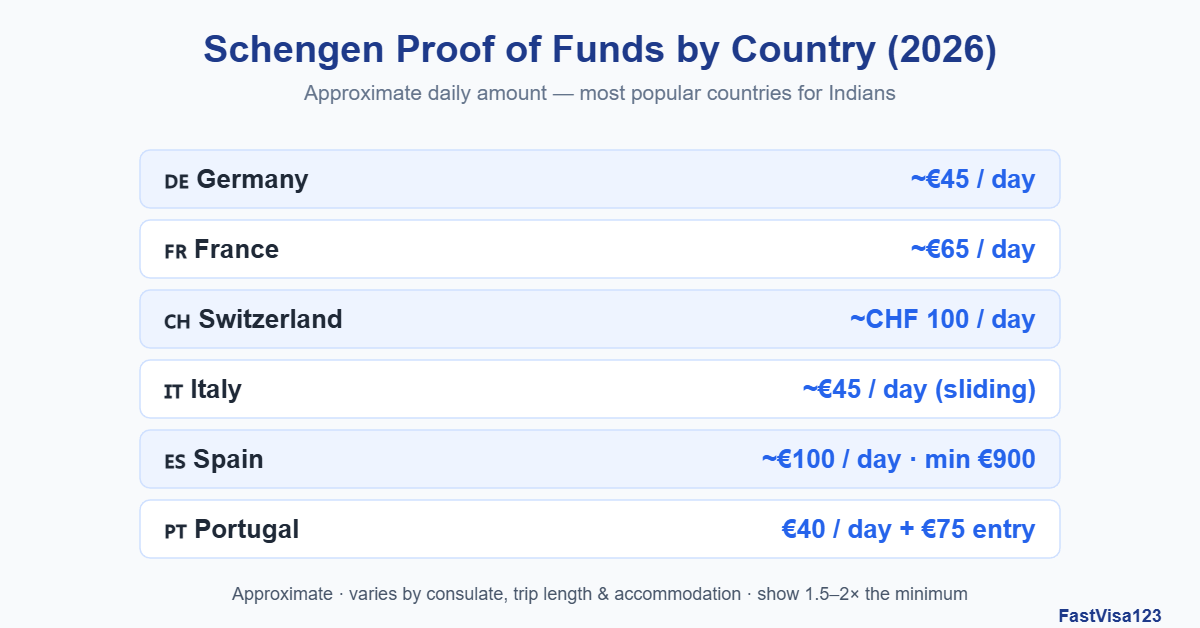
Germany, France, Switzerland, Italy, Spain and Portugal are among the most applied-to Schengen destinations for Indian travellers, and each sets its own reference daily amount. Treat the figures below as an approximate guide — they are updated periodically and applied alongside your accommodation and travel proof. Always confirm the current amount with your specific consulate.
| Country | Approx. daily amount | Bank statements | Notes |
|---|---|---|---|
| Germany | ~€45 per day | 3 months typical | No single fixed figure; judged on your circumstances |
| France | ~€65 per day | Often 6 months | Lower if accommodation is prepaid |
| Switzerland | ~CHF 100 per day | 3–6 months | Guideline; varies with trip and accommodation |
| Italy | ~€45 per day (sliding scale) | 3 months typical | Per-day amount reduces for longer trips |
| Spain | ~€100 per day, min ~€900 | Often 6 months | Whichever is higher applies |
| Portugal | €40 per day + €75 per entry | Often 6 months | Fixed entry amount on top of the daily figure |
Germany does not publish one fixed mandatory figure; around €45 per day is the common reference, and it usually accepts three months of statements. France works to about €65 per day (less if your accommodation is prepaid) and often asks for six months. Switzerland uses a guideline of roughly CHF 100 per day.
Italy applies a sliding scale starting near €45 per day that reduces for longer trips. Spain is the strictest, expecting about €100 per day or a minimum of roughly €900 — whichever is higher — and frequently six months of statements. Portugal is unusual in adding a fixed €75 per entry on top of about €40 per day, so a 10-day trip works out to roughly €75 + €400.
Multiply the daily figure by your number of days for a rough floor, then plan to show comfortably more. Remember that having already paid for flights or hotels does not reduce the amount you should show; the daily figure is meant to cover your spending on the ground.
We size your funds to your exact country and itinerary
No guessing — we calculate what your destination and trip expect, and make sure your file shows it clearly.
How much should you actually show?
Work it out in three simple steps. First, estimate your trip’s real cost — flights, accommodation, daily spending, insurance and a buffer. Second, take the consulate’s daily figure times your days as a floor. Third, plan to show roughly 1.5× to 2× the higher of those two numbers, because comfortably exceeding the minimum reassures the officer far more than scraping past it.
For most short European trips, this lands many Indian applicants in the ₹1.5–3 lakh range of visible, stable funds, scaling up for longer or more expensive trips, or for stricter countries like Spain and Portugal. The exact figure matters less than the principle: show clearly more than you need, held steadily over months, so there is never a question about whether you can afford to travel and return.
What documents prove your funds?
Your Schengen visa bank balance has to be evidenced, not just claimed. The core documents are:
✔ Bank statements for the last 3–6 months, original and stamped/signed by the bank on every page (not self-printed from net banking).
✔ Income-tax returns (ITR) for the last 2–3 years, or Form 16 if salaried.
✔ Salary slips (last 3–6 months) for salaried applicants, or business statements and GST returns for the self-employed.
✔ Fixed-deposit certificates or other savings as supporting proof of financial strength.
✔ Sponsorship documents if someone else is funding you (covered below).
The statements are the heart of it. They should show your salary or business income coming in, normal spending, and a healthy closing balance — a living, genuine account rather than one topped up for the visa.
What raises red flags on your bank statement
Most funds-related refusals are not about having too little money — they are about how the money looks. The biggest red flag is a sudden large deposit shortly before applying, which suggests borrowed funds parked temporarily to inflate the balance. Officers also notice self-printed statements without the bank’s stamp, a balance that doesn’t match your stated income or ITR, and erratic activity with no regular credits.
The fix is simple but takes a little foresight: build and maintain a stable balance over the months before you apply, keep your statements bank-certified, and make sure your funds align with the income shown in your ITR and salary slips. Consistency is far more convincing than a big one-time number.
A weak-looking statement sinks strong applicants
We review your statements for exactly these red flags before you submit, so your funds read as genuine.
If someone else is paying for your trip
You do not always have to fund the trip yourself. A sponsor — a parent for a student, a spouse for a homemaker, or a host relative in Europe — can cover your costs, in which case the sponsor’s bank balance and income become the key proof. Include the sponsor’s bank statements (3–6 months, stamped), their ITR or income proof, a signed sponsorship letter, and proof of your relationship to them.
If a host abroad is inviting and funding you, add their invitation letter and proof of legal residence as well. Whoever pays, the cover letter should state clearly whose money is funding the trip, and that account should show the same stable, comfortable balance. For the full document set, see our documents checklist and our cover letter guide.
Schengen visa bank balance: what to do vs what to avoid
Presenting your funds correctly — at a glance.
✅ What to do
- Show a stable balance held over 6 months
- Keep funds aligned with your declared income
- Explain any genuine large credit such as a bonus
- Show liquid funds for the trip on top of bookings
❌ What to avoid
- Deposit a sudden lump sum before applying
- Show borrowed or arranged money
- Rely on a high one-day balance
- Leave unexplained credits in your statement
Frequently asked questions
How much bank balance is needed for a Schengen visa from India?
There is no fixed official minimum. You need enough to cover your trip’s daily costs (each country sets a reference figure, often €40–€100 per day) plus your return, and you should aim to show comfortably more than that floor. In practice, many Indian applicants keep around ₹1.5–3 lakh visible for a short trip, scaled up for longer or pricier travel.
More important than the exact number is that the balance is stable over the last few months and clearly your own. Showing 1.5× to 2× the bare minimum, held steadily, is what reassures the officer.
Which popular country needs the highest proof of funds?
Among the most-applied-to countries for Indians, Spain is generally the strictest, expecting about €100 per day or a minimum of roughly €900, whichever is higher, and often six months of statements. Switzerland’s guideline of about CHF 100 per day is also on the higher side, and Portugal adds a fixed €75 per entry on top of about €40 per day.
Germany and Italy tend to sit lower at around €45 per day, with France around €65. Whichever country you apply to, showing 1.5× to 2× its figure is the safe approach.
How many months of bank statements do I need?
Most consulates ask for the last three to six months, and some — notably France, Spain and Portugal — often insist on a full six months. The statements must be original and stamped or signed by the bank on every page; self-printed net-banking copies are frequently rejected at the counter.
The officer reads them for a stable balance and regular, genuine activity such as salary credits, not for a single large deposit that appears just before you apply.
Does having paid for my flights and hotel reduce the balance I need to show?
No. The daily subsistence figure is meant to cover what you will spend on the ground during the trip, so prepaying flights and hotels does not lower it. If anything, showing that your bookings are paid and that you still hold sufficient funds for daily expenses makes your application stronger.
Treat prepaid travel as a plus that demonstrates seriousness, not as a way to shrink the balance you keep available.
Will a sudden large deposit get my visa rejected?
It is one of the most common reasons funds are questioned. A large, unexplained deposit shortly before applying looks like money borrowed and parked temporarily to inflate the balance, which undermines the point of proving genuine means. Officers compare your balance against your income and ITR, so a figure that does not fit your profile draws scrutiny.
If a large credit is genuine — a bonus, a property sale, a maturing FD — keep proof of its source and mention it briefly in your cover letter so it reads as legitimate rather than suspicious.
Can I show a sponsor’s bank balance instead of my own?
Yes. If a parent, spouse or host is funding your trip, their bank statements and income proof become the main evidence of funds, supported by a sponsorship letter and proof of relationship. This is the normal route for students, homemakers and many family visits.
The sponsor’s account should show the same stable, comfortable balance you would otherwise prove yourself, and your cover letter should clearly name the sponsor and state that they are covering your costs.
Can I use a fixed deposit (FD) as proof of funds?
Yes, fixed-deposit certificates are accepted and they strengthen your file by showing financial depth. However, an FD on its own is usually not enough, because the officer also wants to see liquid money you can actually spend during the trip.
The best approach is to submit your FD certificates alongside a current savings-account statement (3–6 months, stamped) and your ITR. That way you demonstrate both readily available funds and additional savings behind them.
Can I submit a joint account statement?
Yes, a joint account is accepted as proof of funds. Since the account is shared, consulates usually want assurance that you can genuinely access the money, so include a short signed letter from the other account holder confirming that you may use the funds for your trip.
Attach proof of your relationship to the co-holder as well (for example, a marriage certificate for a spouse). With that consent letter in place, a joint account works just like a personal one.
How recent does my bank statement need to be?
It should be freshly issued — generally within the last 7–10 days of your application — while still covering the previous three to six months of activity. A statement that ends weeks before your appointment can look outdated and may be questioned.
Ask your bank to print and stamp the statement close to your submission date, so the closing balance the officer sees is current and clearly reflects your real position.
Can I use a credit card or its limit as proof of funds?
A credit card limit is not counted as proof of funds, because it is borrowing capacity rather than money you actually hold. So you cannot rely on a high card limit to meet the requirement.
A recent credit-card statement can, however, be submitted as supporting evidence of your spending capacity and financial activity, alongside your main proof — your bank statements and ITR. Treat it as a helpful extra, not a substitute for a real balance.
Can I show a forex card, travel card or cash instead of a bank balance?
A loaded forex or travel card can be included as supplementary proof that you have funds set aside for the trip, but it does not replace your bank statements, which remain the primary evidence the consulate relies on.
Cash on its own is not accepted as proof of funds, because it cannot be traced or verified. The money the officer wants to see is held in, and evidenced by, your bank account.
Does my bank statement need to be stamped on every page and in English?
Yes on both counts. Each page should carry the bank’s official stamp and signature; self-printed net-banking copies without a stamp are frequently rejected at the VFS counter. Get the statement certified at your branch.
Indian bank statements are normally issued in English, which is the safe default. If any financial document is in a regional language, provide a certified English translation, and make sure the name on it matches your passport exactly.
Will the embassy contact or verify my bank?
Consulates reserve the right to verify any document, and they can and sometimes do cross-check bank statements or contact the issuing bank, especially if something looks inconsistent. This is precisely why genuine, bank-stamped statements matter so much.
Never submit edited or fabricated statements; if a discrepancy is found, it leads not just to refusal but potentially to a long Schengen ban for misrepresentation. Authentic documents are always the safer path.
Can I use a recently opened bank account?
You can, but a brand-new account is weak proof on its own, because it has no history and a fresh balance can look like funds arranged just for the visa. Consulates value a stable track record over a snapshot.
If your main account is new, support it with an older account if you have one, your ITR and salary slips, or a sponsor’s well-established statements. The goal is to show that your funds are genuine and not assembled at the last minute.
Can I combine multiple bank accounts, or add mutual funds and shares?
Yes. You can present more than one bank account, and you may include investments such as mutual funds, shares, fixed deposits or property as evidence of overall financial strength. These additions reassure the officer about your stability.
That said, the core of your proof should still be a liquid savings balance shown over three to six months plus your ITR. Treat investments as supporting depth around that central, spendable balance.
What if my salary is paid in cash and not credited to a bank account?
This is a common difficulty, because the consulate evidences income through bank activity. If your salary is paid in cash, the best step is to deposit it regularly into your account so that your statements reflect a consistent income pattern over several months.
Pair that with your ITR or Form 16 and an employer letter confirming your salary. If your own financial trail is thin, leaning on a well-documented sponsor is a reliable alternative.
Can FastVisa123 help me get my finances application-ready?
Yes. For a flat ₹10,000, we review your bank statements and ITR for the exact red flags consulates look for, size your funds against your specific country and itinerary, and set up your proof of funds — your own or a sponsor’s — so it reads as stable and genuine. We then build the rest of your file: cover letter, flights, hotels, itinerary, insurance and a full document check.
We never guarantee approval, as that is the embassy’s decision, but we make sure your finances are presented in the strongest, clearest possible way before you submit.
Make your funds work for your application
We size, check and present your proof of funds so it never raises a doubt — part of your complete ₹10,000 file.
Sources & methodology
Primary reference: the EU Visa Code (Regulation 810/2009).
Based on the EU Visa Code’s “means of subsistence” requirement and the reference daily amounts published by individual Schengen member states (including the Portuguese Ministry of Foreign Affairs and other consulate guidance), plus standard VFS document practice for India. Daily figures are approximate, are updated periodically, and vary by consulate, accommodation and trip length — always confirm the current requirement for your destination country with the relevant consulate or VFS before applying. FastVisa123 is a private visa-filing consultancy; visa approval is at the sole discretion of the embassy and we do not influence consular decisions, nor do we provide financial advice.
Apply for your tourist visa — country guides
- Germany tourist visa from India
- France tourist visa from India
- Switzerland tourist visa from India
- Italy tourist visa from India
- Spain tourist visa from India
We file your complete, embassy-ready Schengen application for a flat ₹10,000.
Which country fits your salary? See best Schengen country by salary & bank balance — higher-odds countries by income band and minimum balance, including for blank passports.
Someone else paying? See who can sponsor your Schengen visa & how.
Official source: European Commission — official Schengen visa policy