Last updated: June 2026 · Reviewed by the FastVisa123 documentation team · Written for Indian applicants.
Schengen travel insurance is one of the few document requirements that is genuinely non-negotiable — without a valid policy, your visa is refused, full stop. Yet it is also one of the easiest things to get right, and one of the cheapest. This guide explains exactly what Schengen travel insurance must cover for Indian applicants, the €30,000 rule, what it costs in rupees, what consulates actually accept, the truth about buying extra days, and the small mistakes that turn a simple requirement into a refusal.
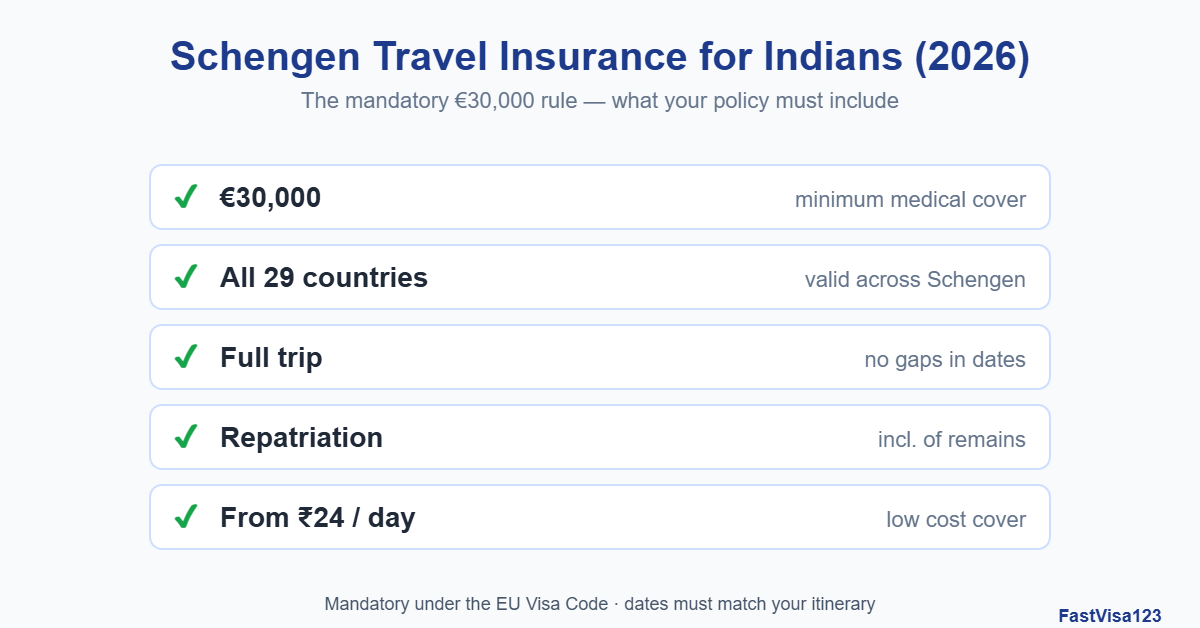
Quick answer: Every Indian Schengen visa applicant must hold travel medical insurance with a minimum of €30,000 coverage, valid across all 29 Schengen countries, covering your entire trip with no date gaps, and including emergency medical treatment and repatriation (including repatriation of remains). It is mandatory under the EU Visa Code. A compliant policy is inexpensive — often ₹24–₹40 per day. One myth to drop: buying more insurance days than your trip does not get you a longer visa; the consulate decides visa length from your whole file.
Travel insurance is included in your file
FastVisa123 arranges a fully compliant €30,000 Schengen policy with your visa file — Starting at ₹20,000 / $200 (GST included).
The €30,000 rule explained
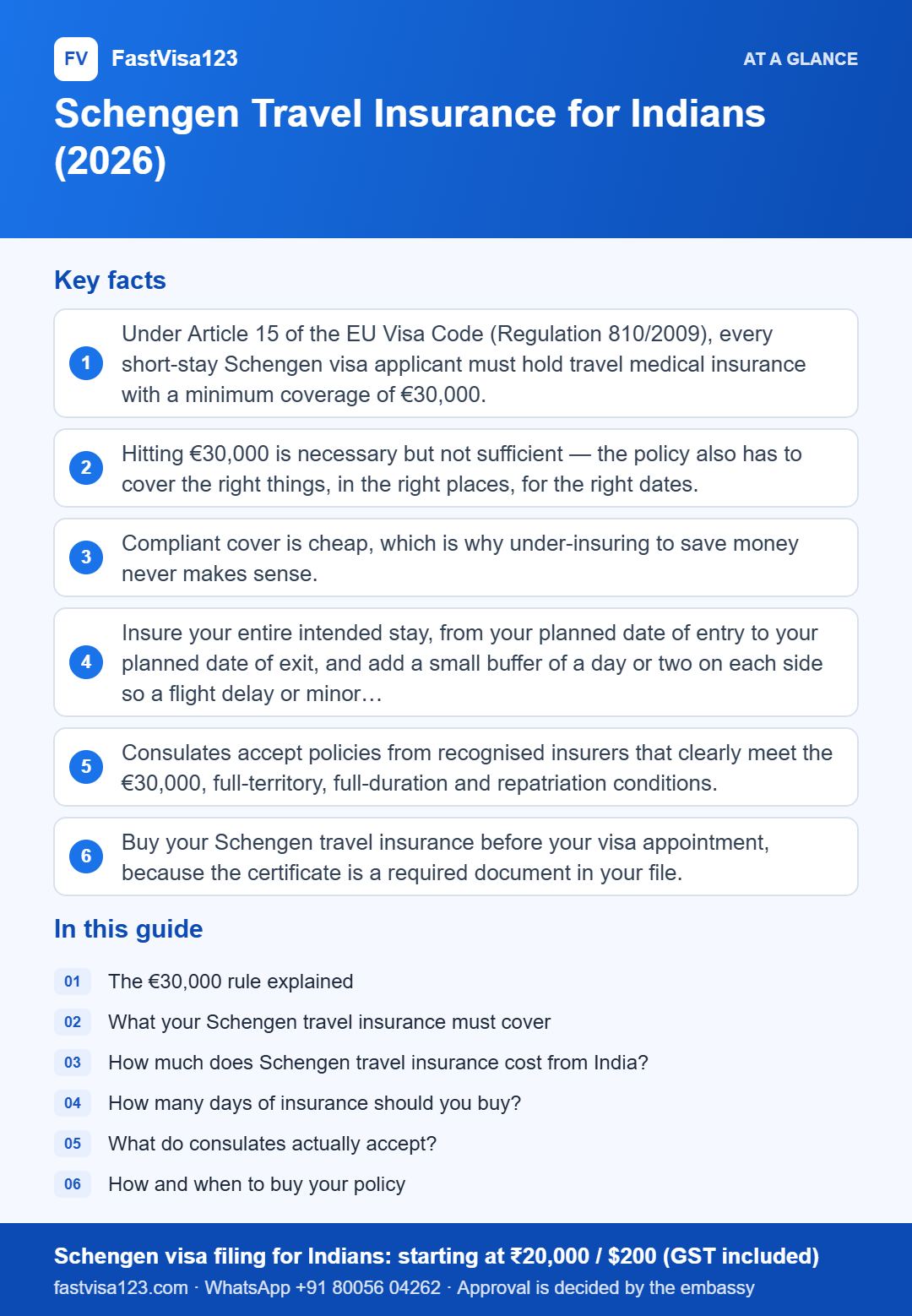
Under Article 15 of the EU Visa Code (Regulation 810/2009), every short-stay Schengen visa applicant must hold travel medical insurance with a minimum coverage of €30,000. This figure is fixed across all member states — roughly ₹28–29 lakh at current exchange rates — and it is the single number every consulate checks. A policy for less than €30,000 will be rejected outright, so always confirm the coverage limit is stated clearly on your certificate.
The purpose is simple: the EU wants assurance that if you fall ill or have an accident in Europe, the cost of treatment and, if necessary, bringing you home will not fall on the host country. Meeting the requirement is therefore not just a formality — it is genuine protection for you on the trip.
What your Schengen travel insurance must cover
Hitting €30,000 is necessary but not sufficient — the policy also has to cover the right things, in the right places, for the right dates. A compliant policy must include:
✔ Minimum €30,000 in medical cover.
✔ Emergency medical treatment and hospitalisation for illness and accidental injury.
✔ Medical evacuation and repatriation, including repatriation of mortal remains.
✔ Validity across all 29 Schengen countries (the territory must say Schengen/Europe, not a single country).
✔ Coverage for your entire trip with no gaps — the policy dates must run from your entry to your exit, ideally with a day’s buffer on each side.
The certificate should clearly state your name (matching your passport), the coverage amount, the validity dates, and that it is valid throughout the Schengen area. Many consulates want it in English, which Indian insurers issue by default.
One wrong date can void the whole certificate
We make sure your policy dates, territory and coverage exactly match your itinerary before you submit.
How much does Schengen travel insurance cost from India?
Compliant cover is cheap, which is why under-insuring to save money never makes sense. Premiums depend mainly on your age and trip length, and start from roughly ₹24–₹40 per day. The table below gives an approximate idea for a single traveller; older travellers and those with add-ons pay more.
| Trip length | Approx. premium (under 40) | Notes |
|---|---|---|
| About 1 week | ~₹400–₹800 | Short tourist trip |
| About 2 weeks | ~₹800–₹1,500 | Most common holiday length |
| About 30 days | ~₹1,100–₹2,800 | Longer European tour |
| About 60 days | ~₹1,600–₹3,500 | From ~₹26/day for a 35-year-old |
These are indicative figures only; the exact premium depends on your age, the insurer, the coverage amount you choose and any optional add-ons. Many travellers choose a higher limit than €30,000 (for example €50,000 or €100,000) for a little extra peace of mind, at modest additional cost.
How many days of insurance should you buy?
Insure your entire intended stay, from your planned date of entry to your planned date of exit, and add a small buffer of a day or two on each side so a flight delay or minor change never leaves you uninsured. That buffer is sensible and widely recommended.
What does not work is the popular myth that buying, say, 20 days of insurance for a 10-day trip will make the embassy grant you a 20-day visa. There is no rule linking insurance length to visa validity — the consulate decides your permitted stay from your whole file: flights, hotels, itinerary and purpose. If you genuinely want a longer stay, your itinerary, accommodation and insurance must all consistently cover that longer period. Inflating only the insurance while your bookings show a shorter trip creates an inconsistency that can raise doubt rather than win you extra days.
Want a longer visa? It’s about the whole file, not just insurance
We align your itinerary, hotels and insurance so the duration you request is fully supported.
What do consulates actually accept?
Consulates accept policies from recognised insurers that clearly meet the €30,000, full-territory, full-duration and repatriation conditions. In India, that includes most well-known travel insurers, and they issue a Schengen-format certificate (often called a “visa letter”) designed for exactly this purpose. What matters is not the brand but that the certificate ticks every box on the requirement.
Be cautious with very cheap or unfamiliar policies that quote a high number but exclude repatriation, restrict the territory, or carry a deductible that effectively reduces cover below €30,000. If in doubt, choose a mainstream insurer’s Schengen-specific plan, which is built to be accepted.
How and when to buy your policy
Buy your Schengen travel insurance before your visa appointment, because the certificate is a required document in your file. You can purchase online in minutes and download the certificate instantly. Set the policy dates to cover your full intended stay plus a small buffer, and make sure the name matches your passport exactly.
If your travel dates are not yet 100% fixed, insure the widest realistic window so there is no gap, and remember that most insurers let you cancel for a refund if your visa is refused (check the policy’s visa-rejection refund terms before buying). Buy early enough that the certificate is ready well before your appointment.
Insurance mistakes that cause refusals
This is an easy requirement to get wrong in small ways. The most common errors are: a coverage limit below €30,000; a policy whose dates don’t fully cover the trip (a gap of even a day can void it); a certificate that doesn’t mention repatriation; cover restricted to a single country instead of the whole Schengen area; and a name that doesn’t match the passport.
Two more catch people out: buying insurance that starts on the visa decision date rather than the travel date, and assuming a regular domestic health policy counts — it does not. Always use a dedicated Schengen/Europe travel medical policy. Getting these details right is exactly the kind of check that protects an otherwise strong file, much like avoiding the issues in our guide to why Schengen visas get rejected.
Detailed FAQs
Is travel insurance mandatory for a Schengen visa from India?
Yes, it is mandatory and non-negotiable. Under the EU Visa Code, every short-stay Schengen visa applicant must submit proof of travel medical insurance with at least €30,000 of cover, valid across the whole Schengen area for the entire trip. Without a compliant certificate, the application is refused.
It is also genuinely useful: if you need medical care in Europe, treatment is expensive, and the policy is what protects you from a very large bill.
Does buying insurance for more days than my trip get me a longer visa?
No — this is a common misconception. There is no rule that links the length of your insurance to the length of your visa, and buying 20 days of cover for a 10-day trip will not, on its own, make the consulate grant a 20-day visa. The duration of stay is decided by the officer based on your entire application, especially your flights, hotels, itinerary and purpose.
What insurance must do is cover your full intended stay with no gap; a one-to-two-day buffer is sensible. If you want a longer permitted stay, make sure your itinerary, accommodation and insurance all consistently support it — inflating only the insurance creates an inconsistency that can backfire.
How many days of insurance should I buy?
Cover your entire planned trip from entry to exit, plus a small buffer of a day or two on each side to absorb delays or minor changes. That is the safe, recommended approach and avoids any coverage gap, which can void the certificate.
For frequent travellers or those who expect several trips, a multi-trip or annual policy can be more convenient and cost-effective than buying single-trip cover each time.
What is the minimum coverage required?
The minimum is €30,000 in medical cover, roughly ₹28–29 lakh. This figure is fixed by EU law and identical for every Schengen country, so a policy for any less will be rejected. Many travellers choose €50,000 or €100,000 for extra protection, which costs only a little more.
Whatever limit you choose, make sure the €30,000-or-higher figure is printed clearly on the certificate.
How much does it cost?
It is inexpensive — premiums start at roughly ₹24–₹40 per day and depend mainly on your age and trip length. A typical two-week holiday for a traveller under 40 often costs around ₹800–₹1,500, and a 30-day trip around ₹1,100–₹2,800.
Because the cost is low, there is never a good reason to risk a refusal by buying inadequate cover. Treat a slightly higher limit as cheap peace of mind.
Will I get a refund if my visa is rejected?
Many Indian insurers offer a refund on the travel insurance premium if your Schengen visa is refused, provided you submit the rejection letter within their stated window. This is a common and useful feature, but it is not universal, so check the visa-rejection refund clause before you buy.
Keep your policy documents and, if refused, request the refund promptly according to the insurer’s process.
Can I buy the insurance after I get the visa?
No. The insurance certificate is a required document that you submit with your application, so it must be purchased before your visa appointment. You cannot apply first and add insurance later.
Because you may not have the visa yet when you buy, choose an insurer that refunds on visa rejection, and set the policy dates to your intended travel window.
Does the policy need to cover COVID-19 or pre-existing conditions?
Most current Schengen travel policies cover emergency medical treatment including for COVID-19, but this varies by insurer, so confirm it is included if it matters to you. Pre-existing medical conditions are usually excluded by default and may require a specific add-on or a higher-tier plan.
If you have a known condition, declare it and choose a plan that covers it, both to meet the requirement properly and to be genuinely protected on your trip.
Can my whole family be on one policy?
Yes. Insurers offer family and group plans that cover multiple travellers under a single policy, which is convenient and often cheaper per person than buying individual cover. Each insured person still needs to meet the €30,000 minimum and appear on the certificate.
Make sure every family member’s name matches their passport and that the dates and territory are correct for the whole group.
Does my existing health insurance or credit-card cover count?
Usually not. A standard Indian domestic health policy does not provide the international Schengen-specific medical and repatriation cover required, and most ordinary credit-card travel benefits do not meet the €30,000-plus-repatriation, full-Schengen-territory conditions either.
Unless a credit-card or corporate policy explicitly issues a Schengen-compliant certificate stating €30,000 cover, repatriation and full territory, use a dedicated Schengen travel medical policy to be safe.
Is it more expensive for senior citizens?
Yes, premiums rise with age because the medical risk is higher, and travellers above certain ages (often 60 or 70) pay noticeably more and may need a senior-specific plan. Such plans are readily available and still meet the €30,000 requirement.
Seniors with pre-existing conditions should choose a plan that covers them, declaring the conditions honestly so the cover is valid if a claim arises.
Does FastVisa123 arrange the insurance for me?
Yes. A fully compliant €30,000 Schengen travel insurance certificate is included in our service starting at ₹20,000 / $200 (GST included), set to match your exact travel dates and itinerary so it ticks every consulate requirement. We handle it alongside the rest of your file — appointment, cover letter, flights, hotels, itinerary and a full document check.
That way you never have to worry about a date gap, a missing repatriation clause or a wrong coverage figure. We never guarantee approval, as that is the embassy’s decision, but we make sure every document, including your insurance, is exactly right.
Don’t let a small insurance detail cost you the visa
We arrange a compliant policy and build your whole file — Starting at ₹20,000 / $200 (GST included), 100% online.
How to choose the right policy (step by step)
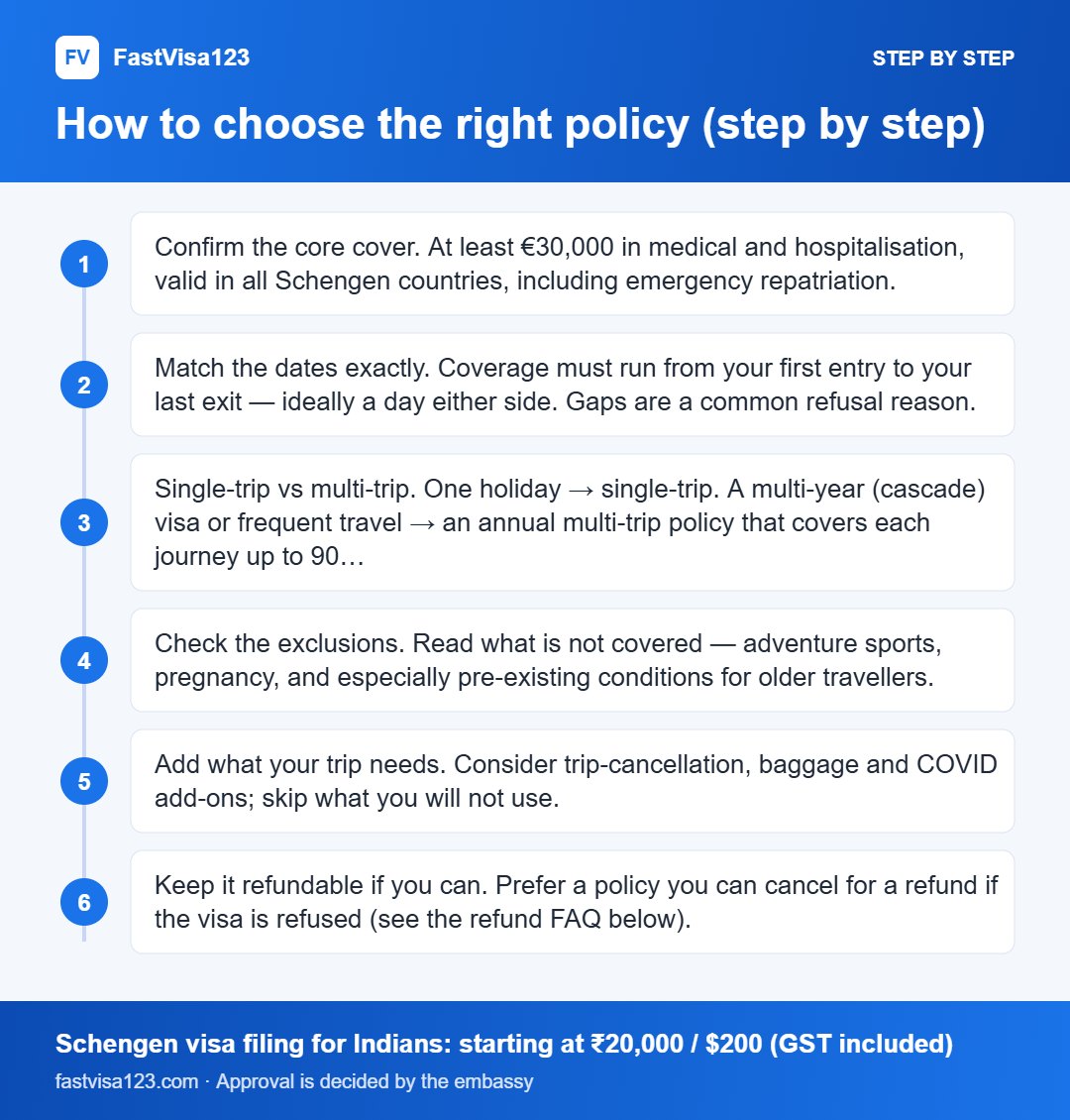
The €30,000 rule is the floor, not the finish line. Here is how FastVisa123 actually picks a policy for an Indian traveller:
- Confirm the core cover. At least €30,000 in medical and hospitalisation, valid in all Schengen countries, including emergency repatriation.
- Match the dates exactly. Coverage must run from your first entry to your last exit — ideally a day either side. Gaps are a common refusal reason.
- Single-trip vs multi-trip. One holiday → single-trip. A multi-year (cascade) visa or frequent travel → an annual multi-trip policy that covers each journey up to 90 days.
- Check the exclusions. Read what is not covered — adventure sports, pregnancy, and especially pre-existing conditions for older travellers.
- Add what your trip needs. Consider trip-cancellation, baggage and COVID add-ons; skip what you will not use.
- Keep it refundable if you can. Prefer a policy you can cancel for a refund if the visa is refused (see the refund FAQ below).
One-minute buyer’s checklist
✅ €30,000+ medical & repatriation ✅ Valid across all 29 Schengen countries ✅ Dates cover your whole trip ✅ Insurer’s name, policy number & cover amount clearly shown ✅ PDF you can print ✅ Pre-existing/senior cover if relevant ✅ Refund-if-refused option where available.
What FastVisa123 recommends (and why)
We do not push a single brand — the “best” policy depends on your profile. As a rule of thumb: a healthy solo traveller on one trip should pick the cheapest policy that clearly meets the €30,000 rule and matches the dates; seniors or anyone with a medical history should pay more for a plan that explicitly covers pre-existing conditions; and frequent or cascade-visa travellers save money with an annual multi-trip plan. Buy from a recognised insurer whose certificate states the cover amount, validity and Schengen-wide coverage in plain text — that is what consulates accept. fastvisa123.com can pick and arrange the right one for you.
Choosing your policy: more FAQs
1. How do I choose the right Schengen travel insurance?
FastVisa123: Start with the €30,000 medical-and-repatriation rule valid across all Schengen countries, match the dates to your whole trip, check the exclusions (especially pre-existing conditions), then add only the extras you need. We walk you through each step at fastvisa123.com.
2. Single-trip or multi-trip policy — which should I buy?
FastVisa123: Buy single-trip for one holiday. If you hold or expect a multi-year (cascade) visa or travel often, an annual multi-trip plan that covers each journey up to 90 days is cheaper and more convenient.
3. Which insurer does FastVisa123 recommend?
FastVisa123: We do not tie you to one brand — the right choice depends on your age, health and trip. We recommend the lowest-cost policy that clearly meets the €30,000 rule for healthy solo travellers, and a stronger plan with pre-existing cover for seniors.
4. What add-ons are worth paying for?
FastVisa123: Trip-cancellation cover (so you recover prepaid costs), baggage loss, and pre-existing-condition cover for older travellers are usually worth it. Adventure-sport riders only matter if you will actually do those activities.
5. Does the policy need to cover all 29 Schengen countries?
FastVisa123: Yes. Your certificate must state that the cover is valid throughout the Schengen area, not just one country, because your visa lets you travel across all of them.
6. Can I get a refund on insurance if my visa is refused?
FastVisa123: Often yes. Many insurers refund the premium if you cancel before the start date and show the refusal letter. Choose a refund-if-refused policy where possible, and keep the consulate’s letter as proof.
7. Do seniors or people with pre-existing conditions need special cover?
FastVisa123: Yes. Standard cheap policies often exclude pre-existing conditions. Older travellers should buy a plan that explicitly covers them, even at a higher premium, to avoid being uninsured for the very risks that matter most.
8. Is the cheapest policy good enough for the visa?
FastVisa123: For a healthy traveller on a single trip, the cheapest policy that genuinely meets the €30,000 rule and matches the dates is accepted. Just confirm the certificate states the cover clearly — do not sacrifice the core requirements to save money.
9. Should the coverage dates match my exact travel dates?
FastVisa123: Yes, and ideally extend a day either side. The policy must cover your entire stay from first entry to last exit; a date gap is a frequent and avoidable cause of refusal.
10. Can I buy insurance online and is the PDF accepted?
FastVisa123: Yes. A PDF certificate from a recognised insurer is accepted as long as it clearly shows your name, the cover amount, validity dates and Schengen-wide coverage. Print a copy for your file and the border.
11. What is the difference between travel insurance and travel medical insurance for the visa?
FastVisa123: For the visa, the consulate cares about the medical component — €30,000 of emergency medical, hospitalisation and repatriation. Broader travel insurance can add cancellation and baggage, but the medical cover is the mandatory part.
12. Does FastVisa123 arrange the insurance for me?
FastVisa123: Yes. As part of building your application, FastVisa123 helps you select and arrange a compliant, correctly dated policy so it never becomes a reason for refusal — included in our service starting at ₹20,000 / $200 (GST included).
Sources & methodology
Primary reference: the EU Visa Code (Regulation 810/2009).
Based on Article 15 of the EU Visa Code (Regulation (EC) No 810/2009), which sets the €30,000 travel medical insurance requirement, and on current Indian travel-insurer pricing and Schengen-certificate practice. Premiums are approximate and vary by insurer, age, trip length and coverage chosen — confirm exact terms with the insurer and the current requirement with the relevant consulate or VFS before applying. FastVisa123 is a private visa-filing consultancy and is not an insurance advisor; visa approval is at the sole discretion of the embassy and we do not influence consular decisions.
Schengen travel insurance: what to do vs what to avoid
Getting your travel insurance accepted — at a glance.
✅ What to do
- Buy €30,000 cover valid in all Schengen states
- Match the policy dates exactly to your trip
- Check that all required clauses are included
- Keep the certificate ready to submit
❌ What to avoid
- Buy one-country-only cover
- Leave any date gap, even a single day
- Miss mandatory clauses or under-insure
- Forget higher cover and age limits for seniors
Apply for your tourist visa — country guides
- Germany tourist visa from India
- France tourist visa from India
- Switzerland tourist visa from India
- Italy tourist visa from India
- Spain tourist visa from India
We file your complete, embassy-ready Schengen application starting at ₹20,000 / $200 (GST included).
Official source: European Commission — official Schengen visa policy