If your son or daughter lives in Europe and you want your parents to visit, the Schengen family-visit visa is the route — but for retired parents it carries one special challenge: proving they will return to India. A working applicant points to their job; a retiree can’t. This 2026 guide explains exactly how Indian parents and senior citizens get a Schengen visitor visa to see their children in Europe — the full document list (yours and your child’s), how sponsorship works, senior travel-insurance rules, the return-intent proof that actually works, real approval and rejection patterns, and a detailed FAQ.
Sending your parents to visit you in Europe? FastVisa123 builds their complete, embassy-ready family-visit file — invitation, sponsorship, insurance and return-intent proof — starting at ₹20,000 / $200 (GST included).
Which visa is this, and where do you apply?
It’s a short-stay (Type C) Schengen visitor visa, purpose “visiting family/friends,” valid for up to 90 days. Apply to the country where your child lives — if they’re in Germany, apply to Germany; in France, apply to France. Biometrics are given in person at a VFS centre.
EES note: Since the EU Entry/Exit System went fully live in April 2026, your parents’ fingerprints and photo are captured digitally on first entry, and entries/exits are logged automatically. It’s quick — but it means staying within the 90-day limit matters more than ever, as overstays are now flagged across all 29 states.
The real challenge: return intent for retired parents
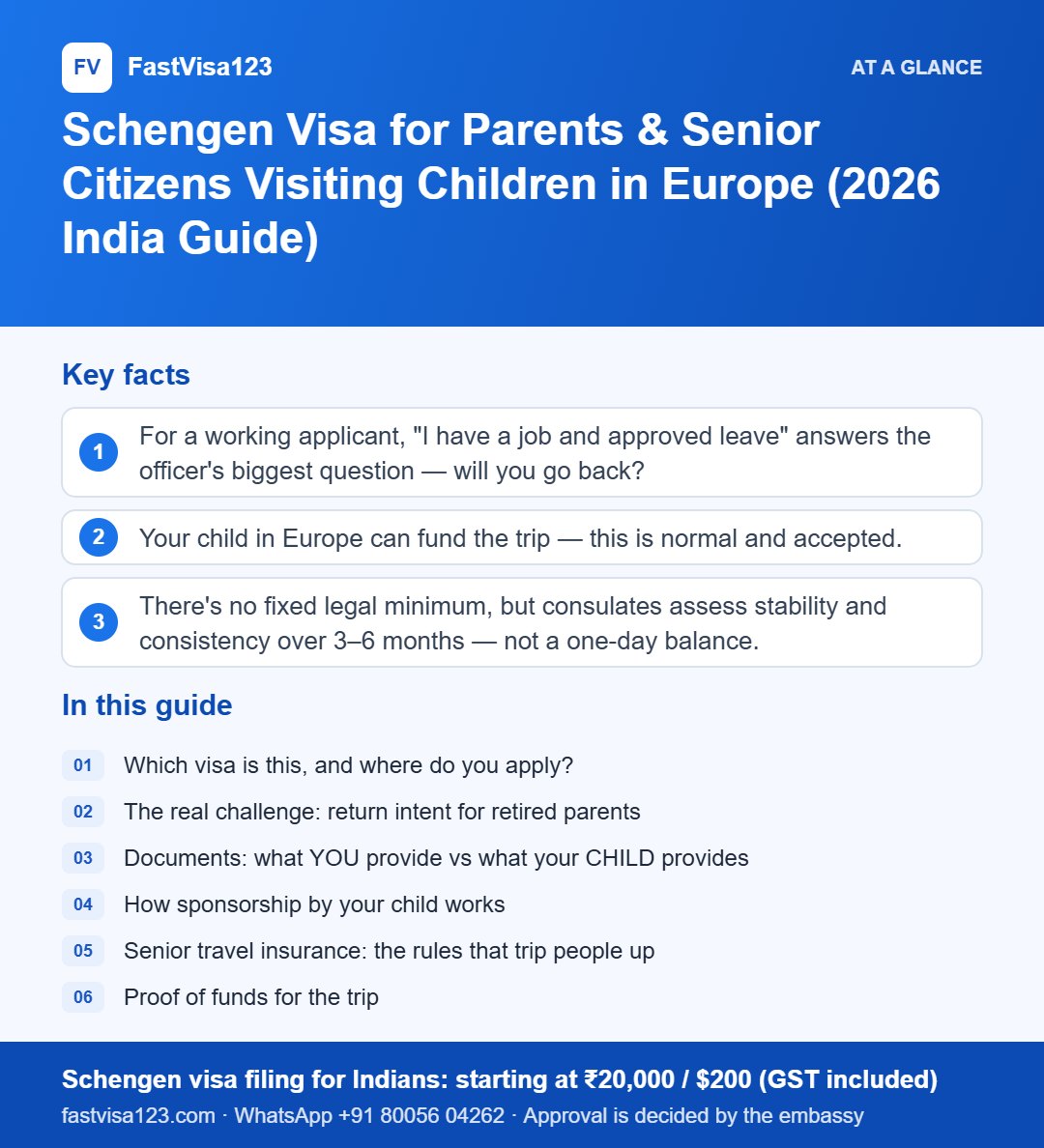
For a working applicant, “I have a job and approved leave” answers the officer’s biggest question — will you go back? Retired parents don’t have that, so officers look harder for other anchors. The fix is to state “retired” clearly and prove ties another way: property ownership is the single strongest asset, plus a spouse or other dependents in India, pension income, fixed deposits, and the simple fact that your life and home are here.
One critical mistake to avoid: never dress up a retired parent as “employed.” Officers know retired people travel; pretending otherwise is a red flag. Honesty — “retired, here is my pension and my property” — is far stronger than a fake job.
Pension + property + a clean invitation
A common approval pattern for parents visiting a child in Germany: the application clearly stated “retired,” attached pension statements and property documents in India, and was backed by the child’s invitation letter, residence permit copy and bank statements as sponsor. Return intent was obvious — a home, a spouse, and a life in India — so the officer had no reason to doubt the trip.
Both parents applying, nothing tying them home
A frequent refusal pattern: both retired parents apply together, the only child is the sponsor in Europe, and the file shows little in India — no property documents, thin financial history, and no clear reason to return. With both parents travelling and the family’s main base appearing to shift abroad, the officer cited doubt over intention to return. The lesson: when both parents travel, return-intent evidence (property, assets, other family ties) must be even stronger.
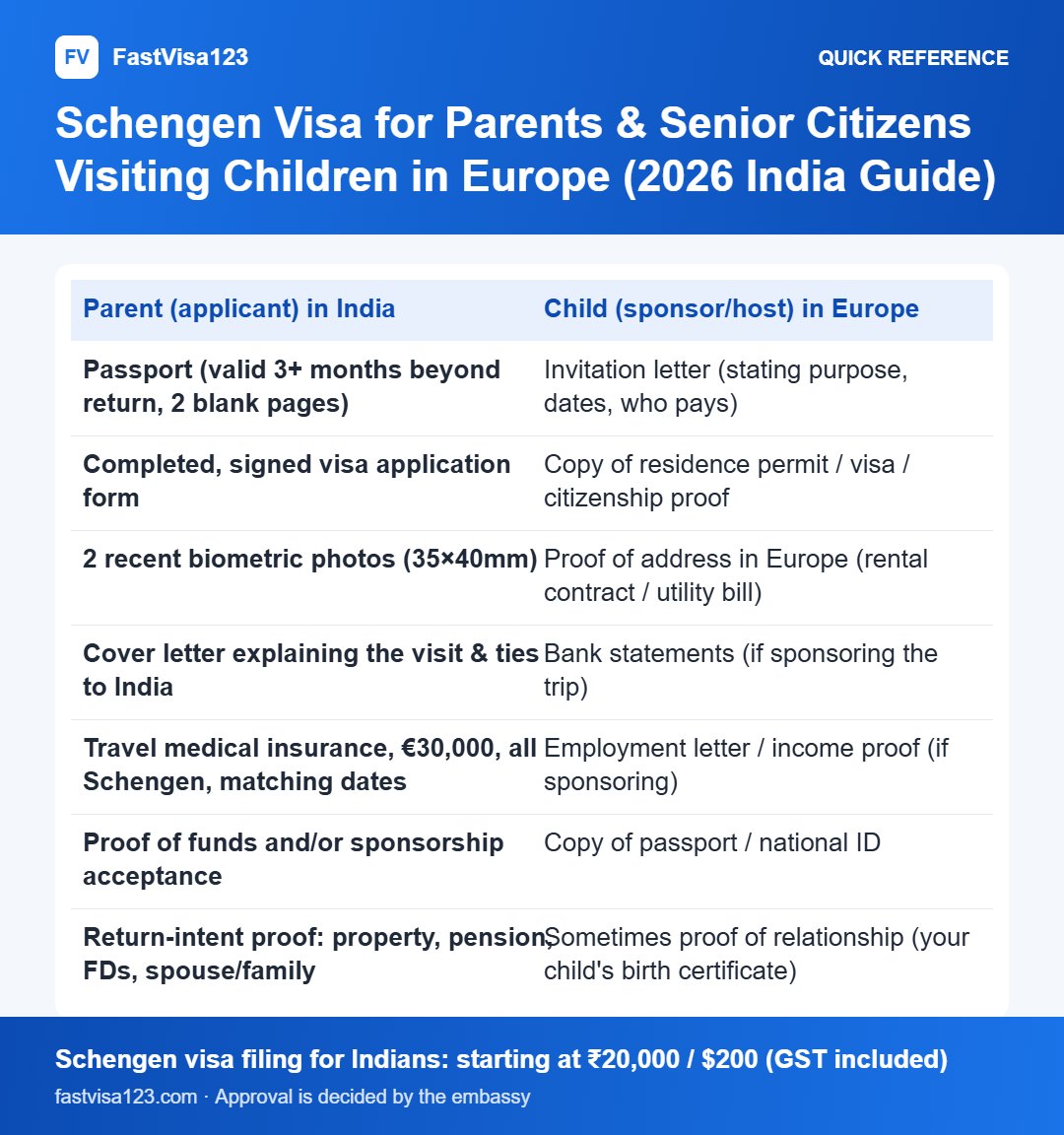
Documents: what YOU provide vs what your CHILD provides
| Parent (applicant) in India | Child (sponsor/host) in Europe |
|---|---|
| Passport (valid 3+ months beyond return, 2 blank pages) | Invitation letter (stating purpose, dates, who pays) |
| Completed, signed visa application form | Copy of residence permit / visa / citizenship proof |
| 2 recent biometric photos (35×40mm) | Proof of address in Europe (rental contract / utility bill) |
| Cover letter explaining the visit & ties to India | Bank statements (if sponsoring the trip) |
| Travel medical insurance, €30,000, all Schengen, matching dates | Employment letter / income proof (if sponsoring) |
| Proof of funds and/or sponsorship acceptance | Copy of passport / national ID |
| Return-intent proof: property, pension, FDs, spouse/family | Sometimes proof of relationship (your child’s birth certificate) |
| Confirmed return flight reservation | — |
How sponsorship by your child works
Your child in Europe can fund the trip — this is normal and accepted. They provide an invitation letter, a copy of their residence permit, proof of their address, and their bank statements and employment letter to show they can support the visit. Even when your child sponsors fully, it helps for the parent to also show some personal savings in India, plus a clear sponsorship letter and proof of the parent-child relationship. A sponsored trip with zero personal funds on the parent’s side can still read as weak; a little of your own money signals independence and ties to home.
Senior travel insurance: the rules that trip people up
• €30,000 minimum cover, valid across all Schengen states, with dates matching the trip exactly — non-negotiable, and a top refusal cause when wrong.
• Age matters: approved insurance schemes generally treat 70 as the upper age for full standard coverage, so travellers 70+ have fewer plan options and should choose carefully.
• Cost: seniors aged 60+ typically pay 2–3× the adult premium for the same cover.
• Pre-existing conditions: usually covered only for acute, life-threatening emergencies within policy limits — read the wording, especially for travellers under vs over 70.
• Senior-friendly insurers: providers like Bajaj Allianz and Tata AIG tend to be more accommodating, with some plans covering up to age 80.
Proof of funds for the trip
There’s no fixed legal minimum, but consulates assess stability and consistency over 3–6 months — not a one-day balance. If your child sponsors, their finances carry the weight; if you fund it yourself, show steady savings and, as a rough guide, liquid funds covering roughly €50–100 per day of stay plus your booked flights and accommodation. As always, don’t park a sudden large deposit just before applying — it reads as borrowed money.
How FastVisa123 handles your parents’ visa
Family-visit files fail on two things: weak return-intent proof and a mismatched invitation/sponsorship set. FastVisa123 fixes both. For a fee starting at ₹20,000 / $200 (GST included), we assemble your parents’ complete, embassy-ready application — the right invitation and sponsorship documents from your side in Europe, correct senior insurance, a clear cover letter, and a return-intent case built on property, pension and family ties in India. If a parent has a pre-existing condition or is 70+, we help choose insurance that the embassy will accept.
Bring your parents over with confidence. Transparent pricing from ₹20,000 / $200 (GST included), embassy-ready file, honest advice.
Apply with FastVisa123 — starting at ₹20,000 / $200 (GST included) →
Schengen visa for parents: what to do vs what to avoid
Helping retired parents get approved — at a glance.
✅ What to do
- State “retired” clearly and attach pension proof
- Show property and family ties in India
- Get a complete invitation, residence permit and sponsorship from the child
- Choose senior insurance that meets the €30,000 rule
❌ What to avoid
- Dress up a retiree as employed
- Send both parents with weak return-intent proof
- Mismatch the sponsor and parent documents
- Ignore the age-70 insurance coverage cap
Frequently asked questions
1. Which Schengen visa do my parents need to visit me in Europe?
FastVisa123 confirms it is a short-stay Type C Schengen visitor visa with the purpose stated as “visiting family/friends,” valid for up to 90 days. We prepare it specifically for parents visiting a child living in Europe.
2. Which country should my parents apply to?
FastVisa123 advises applying to the country where you, the child, live, because that is the main destination — if you live in Germany they apply to Germany, if in France they apply to France. Applying to the wrong embassy is an avoidable rejection cause we help you prevent.
3. Can I sponsor my parents’ trip from Europe?
FastVisa123 confirms yes, a child in Europe can sponsor the trip, which is normal and accepted. You provide an invitation letter, a copy of your residence permit, proof of address, bank statements and employment letter, and we make sure these match the parent’s file exactly.
4. What is the hardest part of a retired parent’s application?
FastVisa123 finds return intent is the hardest part, because a retiree has no job to “return to.” We solve it by proving other anchors in India — property, pension, fixed deposits, a spouse and family ties — which is what convinces the officer they will go back.
5. Should my retired parent pretend to be employed?
FastVisa123 strongly warns against this. Officers expect retired parents to travel, so state “retired” clearly and provide pension and property documents. Faking employment is a serious red flag, while honesty backed by assets is far stronger.
6. Do my parents still need their own bank balance if I sponsor them?
FastVisa123 recommends that even when you fully sponsor, your parents show some personal savings in India alongside your sponsorship letter and proof of relationship. A little of their own money signals independence and ties to home and strengthens the file.
7. How much money should be shown for the trip?
FastVisa123 notes there is no fixed legal minimum, but consulates assess stable funds over 3-6 months, roughly €50-100 per day of stay plus booked flights and accommodation. If you sponsor, your finances carry the weight rather than your parents’.
8. What travel insurance do senior parents need?
FastVisa123 confirms travel medical insurance of at least €30,000, valid across all Schengen states, with dates matching the trip exactly. For seniors this is the same legal minimum, but plan choice matters more, which we guide you through.
9. Is there an age limit on Schengen travel insurance?
FastVisa123 explains that approved schemes generally treat 70 as the upper age for full standard coverage, so travellers aged 70 and above have fewer options and must choose a plan carefully. We help select one the embassy will accept.
10. Does insurance cover my parent’s pre-existing medical conditions?
FastVisa123 notes that pre-existing conditions are usually covered only for acute, life-threatening emergencies within policy limits. The exact wording differs by plan and by whether the traveller is under or over 70, so reading the policy carefully is essential.
11. How much does senior travel insurance cost?
FastVisa123 finds that travellers aged 60 and above typically pay two to three times the standard adult premium for the same €30,000 cover. Insurers like Bajaj Allianz and Tata AIG tend to be more accommodating, with some plans covering up to age 80.
12. My parent owns property in India — how does that help?
FastVisa123 rates property as a retiree’s single strongest return-intent asset. Include registered ownership papers and property tax receipts, because a home and land in India are powerful evidence the parent will return.
13. Both my parents want to visit together — is that harder?
FastVisa123 cautions that when both parents travel together, return-intent evidence must be even stronger, since the family’s main base can appear to shift abroad. Strong property, assets and other family ties in India are essential, and we build that case.
14. Does my parent need a return flight ticket?
FastVisa123 advises showing a confirmed return flight reservation rather than a fully paid ticket, with dates that match the itinerary and the 90-day limit. Mismatched dates are a common, avoidable rejection cause.
15. What is EES and how does it affect elderly first-time travellers?
FastVisa123 explains that the EU Entry/Exit System, live since April 2026, captures fingerprints and a photo on first entry and logs every entry and exit. It is quick, but it means staying within the 90-day limit is critical because overstays are flagged across all 29 states.
16. Can my parent’s visa be refused even if I sponsor everything?
FastVisa123 confirms yes, because sponsorship answers the money question but not the return question. A fully funded trip can still be refused if return intent is weak, which is exactly why we focus on proving ties to India.
17. How long does the family-visit visa take to process?
FastVisa123 notes processing typically takes 15-30 working days, stretching toward 45 in peak summer season. We advise applying 6-8 weeks ahead and booking the VFS appointment early because slots fill fast.
18. Does a previous refusal hurt my parent’s chances?
FastVisa123 explains a past refusal is recorded and visible to all member states, so the next application must be visibly stronger and address the earlier reason. We rebuild the file around that exact ground rather than simply resubmitting.
19. Can my parents travel to other Schengen countries during the visit?
FastVisa123 confirms that once issued, a standard Schengen visa allows travel across all 29 states within its validity and the 90/180-day limit, though they must apply through the country that is their main destination — usually where you live.
20. What cover letter does a parent’s application need?
FastVisa123 prepares a cover letter that explains who the parent is, why they are visiting, where they will stay, when they will return, and what ties them to India. For parents this letter is essential to frame the visit and the return clearly.
21. Can FastVisa123 handle the whole process from India and Europe?
FastVisa123 coordinates both sides: the sponsorship and invitation documents from your side in Europe and the parent’s documents and return-intent proof in India, assembled into one consistent, embassy-ready file. It starts starting at ₹20,000 / $200 (GST included).
22. Is ₹20,000+ / $200+ (GST included) the full cost for my parents’ visa service?
FastVisa123 charges starting at ₹20,000 / $200 (GST included) for building the embassy-ready application. Government and VFS charges such as the €90 visa fee and the insurance premium are separate and paid directly by you, with no hidden extras from us.
Sources & methodology
This guide reflects current consular practice and documented requirements, including family-visit checklists from the German Federal Foreign Office and senior-insurance guidance summarised by travel-insurance resources. Refusal patterns and return-intent factors are drawn from 2026 reporting on Indian Schengen rejections. The visa officer’s grounds for assessment are set by the EU Visa Code (Regulation 810/2009). Applicant stories are anonymized; requirements and outcomes vary by country, profile and consular discretion.
Apply for your visa — country guides
- Germany visa from India
- France visa from India
- Switzerland visa from India
- Italy visa from India
- Spain visa from India
FastVisa123 builds your parents’ complete, embassy-ready family-visit file starting at ₹20,000 / $200 (GST included).
Official source: European Commission — official Schengen visa policy