Last updated: June 2026 · Reviewed by the FastVisa123 documentation team · Based on the EU’s more favourable Schengen visa rules for India (cascade regime, effective 18 April 2024).
The Schengen cascade visa is the single biggest piece of good news for Indian travellers in years. Since April 2024, the European Union has allowed eligible Indians to stop reapplying for a visa before every single trip and instead earn long-validity, multiple-entry visas valid for two years and, eventually, up to five years. For anyone who travels to Europe more than once in a while, this changes the maths completely — fewer applications, fewer fees, fewer nerve-wracking appointment waits.
This guide explains the Schengen cascade visa in full: what it is, the exact validity tiers, who qualifies in 2026, the benefits and the limits, a step-by-step look at how to apply, and how FastVisa123 helps you build a file that gives you the strongest possible shot at a long-term visa if you are eligible.
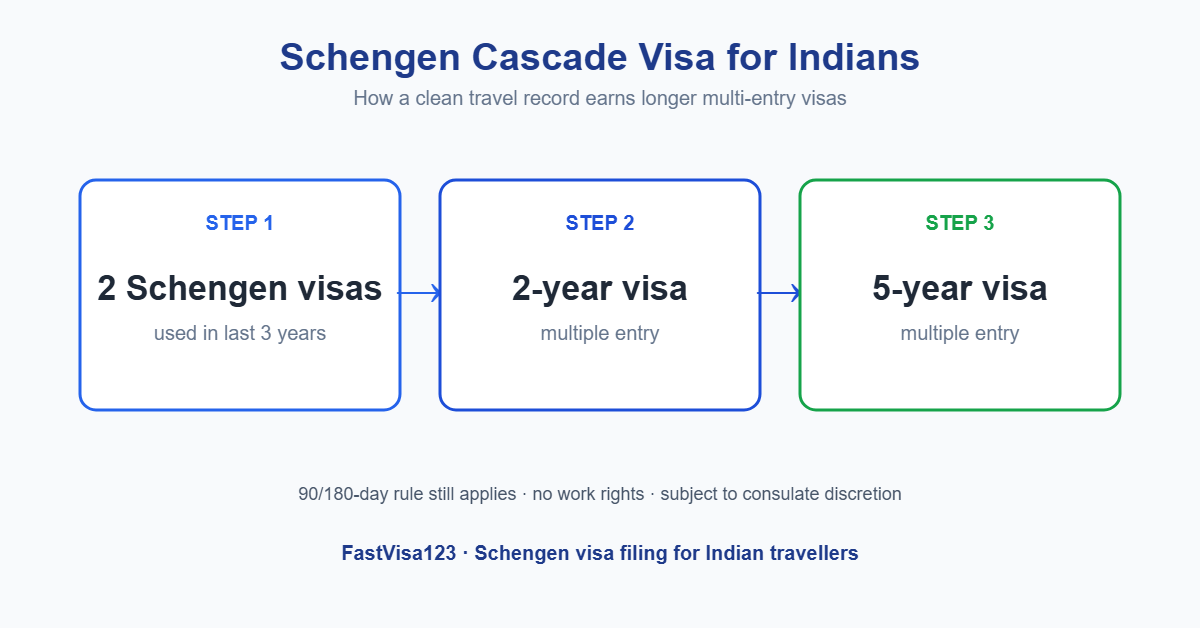
Quick answer: The Schengen cascade visa is a “trusted traveller” reward system. An Indian who has obtained and lawfully used two Schengen visas in the last three years can be granted a two-year multiple-entry visa; someone who has then used a two-year multiple-entry visa can move up to a five-year multiple-entry visa. During the visa’s validity you can enter and leave all 29 Schengen-area countries as often as you like — but the 90-days-in-any-180-days limit still applies, the visa never grants the right to work, and the exact validity is always the consulate’s decision.
Think you qualify for a long-term visa?
FastVisa123 reviews your past visa history and builds a cascade-ready file that gives you the best shot at a 2 or 5-year visa — for a flat ₹10,000.
What is the Schengen cascade visa?
The Schengen cascade visa is not a new category of visa. It is a more generous way of issuing the ordinary short-stay (Type C) Schengen visa to people who have already shown they can be trusted to follow the rules. The European Commission adopted these more favourable visa rules for India on 18 April 2024, putting India in a small group of countries — currently India, Türkiye and Indonesia — that benefit from this approach.
The idea behind the Schengen cascade visa is straightforward. If you have already travelled to the Schengen area on previous visas and respected every condition — you entered and left on time, you did not work, and you never overstayed — then the consulate no longer needs to treat you like an unknown risk. Instead of issuing another single-trip visa, it can reward you with a longer multiple-entry visa so you do not have to start the whole process again for your next holiday or business trip.
It is called a “cascade” because the benefit builds in steps. Each compliant visa you use makes you eligible for a longer one the next time you apply, so your visa validity can cascade upward from a single entry, to a two-year multiple-entry visa, and ultimately to a five-year multiple-entry visa. The better and cleaner your travel record, the further up the cascade you can climb.
The Schengen cascade visa tiers: 1, 2 and 5 years
The cascade works in clearly defined steps, and the length of the visa you can be granted depends on your recent, lawfully used visa history. The widely reported structure for Indian applicants is set out below.
| Your recent, lawfully used visa history | Visa you can be granted |
|---|---|
| Two Schengen visas obtained and used in the last three years | Two-year multiple-entry visa |
| A two-year multiple-entry visa used within the last three years | Five-year multiple-entry visa |
In plain terms, this means a first-time applicant will still receive a single-entry or short-validity visa — the cascade is a reward for a track record, not a starting point. But a frequent, compliant traveller can move from short visas, to a two-year multiple-entry Schengen cascade visa, and then to a five-year multiple-entry visa over successive, well-documented trips.
One condition runs through every tier: your passport must stay valid for the full length of the visa. A consulate cannot issue a five-year visa in a passport that expires in three years, and it normally wants a few months of buffer beyond the visa’s end date. If your passport is close to expiry, it is often worth renewing it before you apply so that nothing artificially caps the validity you can be granted.
Finally, remember that the tiers describe what you are eligible for. The cascade rules set the ceiling, but the consular officer still decides the actual validity based on your complete profile — your finances, your ties to India, the consistency of your file, and your travel history together.
Already have a Schengen visa or two?
You may be closer to a long-term visa than you think. We’ll review your history and present it exactly the way the consulate wants to see it.
Who is eligible for the Schengen cascade visa in 2026?
To benefit from the Schengen cascade visa as an Indian applicant, you generally need to satisfy all of the conditions below. Each one matters, and a gap in any single area can pull you back down to a shorter visa.
A genuine, recent and used visa record. The cascade is built on proof that you have actually travelled. For the two-year tier, you typically need two Schengen visas obtained and lawfully used within the last three years. The key word is “used” — the consulate is looking for evidence that you entered and exited the Schengen area on those visas, not simply that they were once stamped into your passport. This is why your old visas and the matching entry and exit records are the most important documents in a cascade claim.
A spotless compliance history. You must have no overstays, no unauthorised work, and no other immigration violations on your record. This is the condition that most often quietly disqualifies otherwise frequent travellers. Even a single overstay of a few days, or any hint that you worked while on a tourist visa, can be enough for the consulate to decline the longer validity — no matter how many trips you have made.
You apply from within India. Applications under the cascade regime must be made from your country of residence. For Indian nationals that means applying while you are in India, at the consulate or visa application centre responsible for your destination, rather than from a third country.
A passport that supports the validity. As covered above, your passport must be valid for the full term of the visa you are hoping for, with a buffer. If you want the five-year Schengen cascade visa, your passport needs to comfortably cover those five years.
A strong underlying application. The cascade does not replace the normal requirements. You still need to show sufficient funds, genuine ties to India, travel insurance and a coherent travel plan. A traveller who technically qualifies on history but submits a weak current file can still be refused, or granted only a short visa.
Benefits and limits of the Schengen cascade visa
A long-term Schengen cascade visa is genuinely valuable, but it is important to understand exactly what it does and does not give you, so your expectations match reality.
What you gain. The biggest benefit is freedom and convenience. With a valid multiple-entry visa you can enter and leave the entire 29-country Schengen area as many times as you wish during its validity, without submitting a new application, paying the fee again, or waiting weeks for an appointment each time. For people who travel to Europe regularly — for business, to visit family, or simply because they love the continent — this is close to the convenience that visa-free nationalities enjoy, and it removes the single most stressful part of repeat travel.
What stays exactly the same. The Schengen cascade visa does not change the fundamental rules of short stays. The 90/180 rule still applies in full: you may spend a maximum of 90 days inside the Schengen area within any rolling 180-day period, regardless of whether your visa is valid for two years or five. The visa is strictly for tourism, business meetings or family visits — it does not grant the right to take up employment, run a business on the ground, or settle. And every time you actually travel, you must still be able to show proof of accommodation, sufficient funds, and valid travel medical insurance of at least €30,000, just as you would on any Schengen trip.
How to apply for the Schengen cascade visa: step by step
There is no separate “cascade application form.” You apply for a normal short-stay Schengen visa, and the consulate decides whether your history qualifies you for a longer multiple-entry validity. The steps below give you the best possible chance of being awarded the long visa rather than another single-trip one.
Step 1 — Confirm your eligibility honestly. Before anything else, check your own record against the criteria above: do you have two lawfully used Schengen visas in the last three years (for the two-year tier), or a used two-year visa (for the five-year tier)? Is your compliance history clean? If you are not sure, it is far better to find out now than to have the consulate reach the wrong conclusion from a poorly assembled file.
Step 2 — Choose the correct country. You must apply to the country where you will spend the most days on your upcoming trip, or your first point of entry if your stay is evenly split. Applying to the wrong country is itself a ground for refusal. Our guide to the easiest Schengen country for Indians explains how to choose correctly.
Step 3 — Gather proof of your past travel. This is the heart of any cascade claim. Collect copies of your previous Schengen visas and, crucially, the entry and exit stamps or records that prove you actually used them and left on time. Organise them clearly so the officer can see your compliant history at a glance.
Step 4 — Build a strong current file. Prepare the standard documents to a high standard: recent bank statements showing stable funds, your income-tax returns, proof of employment or business, proof of ties to India, confirmed travel and accommodation bookings, and travel medical insurance of at least €30,000. A weak file here can sink even a strong cascade claim — our guide on why Schengen visas get rejected covers the pitfalls.
Step 5 — Explicitly request a long-term multiple-entry visa. In your cover letter, state clearly that you are requesting a multiple-entry visa with extended validity under the cascade arrangement, and explain your travel pattern and why a long-term visa fits it. Officers are not obliged to volunteer the longer validity — asking for it, and justifying it, matters.
Step 6 — Book your appointment and submit biometrics. Book your slot at the relevant visa application centre, submit your file, and give your biometrics. Apply well in advance, as appointment waits can run to several weeks at the busier consulates.
How FastVisa123 helps you if you’re eligible for the cascade scheme
The cascade scheme rewards travellers who can prove a clean, used visa history — and that proof has to be assembled and presented correctly. This is exactly where most eligible Indians lose out and end up with a short visa they didn’t need to settle for. Here is precisely how FastVisa123 helps you make the most of your eligibility.
1. We assess your eligibility first, honestly. Before you pay anything, share your travel history with us and we will tell you frankly whether you appear to qualify for the two-year or five-year tier, or whether you are a trip or two away. If you are not yet eligible, we will tell you that too, rather than charging you for a claim that won’t succeed.
2. We assemble and present your visa history. We help you compile your previous visas and the matching entry and exit evidence, and we lay them out in a clean, consulate-friendly format so the officer can see your compliant record at a glance. This single step is what turns “eligible on paper” into a visa actually granted.
3. We build your complete file. For a flat ₹10,000, all-inclusive, we prepare everything an Indian applicant needs: your VFS appointment booking, a tailored cover letter that explicitly requests the long-term multiple-entry visa and explains your travel pattern, verifiable flight reservations, hotel bookings, a day-wise itinerary, travel insurance, and a full check of your forms, bank statements, ITR and supporting documents.
4. We support you all the way to the VFS counter. The entire process is handled online over WhatsApp and email — no office visits — and we are reachable throughout. You simply walk into your nearest VFS centre on appointment day with a complete, embassy-ready file and submit your biometrics.
An honest promise. We have helped Indian travellers build files with a 99% historical success rate, but we never guarantee a particular visa or validity. The cascade rules decide what you are eligible for; the consulate makes the final call. What we guarantee is that your eligibility will be presented as clearly and completely as possible, so nothing is lost to a weak or incomplete file.
Find out which tier you qualify for
Send us your travel history and we’ll tell you honestly whether you’re in line for a 2 or 5-year visa — then build the file to claim it. Flat ₹10,000, 100% online.
Mistakes that cost Indians a long-term visa
Plenty of eligible travellers still walk away with a short single-entry visa because of avoidable errors. The most common is failing to prove past usage — showing the old visa but not the entry and exit stamps that prove it was actually used and respected. Close behind is any compliance blemish, such as a past overstay or a hint of unauthorised work, which can quietly cap your validity regardless of how often you have travelled.
Others include a passport expiring too soon to support a long validity, a weak current file where finances or ties raise doubt, and simply never explicitly requesting a multiple-entry, long-validity visa in the cover letter. A properly built, cascade-ready file removes every one of these risks before submission.
Detailed FAQs about the Schengen cascade visa
Can Indians really get a 5-year Schengen visa?
Yes. Under the Schengen cascade visa rules that took effect for India in April 2024, an Indian traveller who has obtained and lawfully used a two-year multiple-entry visa within the last three years can be granted a five-year multiple-entry visa. There have been widely reported cases of Indian travellers receiving exactly this. Two conditions are essential, though: your passport must be valid for the full five years (with a buffer), and the final decision on validity always rests with the consulate, which weighs your complete profile and not just your travel count.
How exactly do I qualify for the two-year cascade visa?
The standard route to the two-year tier is to have obtained and lawfully used two Schengen visas within the previous three years, with a completely clean compliance record. “Lawfully used” is the part that trips people up — it is not enough to have been granted the visas; you need to be able to show that you actually entered and left the Schengen area within their conditions, with no overstays. This is why your old visas together with the matching entry and exit stamps or records are the single most important part of the application. If those are in order and your current file is strong, you are well positioned for the two-year visa.
Does a 5-year visa mean I can live in Europe for five years?
No, and this is the most common misunderstanding. The five years refers only to how long the visa stays valid for repeated entries — not to how long you may stay on any visit. The 90/180 rule continues to apply throughout: you can spend a maximum of 90 days inside the Schengen area within any rolling 180-day period. So a five-year cascade visa is best thought of as five years of hassle-free repeat trips, each within the 90-day limit, rather than permission to settle or stay continuously.
Can a first-time applicant get a cascade visa?
No. The cascade is specifically designed to reward an existing track record, so a first-time applicant cannot jump straight to a two-year or five-year visa. First-time travellers typically receive a single-entry or short-validity visa for their specific trip. The good news is that this is the first step onto the ladder — if you travel, respect every condition, and keep your record clean, those trips become the foundation that makes you eligible for a longer cascade visa next time.
Do Schengen visas I was granted but never used count toward the cascade?
Generally no — the benefit is built on visas you obtained and lawfully used. A visa that was issued but never actually used to travel does not demonstrate the compliant travel behaviour the cascade is designed to reward, and consulates focus on evidence of real entries and timely exits. This is why simply listing past visas is not enough; you need to show the stamps or records that prove you genuinely travelled on them and left on time.
Which Schengen countries offer the cascade visa to Indians?
The cascade is an EU-wide rule, so it applies to applications made from India regardless of which Schengen country you are applying to — it is not something only certain member states offer. What is limited is the list of nationalities: at present only Indian, Turkish and Indonesian nationals benefit from this more favourable regime. In practice, you should still apply to the correct country for your itinerary (your main destination or first entry point), and that consulate will assess your cascade eligibility.
Will a past visa refusal ruin my cascade eligibility?
A past refusal does not erase the visas you have already used, and it does not automatically disqualify you. However, the consulate looks at your overall record, so a history that mixes used visas with refusals is weighed as a whole. The best approach is to make sure your current application is clean, complete and well-documented, and to clearly present the visas you have successfully used. If a previous refusal was due to a fixable issue such as weak finances or documentation, addressing that properly in your new file is what matters.
Can I work or run a business on a cascade visa?
No. Like every short-stay Schengen visa, the cascade visa is strictly for tourism, business visits such as meetings and conferences, and family visits. It does not grant the right to take up employment, work locally, or establish and run a business on the ground in the Schengen area. Working on a short-stay visa is exactly the kind of violation that would damage your compliance record and disqualify you from future cascade benefits, so it is important to stay within the visa’s purpose.
Do I still need travel insurance and proof of funds each time?
Yes. The cascade visa changes how often you apply, not the underlying requirements for travel. Every time you apply, and every time you actually travel, you must be able to show valid travel medical insurance covering at least €30,000, sufficient funds for your trip, and proof of accommodation. Carrying these each time you enter is part of respecting the visa’s conditions — and respecting those conditions is precisely what keeps your record clean for the next step up the cascade.
How can FastVisa123 help me get a cascade visa?
We help in four concrete ways. First, we assess your travel history honestly and tell you whether you appear eligible for the two-year or five-year tier before you pay anything.
Second, we assemble and present your past visas and entry/exit evidence in the clean, consulate-friendly format that turns eligibility on paper into a visa actually granted.
Third, for a flat ₹10,000 we build your complete file — VFS appointment, a cover letter that explicitly requests the long-term multiple-entry visa, verifiable flight and hotel reservations, a day-wise itinerary, insurance, and a full document check.
Fourth, we support you over WhatsApp and email right up to the VFS counter. We never guarantee a specific visa or validity, because that is the consulate’s decision — but we make sure your eligibility is presented as clearly and completely as possible.
Ready to go for a 2 or 5-year visa?
Get your cascade file built by people who’ve prepared hundreds of Indian applicant profiles.
Sources & methodology
Based on the European Union’s more favourable Schengen visa rules for India (cascade regime, effective 18 April 2024) as published by the EU Delegation to India (EEAS) and reported by Business Today and Business Standard. The exact validity granted is at the consulate’s discretion and rules can change — always confirm current requirements with the relevant consulate or VFS before applying. FastVisa123 is a private visa-filing consultancy; visa approval and validity are at the sole discretion of the embassy and we do not influence consular decisions.
Schengen cascade visa: what to do vs what to avoid
Getting a long-validity (cascade) visa — at a glance.
✅ What to do
- Use every Schengen visa lawfully and exit on time
- Keep a clean, honest travel record
- Reapply showing your genuine prior travel history
- Apply where you will spend the most nights
❌ What to avoid
- Overstay even by a single day
- Expect a 2–5 year visa to be granted automatically
- Hide a past overstay — EES now records it
- Assume cascade ignores a weak current profile
Apply for your tourist visa — country guides
- Germany tourist visa from India
- France tourist visa from India
- Switzerland tourist visa from India
- Italy tourist visa from India
- Spain tourist visa from India
We file your complete, embassy-ready Schengen application for a flat ₹10,000.
Confused by the entries number? See single vs multiple-entry Schengen visa.
Official source: European Commission — official Schengen visa policy