Last updated: June 2026 · Reviewed by the FastVisa123 documentation team · Based on official European Commission visa statistics and the EU Visa Code (Regulation 810/2009).
Schengen visa rejection is one of the biggest worries for Indian travellers planning a trip to Europe — and the 2025 statistics show exactly why that worry is justified. This guide breaks down the real Schengen visa rejection numbers for India, the official reasons applications are refused, and practical steps to avoid a Schengen visa rejection.
Quick answer
In 2025, Indian travellers submitted more than 1.15 million Schengen visa applications and 181,111 were rejected — an overall refusal (non-issuance) rate of about 15.8%, meaning roughly 1 in 6 applications was turned down. India remained the world’s third-largest source of Schengen visa applications, behind China and Türkiye. The most common reasons for rejection are doubts about your intention to return, weak or inconsistent financial proof, poorly justified travel purpose, missing travel insurance, and inconsistent supporting documents — all formally grounded in Article 32 of the EU Visa Code.
Worried your file isn’t strong enough?
FastVisa123 builds embassy-ready Schengen files for Indian applicants — cover letter, dummy flights, hotels, itinerary and full document check — for a flat ₹10,000. 99% historical success rate on files we prepare.
How many Indians apply for a Schengen visa — and how many face a Schengen visa rejection?
If you are reading this, you probably want hard numbers, not vague reassurance. Here they are, drawn from the official statistics published by the European Commission’s Directorate-General for Migration and Home Affairs (the only authoritative source for Schengen visa data).
In 2025, Indian nationals filed more than 1.15 million short-stay (Type C) Schengen visa applications. Of those, 181,111 were refused, giving an overall non-issuance rate of approximately 15.8%. In plain terms, close to one in every six Indian applicants was turned away. India held its position as the third-largest source market for Schengen visas worldwide, behind China (around 1.8 million applications) and Türkiye (around 1.25 million).
To understand the trend, it helps to compare with 2024. That year, India submitted roughly 1.1 million applications, of which about 936,748 were issued and 165,266 were refused — a refusal rate of around 15%. So both the volume of applications and the refusal rate ticked upward from 2024 to 2025. More Indians are travelling to Europe than ever, but the bar for approval has not loosened.
| Metric (India) | 2024 | 2025 |
|---|---|---|
| Applications submitted | ~1.1 million | ~1.15 million |
| Visas refused | 165,266 | 181,111 |
| Refusal / non-issuance rate | ~15% | ~15.8% |
| Global rank as source market | 3rd | 3rd |
A note on terminology: the European Commission uses the term “non-issuance rate”, which includes both outright refusals and applications that did not result in a visa for other reasons. In everyday language this is what most people call the “rejection rate.”
Schengen visa rejection: how India compares globally
Schengen visa demand rebounded strongly after the pandemic. In 2024, a total of 11,716,723 applications were filed worldwide — up about 13.5% on 2023, though still below the 2019 peak of nearly 17 million. The global refusal rate in 2024 was 14.8%, down slightly from 16% in 2023 and 17.9% in 2022.
Against that backdrop, India’s ~15.8% refusal rate in 2025 sits a little above the global average but is far from the worst. Applicants from some countries face dramatically higher odds of refusal — in 2024, Bangladesh (54.9%), Pakistan (47.5%), Guinea-Bissau (47%), Senegal (46.8%) and Haiti (46.3%) recorded the highest refusal rates in the world. There is also a stark regional gap: refusal rates for applicants from Africa (around 27%) were roughly double those from Asia (around 13%).
The takeaway for an Indian traveller is reassuring but realistic: your passport gives you better-than-average odds, but a 1-in-6 refusal rate is high enough that a careless or incomplete file is a genuine risk — not a theoretical one.
Don’t gamble ₹10,000 in embassy fees on a weak file
A refused application means your visa fee is gone — and so is your travel plan. We prepare your file exactly to your chosen consulate’s requirements before you ever pay the embassy.
Which Schengen country is most likely to reject an Indian applicant?
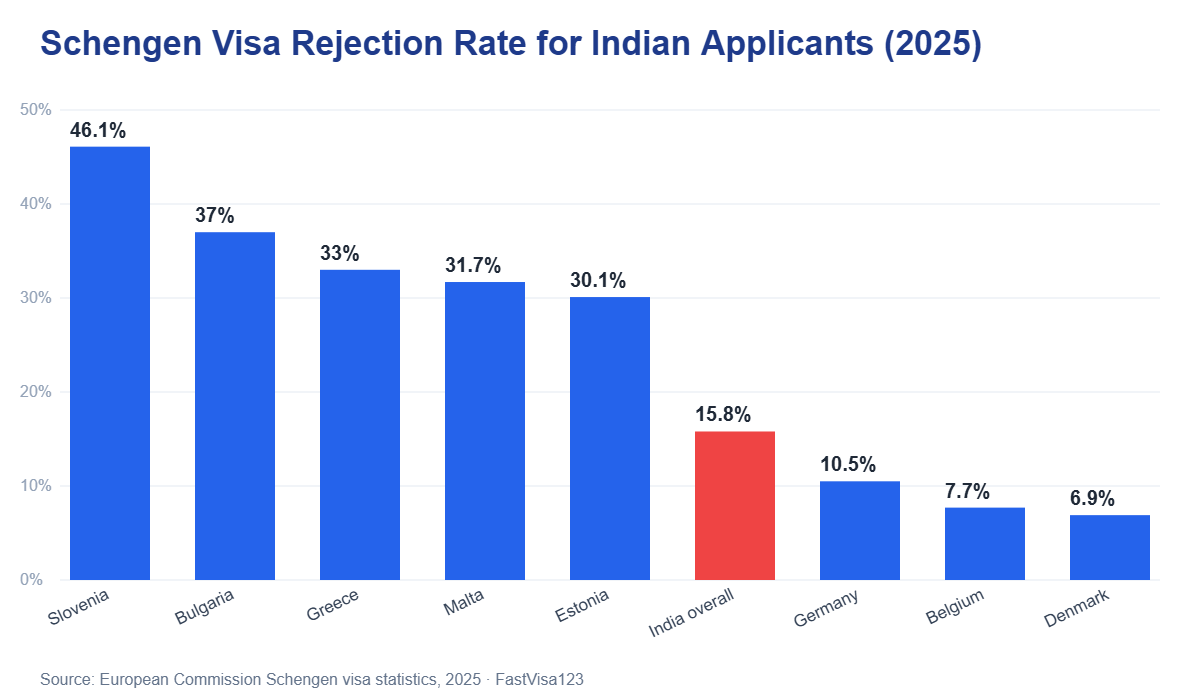
This is one of the most important — and least understood — facts about the Schengen system. Although the rules are common to all member states, refusal rates vary enormously depending on which country’s consulate you apply through. Two applicants with identical profiles can face opposite outcomes — approval or Schengen visa rejection — simply because one applied to Germany and the other to Slovenia.
Based on the 2025 data for Indian applicants, here is how the picture looked:
| Toughest for Indians (highest refusal rate, 2025) | Rate |
|---|---|
| Slovenia | ~46.1% |
| Bulgaria | ~37% |
| Greece | ~33% |
| Malta | ~31.7% |
| Estonia | ~30.1% |
| Smoother for Indians (lower refusal rate, 2025) | Rate |
|---|---|
| Denmark | ~6.9% |
| Belgium | ~7.7% |
| Germany | ~10.5% (processed 153,000+ Indian applications — the highest volume) |
A crucial caveat: you cannot simply pick the country with the lowest refusal rate. Schengen rules require you to apply to the country where you will spend the most days, or — if your stay is evenly split — the country you enter first. Applying to the “wrong” country to chase a better refusal rate is itself a ground for refusal and can damage your record. The right move is to build the strongest possible file for the correct country.
For context on absolute numbers, in 2024 the consulates that refused the most Indian applications were France (31,314 refusals), Switzerland (26,126), Germany (15,806), Spain (15,150) and the Netherlands (14,569) — but these are also the consulates that receive the most applications, so high totals do not necessarily mean a high rate.
The 11 official reasons for a Schengen visa rejection
Every Schengen refusal must be justified using a standard refusal form (Annex VI of the Visa Code) that ticks one or more of the official grounds set out in Article 32 of Regulation (EC) No 810/2009. Understanding these is the single most useful thing you can do, because every practical mistake maps back to one of them. Here are the eleven grounds, explained in plain English.
1. False, counterfeit or forged travel document
If the consulate believes your passport or any document is fake or tampered with, refusal is automatic — and the consequences are severe, potentially including a ban from the Schengen Area of up to five years. Never submit edited bank statements, fabricated reservations or “arranged” documents.
2. Purpose and conditions of the intended stay not justified
You must clearly show why you are travelling and that your documents match that purpose. A tourist trip with no itinerary, or a “business” visit with no invitation letter, falls here.
3. Insufficient means of subsistence
You must prove you can fund the trip — for the whole stay and for your return. Officers look at bank statements, salary, income-tax returns and the source of your funds. Sudden large deposits just before applying are a classic red flag.
4. Insufficient means for the return / onward journey
Closely related to the above: you also need to show you can afford to get home, not just to arrive.
5. Already stayed 90 days in the current 180-day period
A short-stay visa allows a maximum of 90 days within any rolling 180-day window. If you have exhausted this, a new short-stay visa cannot be issued.
6. An SIS alert for the purpose of refusing entry
If your name appears in the Schengen Information System (SIS) with a refusal-of-entry alert, no visa can be granted regardless of how strong the rest of your file is.
7. Considered a threat to public policy, internal security or public health
This broad ground covers criminal records, security concerns and, in some cases, serious communicable diseases.
8. Considered a threat to the international relations of a member state
A rarely used but real diplomatic ground.
9. No proof of adequate, valid travel medical insurance
Every Schengen applicant must hold travel insurance covering at least €30,000 in medical and repatriation costs, valid across all member states for the full trip. Missing or insufficient insurance is an easily avoided but common refusal.
10. Reasonable doubts about the authenticity of supporting documents or the truth of their content
Even genuine documents can trigger refusal if something looks inconsistent — mismatched dates, a hotel booking that doesn’t align with your flights, or an employer letter that can’t be verified.
11. Reasonable doubts about your intention to leave before the visa expires
This is the big one. The consulate must be satisfied you will return home. Weak “ties to India” — no stable job, no property, no family dependents, an empty or erratic bank account — feed doubt here. For many Indian applicants, this is the underlying reason behind a refusal, even when another box is ticked.
Most refusals come down to how the file is presented
The facts of your life may be perfectly strong — but if the documents don’t tell that story clearly, the consulate fills the gaps with doubt. That’s exactly what we fix.
Why Indian applicants actually face a Schengen visa rejection (the practical version)
Understanding the real triggers of a Schengen visa rejection helps you fix them before you apply. The legal grounds above are the “what.” Here is the “why” behind most cases of Schengen visa rejection we see in real Indian files:
Weak proof of intention to return. Self-employed applicants, freelancers, students and homemakers are scrutinised harder because their “ties” are less obvious on paper. The fix is not to hide this but to document it well — property papers, business registration, family responsibilities, a clear reason the trip is temporary.
Financial inconsistencies. A balance that suddenly jumps just before applying, income that doesn’t match the lifestyle implied by the trip, or statements that don’t reconcile with your ITR. Consulates want to see stable, explainable funds, not a one-time top-up.
A travel purpose that doesn’t hang together. Flights, hotels, itinerary and cover letter must tell one consistent story. A flight landing in one city while the hotel is booked in another, or dates that don’t match, creates exactly the “reasonable doubt” Article 32 talks about.
A thin or generic cover letter. A copy-pasted letter that doesn’t address your specific profile, occupation and finances is a missed opportunity to pre-empt the officer’s doubts.
Missing or wrong insurance. Insurance that doesn’t cover the full trip, or that falls short of the €30,000 minimum.
Applying to the wrong consulate. Choosing a country you’re not actually spending the most time in.
Incomplete documentation. A single missing document — an NOC, a Form 16, a confirmed return reservation — can sink an otherwise strong file.
The real cost of a Schengen visa rejection
A Schengen visa rejection is not just disappointing — it is expensive. The Schengen visa fee is non-refundable whether you are approved or refused. The standard short-stay fee is €90 for adults (raised from €80 in June 2024), €45 for children aged 6–11, and free for children under six. On top of that, applicants going through an external provider such as VFS Global pay an additional service charge.
Multiply that across the country and the numbers are staggering. In 2024, the 165,000+ rejected Indian applications translated into an estimated ₹136 crore (around €14 million) in lost, non-refundable fees — placing India third in the world for visa-related financial losses, behind only Algeria and Türkiye. And that figure counts only the embassy fee; it does not include the cost of insurance, VFS charges, paid leave, or the holiday plans that fell apart.
This is the core reason getting your file right the first time matters so much: a Schengen visa rejection costs you the fee, the time, and often a second round of fees on reapplication.
₹10,000 to do it right beats losing the embassy fee twice
Our flat ₹10,000 service fee builds a complete, consulate-ready file so you submit with confidence the first time.
How to avoid a Schengen visa rejection
Every one of the points below maps directly to an Article 32 ground. Treat this as your pre-submission checklist.
Apply to the correct country. The one where you’ll spend the most nights, or your point of first entry if the stay is even. Your itinerary should make this obvious.
Show stable, explainable finances. Provide three to six months of bank statements with a healthy, steady balance, your latest ITR, and salary slips or business proof. Avoid unexplained last-minute deposits.
Prove strong ties to India. Employment letter with leave approval and return date, property documents, business registration, family dependents — whatever genuinely shows you have reasons to come back.
Build a consistent travel story. Confirmed return flight reservation, hotel bookings covering every night, and a day-wise itinerary where dates, cities, flights and hotels all line up.
Write a tailored cover letter. Address your purpose, occupation, finances and travel plan specifically — and pre-empt the obvious doubts about your profile.
Buy compliant travel insurance. Minimum €30,000 medical cover, valid across the whole Schengen Area for the full duration of your trip.
Be truthful and consistent. Never submit altered documents. Make sure every figure and date matches across your form, cover letter and supporting papers.
Apply early. You can apply up to six months before travel (and should apply at least 15 days before, though earlier is safer given appointment waits).
What to do after a Schengen visa rejection
A Schengen visa rejection is not the end of the road. You have two main options, and the right one depends on why you were refused.
Read the refusal letter carefully. By law (Article 32(3)), every refusal must state the grounds (the ticked boxes on the Annex VI form) and explain the appeal procedure and deadline. This tells you exactly what went wrong.
Option 1 — Appeal. If you believe the decision was wrong or unfair, you can appeal to the same member state. Deadlines are strict and vary by country: for example, France allows two months, Germany one month, the Netherlands six weeks, and Spain one month. Miss the deadline and you lose the right to appeal. An appeal is a formal written submission arguing why the decision should be overturned, with supporting evidence.
Option 2 — Reapply with a stronger file. If the refusal reflects a genuine gap — weak finances, thin documentation, a poorly justified purpose — it is often faster and more effective to fix the issues and reapply. There is no mandatory waiting period before reapplying, but reapplying with the same weak file will only produce the same result. The key is to address the specific ground cited and strengthen everything around it.
Rejected before? We specialise in reapply & appeal files
Tell us your refusal ground and we’ll rebuild your file to directly address it — or help you prepare a structured appeal.
Schengen visa rejection: what to do vs what to avoid
Avoiding a Schengen visa refusal — at a glance.
✅ What to do
- Keep a stable 6-month bank balance that matches your income
- Prove strong ties to India — job, property, family
- Keep dates identical across flight, hotel, insurance and itinerary
- Apply to your true main-destination country
- Buy correct €30,000 insurance for your exact trip dates
❌ What to avoid
- Deposit a large lump sum just before applying
- Submit a vague or generic itinerary or cover letter
- Apply to an “easier” country you barely visit
- Leave forms unsigned or dates mismatched
- Ever use fake or altered documents
30 frequently asked questions about Schengen visa rejection
1. What is the Schengen visa rejection rate for Indians in 2025?
About 15.8% — roughly 1 in 6. Of more than 1.15 million applications from India, 181,111 were refused.
2. How many Indians applied for a Schengen visa in 2025?
More than 1.15 million, making India the world’s third-largest source of Schengen visa applications after China and Türkiye.
3. How many Indian Schengen visa applications were rejected in 2025?
181,111 applications were refused in 2025, up from 165,266 in 2024.
4. Is the Schengen visa rejection rate increasing for Indians?
Slightly. It rose from about 15% in 2024 to about 15.8% in 2025, while application volumes also grew.
5. What is the most common reason for Schengen visa rejection?
The most common Schengen visa rejection reason is reasonable doubt about your intention to return home before the visa expires. Weak “ties to India” are the usual underlying cause.
6. How many official reasons for refusal are there?
Eleven, all listed under Article 32 of the EU Visa Code (Regulation 810/2009). Every refusal cites one or more of them on a standard form.
7. Which Schengen country rejects Indian applicants the most?
In 2025, Slovenia had the highest refusal rate for Indians at around 46.1%, followed by Bulgaria (~37%) and Greece (~33%).
8. Which Schengen country is easiest for Indians?
By refusal rate in 2025, Denmark (~6.9%) and Belgium (~7.7%) were lowest, and Germany (~10.5%) was notably low despite handling the most Indian applications. But you must apply to the country matching your itinerary, not the easiest one.
9. Can I choose the country with the lowest rejection rate?
No. You must apply to the country where you’ll spend the most days, or your first point of entry if the stay is split evenly. Applying elsewhere is itself a refusal ground.
10. Do I get my visa fee back if I’m rejected?
No. The Schengen visa fee is non-refundable regardless of the outcome.
11. How much is the Schengen visa fee in 2025?
€90 for adults, €45 for children aged 6–11, and free for children under 6. VFS or other external providers charge an additional service fee on top.
12. How much money did Indians lose to rejections?
In 2024, rejected Indian applications cost an estimated ₹136 crore (about €14 million) in non-refundable fees — the third-highest national loss in the world.
13. How much bank balance do I need for a Schengen visa?
There is no single official figure; it depends on your destination, trip length and the daily-funds requirement of the country. As a guide, show enough to comfortably cover your whole trip plus return, with a stable balance over several months rather than a sudden deposit.
14. Can a low bank balance cause rejection?
Yes. “Insufficient means of subsistence” is a direct Article 32 ground. So is a balance that looks artificially inflated just before applying.
15. Is travel insurance mandatory?
Yes. You need travel medical insurance covering at least €30,000, valid across the entire Schengen Area for the full trip. Missing or insufficient insurance is a standard refusal ground.
16. Can I appeal a Schengen visa rejection?
Yes. Every refusal includes appeal instructions and a deadline. Deadlines vary — for example two months for France, one month for Germany and Spain, six weeks for the Netherlands.
17. Is it better to appeal or reapply?
Appeal if you believe the decision was genuinely wrong. Reapply if the refusal reflects a real gap you can fix — it’s often faster, as appeals can take months.
18. How long do I have to wait to reapply after rejection?
There is no mandatory waiting period. But reapplying with the same weak file will likely fail again — fix the cited issue first.
19. Does a rejection affect future visa applications?
A single, well-handled refusal is not a permanent black mark, but it must be declared honestly in future applications. Submitting fake documents, however, can lead to a multi-year Schengen ban.
20. Will a US or UK visa help my Schengen application?
It doesn’t guarantee approval, but a clean travel history — especially prior travel to the US, UK, Canada, Australia or Schengen itself — supports your credibility and your intention to return.
21. Can first-time travellers get a Schengen visa?
Yes. Many first-time travellers are approved every year. You simply need to compensate for a thin travel history with strong finances, clear ties to India and a well-documented purpose.
22. Can students, freelancers or homemakers get approved?
Yes, but these profiles face more scrutiny on “intention to return.” A sponsor letter, strong ties, and clear funding (your own or a sponsor’s, properly documented) make the difference.
23. What is a dummy ticket and is it allowed?
It’s a verifiable flight reservation (a real PNR you don’t pay for in full) used for the visa file so you don’t buy expensive tickets before approval. Genuine, verifiable reservations are accepted by Schengen consulates; fake or non-verifiable ones are not.
24. Do I need to book hotels before getting the visa?
You need confirmed reservations covering your whole stay for the file. Many applicants use refundable bookings or verifiable reservations rather than paying in full upfront.
25. How important is the cover letter?
Very. It’s your chance to explain your purpose, finances and ties in your own words and to pre-empt the officer’s doubts. A generic letter is a wasted opportunity.
26. How early should I apply?
You can apply up to six months before travel and must apply at least 15 days prior. Given appointment waits, applying 6–10 weeks ahead is sensible.
27. Can a travel agent or consultant guarantee approval?
No — and anyone who guarantees a visa is being dishonest. The decision rests solely with the embassy. A good consultant strengthens your file; it cannot influence the consular decision.
28. What does “non-issuance rate” mean?
It’s the European Commission’s term for the share of applications that did not result in a visa, including refusals. It’s effectively the “rejection rate” in everyday language.
29. How long is a Schengen tourist visa valid and how long can I stay?
A short-stay (Type C) visa allows a maximum of 90 days within any rolling 180-day period. The visa’s validity window may be longer, but your total stay cannot exceed the 90/180 limit.
30. How can FastVisa123 reduce my chance of rejection?
We assess your profile honestly, then build a complete, consulate-specific file — cover letter, verifiable flight reservations, hotels, day-wise itinerary, form filling and a full document check — so nothing is missing on appointment day. Our files carry a 99% historical success rate, though, like any honest service, we never guarantee approval.
Ready to apply with a file built by experts?
Flat ₹10,000, 100% online, WhatsApp support, serving applicants across India. We tell you honestly whether your profile is ready before you spend a rupee on embassy fees.
Key takeaways on Schengen visa rejection
Here is a quick recap of the most important Schengen visa rejection facts, so you can lower your own Schengen visa rejection risk before you apply.
- The Schengen visa rejection rate for Indian applicants in 2025 was about 15.8% — roughly 1 in 6 applications.
- Most cases of Schengen visa rejection trace back to doubts about intention to return, weak finances, or an inconsistent travel purpose.
- Your odds change a lot by consulate: Schengen visa rejection rates ranged from under 7% (Denmark) to over 46% (Slovenia) for Indians.
- A Schengen visa rejection costs you a non-refundable fee, so a complete, well-documented file is the best protection.
Sources & methodology
All statistics in this article are drawn from official European Commission (DG Migration and Home Affairs) Schengen visa statistics and reputable reporting based on that data, plus the EU Visa Code (Regulation (EC) No 810/2009). Figures are rounded where appropriate. Visa rules, fees and refusal rates change over time — always confirm current requirements with the relevant consulate or VFS before applying. FastVisa123 is a private visa-filing consultancy; visa approval is at the sole discretion of the embassy and we do not influence consular decisions.
- European Commission — short-stay Schengen visa statistics (official source for application and refusal figures).
- EU Visa Code — Regulation (EC) No 810/2009, Article 32 (official legal grounds for refusal).
- 2025 India figures (181,111 refusals of 1.15M; country-wise rates): Free Press Journal, Business Today reporting on EC 2025 data
- 2024 India figures (165,266 refusals; ₹136 crore loss): Business Standard, Gulf News, Business Today
- Schengen visa fees & insurance: official consulate / France-Visas guidance
Final word on Schengen visa rejection
A Schengen visa rejection is almost always preventable.
The 2025 data puts the Schengen visa rejection rate for Indian applicants at about 15.8%. Most refusals come down to a few fixable gaps in the file.
Treat every document as part of your defence against a Schengen visa rejection, and get your application reviewed before you submit.
Avoiding a Schengen visa rejection is far cheaper than paying the non-refundable embassy fee twice.
Apply for your tourist visa — country guides
- Germany tourist visa from India
- France tourist visa from India
- Switzerland tourist visa from India
- Italy tourist visa from India
- Spain tourist visa from India
We file your complete, embassy-ready Schengen application for a flat ₹10,000.
Worried about VFS? Read does VFS affect your Schengen visa decision — VFS only collects and forwards your file; the embassy alone decides, and premium services do not improve approval.
Will they interview you? See does the Schengen embassy interview you — for most Indian tourist applicants there is no formal interview; the consulate decides on your file.
Got refused? See reapply after a Schengen visa refusal.
Considering Malta? See Malta tourist visa (Type C) from India guide.
Refused by Germany? See what to do if your German visa is refused (appeal & contacts).
Official source: European Commission — official Schengen visa policy