“Which Schengen visa should I apply for?” trips up a lot of first-time Indian applicants — but the answer is usually simple. The Schengen system has four visa categories — Type A, Type C, Type D and LTV — and for the vast majority of Indian travellers the right one is the Type C short-stay visa. This FastVisa123 guide explains each type in plain English, what it covers, who needs it, and how to know which one is right for your trip, with a comparison table and a detailed FAQ.
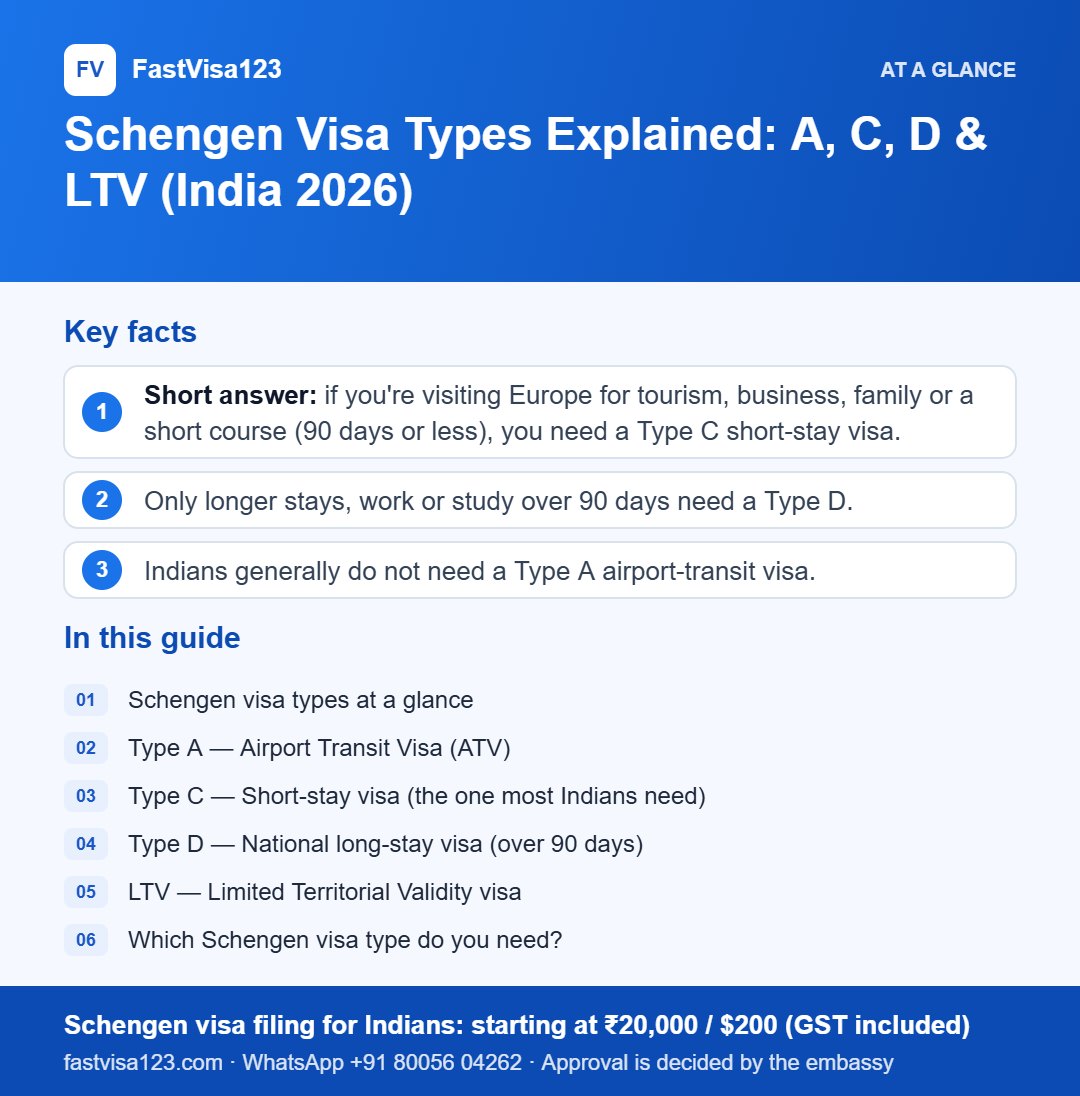
Short answer: if you’re visiting Europe for tourism, business, family or a short course (90 days or less), you need a Type C short-stay visa. Only longer stays, work or study over 90 days need a Type D. Indians generally do not need a Type A airport-transit visa.
Not sure which visa you need? FastVisa123 picks the right type and builds your full application — Starting at ₹20,000 / $200 (GST included).
Schengen visa types at a glance
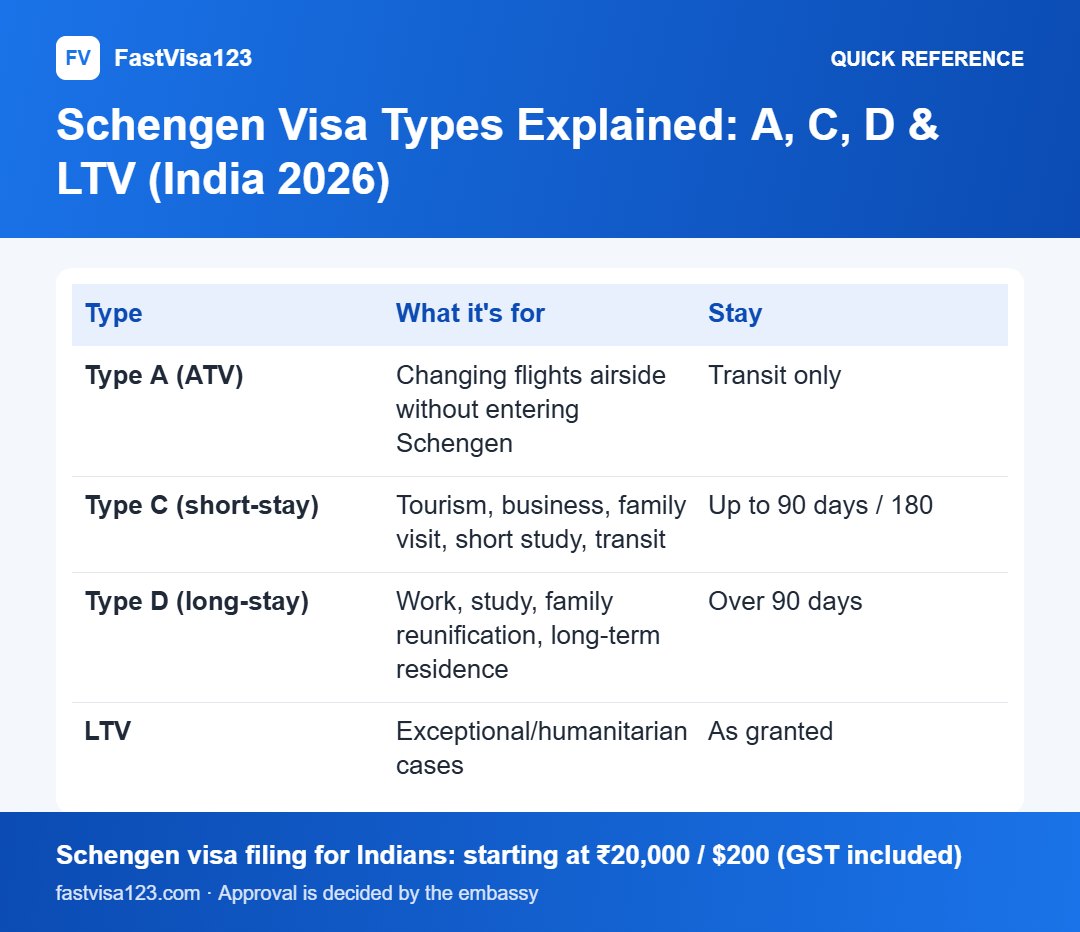
| Type | What it’s for | Stay | Coverage |
|---|---|---|---|
| Type A (ATV) | Changing flights airside without entering Schengen | Transit only | Airport transit zone |
| Type C (short-stay) | Tourism, business, family visit, short study, transit | Up to 90 days / 180 | All 29 Schengen countries |
| Type D (long-stay) | Work, study, family reunification, long-term residence | Over 90 days | The issuing country (+ short travel) |
| LTV | Exceptional/humanitarian cases | As granted | Specific country/countries only |
Type A — Airport Transit Visa (ATV)
The Type A visa lets certain travellers change planes in the international transit zone of a Schengen airport without entering the Schengen area. It is required only for nationals of a specific list of countries — and India is not on that list, so Indian passport holders generally do not need a Type A for airside transit. If you plan to leave the airport or enter Schengen during a layover, you need a Type C instead.
Type C — Short-stay visa (the one most Indians need)
The Type C is the “uniform” short-stay Schengen visa: one visa that lets you travel across all 29 Schengen countries for up to 90 days within any 180-day period. It covers most travel purposes, and it can be single-entry or multiple-entry. This is the visa our whole site is built around. Its main purposes are:
• Tourism — holidays and sightseeing; see our country tourist-visa guides.
• Business — meetings, conferences and trade fairs, with an invitation from the EU counterpart.
• Family/friends visit — visiting relatives, including our guide to a visa for parents & seniors.
• Short study — courses under 90 days; see our student-visa guide.
• Transit — passing through Schengen when you leave the airport or enter the area.
How long you can stay and whether you get single or multiple entries is explained in our 90/180-day rule guide, and repeat travellers can earn long validity through the cascade system.
Type D — National long-stay visa (over 90 days)
If you want to stay longer than 90 days — to work, study a full course, join family, or live in Europe (including digital-nomad visas) — you need a Type D national long-stay visa issued by that specific country. Unlike the Type C, it is country-specific, follows national rules, and usually leads to a residence permit. It’s a different application from the short-stay visa this site focuses on, so always check that country’s long-stay requirements.
LTV — Limited Territorial Validity visa
An LTV visa does not give free movement across all 29 countries — it restricts you to a specific country or countries. It is issued only in exceptional or humanitarian situations, or when your travel document isn’t recognised by every member state. Most travellers never encounter it.
Which Schengen visa type do you need?
• Holiday, business trip, family visit or short course (≤90 days)? → Type C short-stay.
• Only changing flights airside (and Indian passport)? → usually no visa needed (no Type A for Indians).
• Studying a full course, working, or moving to Europe (90+ days)? → Type D national long-stay.
• Told you qualify only for one or two countries in special circumstances? → LTV.
Schengen visa types: what to do vs what to avoid
Choosing the right category from the start.
✅ What to do
- Use Type C for any trip of 90 days or less
- Apply for Type D directly with the country for long stays
- Match the visa purpose to your real reason for travel
- Ask for multiple entry if you’ll re-enter Schengen
❌ What to avoid
- Use a short-stay Type C for a 6-month course or job
- Assume you need a Type A airport-transit visa
- Pick the wrong purpose on the form
- Overstay a Type C beyond 90/180
We’ll choose the right type and build the file. FastVisa123 — Starting at ₹20,000 / $200 (GST included).
How FastVisa123 helps
FastVisa123 makes sure you apply for the correct visa type and purpose from the start — almost always a Type C short-stay for Indian travellers — and builds your complete, embassy-ready application starting at ₹20,000 / $200 (GST included). New to the process? Start with our step-by-step first-timer guide.
Frequently asked questions
1. How many types of Schengen visa are there?
FastVisa123: There are four Schengen visa categories — Type A (airport transit), Type C (short stay), Type D (national long stay) and the LTV (limited territorial validity) visa. They differ mainly by how long you can stay and where the visa is valid. For almost every Indian visiting Europe for 90 days or less, the correct one is the Type C short-stay visa.
2. Which Schengen visa do most Indians need?
FastVisa123: Most Indian travellers need the Type C short-stay visa, which covers tourism, business, family visits and short courses of up to 90 days. It is a single visa that lets you move freely across all 29 Schengen countries. Only stays longer than 90 days, or actual work or full-time study, require a different visa type.
3. What is a Type C Schengen visa?
FastVisa123: The Type C is the uniform short-stay Schengen visa — one visa that is valid across all 29 member states. It allows you to stay up to 90 days within any 180-day period, for purposes like tourism, business or visiting family. It can be issued as single-entry or multiple-entry depending on your profile and travel history.
4. What is a Type D visa?
FastVisa123: A Type D is a national long-stay visa for stays longer than 90 days, used for work, full-time study, family reunification or moving to Europe. Unlike the Type C, it is issued by one specific country under its own rules and usually leads to a residence permit. It is a separate application from the short-stay visa this site focuses on.
5. Do Indians need a Type A airport-transit visa?
FastVisa123: Generally no — India is not on the list of nationalities that require a Type A visa to change planes inside a Schengen airport. So if you are only transiting airside on an Indian passport, you usually do not need any Schengen visa. If you plan to leave the airport or enter the Schengen area during a layover, you need a Type C instead.
6. When would I need a Type A visa?
FastVisa123: A Type A airport-transit visa is required only for nationals of a specific list of countries when they change flights in the international transit zone of a Schengen airport. It does not normally apply to Indian passport holders. Always confirm with your airline and the transit country if you are unsure about a particular route.
7. What is an LTV visa?
FastVisa123: An LTV (Limited Territorial Validity) visa restricts you to a specific country or countries rather than the whole Schengen area. It is issued only in exceptional or humanitarian situations, or when your travel document is not recognised by every member state. Most ordinary travellers never encounter it.
8. Is the tourist visa a separate type?
FastVisa123: No — a tourist visa is not a separate category; tourism is simply one purpose within the Type C short-stay visa. When you apply for a holiday in Europe, you are applying for a Type C with the purpose marked as tourism. The same Type C visa also covers business and family visits.
9. Is a business visa a different type?
FastVisa123: No — a Schengen business visa is also a Type C short-stay visa, just with the purpose stated as business and supported by an invitation letter from your EU counterpart. There is no separate short-stay business-visa category. A business assignment longer than 90 days would instead need a Type D.
10. Which type do I need to visit family in Europe?
FastVisa123: To visit relatives or friends in Europe you need a Type C short-stay visa with the purpose visiting family or friends. Your host usually provides an invitation letter and proof of their residence status. Our FastVisa123 guide for parents and seniors explains the family-visit documents in detail.
11. Which type is a short course or summer school?
FastVisa123: A short course, language programme or summer school under 90 days uses a Type C short-stay visa, applied for with your acceptance letter. If the course runs longer than 90 days, you instead need a Type D national study visa from that country. Our FastVisa123 student-visa guide covers the short-course route.
12. Can a Type C visa be multiple entry?
FastVisa123: Yes — a Type C visa can be single-entry or multiple-entry. A multiple-entry visa lets you leave and re-enter the Schengen area as often as you like during its validity, as long as you stay within the 90/180-day limit. Multiple entry and long validity are usually earned through a clean travel history.
13. How long can I stay on a Type C visa?
FastVisa123: A Type C visa allows up to 90 days within any rolling 180-day period, counted across all 29 Schengen countries together. The visa’s validity dates may be longer, but the actual days you can stay are capped at 90 per 180. Our FastVisa123 90/180-day rule guide explains exactly how to count this.
14. Does a Type D visa let me travel the whole Schengen area?
FastVisa123: A Type D is primarily for living in the issuing country, but it usually also lets you travel to other Schengen states for short periods within the 90/180-day limit. Its main purpose, though, is residence in that one country for study, work or family. It is not a substitute for a short-stay tourist visa.
15. Is a digital-nomad visa a Type C or Type D?
FastVisa123: A digital-nomad visa is a national long-stay (Type D) style permit offered by certain countries, not the short-stay Type C tourist visa. It lets you live in that country while working remotely, typically for a year or more. You cannot use a short-stay tourist visa to live and work in Europe.
16. Can I work on a Type C visa?
FastVisa123: No — the Type C short-stay visa is strictly for visits such as tourism, business meetings or family, not for taking up employment. Working on it, including remote work, is not permitted and can lead to serious consequences. To work in Europe you need a Type D work visa or permit.
17. Which type do I apply for to attend a conference?
FastVisa123: To attend a conference, trade fair or business meeting you apply for a Type C short-stay visa with the purpose marked as business. You support it with the event invitation, your employer’s letter and proof of funds. It is the same Type C visa, just with business-purpose documents.
18. What if my trip is exactly 90 days?
FastVisa123: A stay of exactly 90 days within a 180-day period is the maximum a Type C short-stay visa allows, so it still fits the short-stay category. Anything beyond 90 days moves you into Type D long-stay territory. Plan carefully so you do not accidentally exceed the limit.
19. Do all Schengen countries issue the same Type C visa?
FastVisa123: Yes — the Type C is a uniform visa, so a Type C issued by any member state is valid across all 29 Schengen countries. You still apply through the country that is your main destination, but once issued the visa works area-wide. The format and rules are standardised.
20. Can I change from a Type C to a Type D inside Europe?
FastVisa123: Generally no — you cannot simply convert a short-stay tourist visa into a long-stay one while in Europe. A Type D must be applied for through the relevant country’s process, often from your home country. If you know you will stay long-term, apply for the Type D from the start.
21. Which type do I need just to pass through a Schengen airport?
FastVisa123: As an Indian passport holder you usually need no visa for purely airside transit, because India is not on the Type A list. The moment you leave the airport or pass immigration into the Schengen area, however, you need a Type C visa. Check your specific route if you have a long or multi-stop layover.
22. How do I know which visa purpose to select on the form?
FastVisa123: Choose the genuine main reason for your trip — tourism, business, visiting family or short study — because the purpose must match your supporting documents. Picking the wrong purpose is a common, avoidable mistake. FastVisa123 confirms the correct purpose and aligns your whole file to it.
23. Can FastVisa123 tell me which type I need?
FastVisa123: Yes — we assess your trip and confirm the right visa type and purpose, which for Indian travellers is almost always a Type C short-stay visa. We then build your complete, embassy-ready application around it, for 20,000 rupees ($200, GST included).
24. Is 20,000 rupees ($200, GST included) the full cost?
FastVisa123: Yes for our professional service fee to prepare your application. Government and VFS charges — the 90 euro visa fee, the VFS service charge and your insurance — are separate and paid by you directly, with no hidden extras from FastVisa123.
Sources & methodology
The Schengen visa categories (Type A, C, D and LTV) are defined by the EU Visa Code and EU visa-policy pages, summarised by resources such as Schengen Visa Info. Airport-transit requirements depend on nationality; long-stay (Type D) rules are set nationally. Always confirm your destination consulate’s requirements.
Apply for your visa — FastVisa123 country guides
- Germany visa from India
- France visa from India
- Switzerland visa from India
- Italy visa from India
- Spain visa from India
FastVisa123 picks the right visa type and builds your application starting at ₹20,000 / $200 (GST included).
Official source: European Commission — official Schengen visa policy