If you’re self-employed, a freelancer, or work fully remotely, a Schengen visa feels harder to get — and it is, but only because you have to prove your income a different way. Salaried applicants hand over a salary slip and an employment letter; you don’t have those. The good news: thousands of self-employed Indians and remote workers get approved every year by showing documented income, proof that your work is real, and clear ties that bring you home. This guide explains exactly how — for registered business owners, freelancers with no business registration, and fully remote employees — with a declaration-letter template and a detailed FAQ.
No salary slip, no problem. FastVisa123 builds a self-employed or remote-worker file that proves your income the way consulates accept — Starting at ₹20,000 / $200 (GST included).
Why this profile faces extra scrutiny
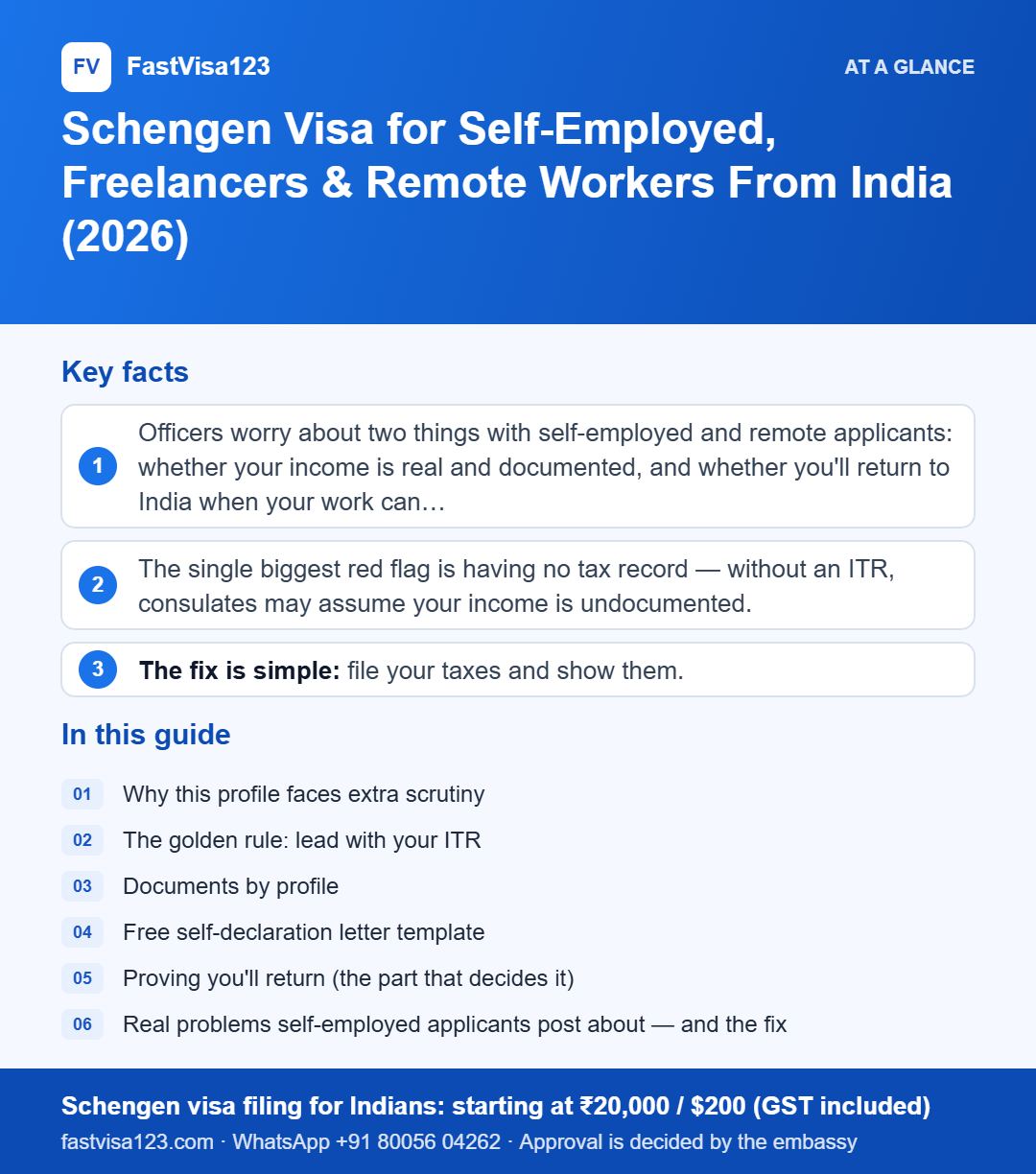
Officers worry about two things with self-employed and remote applicants: whether your income is real and documented, and whether you’ll return to India when your work can travel with you. The single biggest red flag is having no tax record — without an ITR, consulates may assume your income is undocumented. The fix is simple: file your taxes and show them.
The golden rule: lead with your ITR
Your Income Tax Return (ITR), ideally for 2–3 years, is the most powerful document you have, because it proves a declared, taxed income to a government — exactly what a consulate trusts. Even a modest declared income on an ITR beats a large but undocumented one. If you’ve never filed, that’s the first thing to fix before applying.
Documents by profile
1. Registered business owner
Show your business registration (GST certificate, Udyam, partnership deed, or MOA/AOA), 2–3 years of ITR, business and personal bank statements (6 months, steady), GST returns, and a professional licence if you have one (CA, doctor, lawyer). Add a declaration on your letterhead stating you own the business and will return to run it.
2. Freelancer with no business registration
You don’t need a registered company. Show your ITR filed as an individual, 3–6 months of bank statements with visible client payments, 10–15 recent invoices, client contracts or even email agreements, and your portfolio or website to prove the work is real. A clear self-declaration of your profession and average monthly income ties it together.
3. Fully remote worker / remote employee
If you work remotely for an Indian or foreign employer, show your employment contract, salary slips, bank statements showing salary credits, an employer letter with approved leave and a return-to-work date (a foreign employer’s letter is fine), and your ITR. Apply as a tourist: you’re visiting Europe on holiday, not relocating, and your job in India anchors your return.
Important: a short-stay Schengen tourist visa does not permit you to take up work in Europe. Continuing your existing remote job casually while on holiday is a grey area, so present the trip as tourism. If you actually want to live and work from Europe, that’s a separate national digital-nomad or long-stay (Type D) visa, not the short-stay visa covered here.
Free self-declaration letter template
Copy this, fill the brackets, print on your letterhead (or plain paper for unregistered freelancers), sign, and attach your ITR, bank statements and sample contracts:
[Date]
To: The Visa Officer, [Embassy/Consulate of country]
Subject: Self-employment & income declaration — [Your name], passport [No.]
I am self-employed as a [profession, e.g. freelance graphic designer / IT
consultant / business owner of (firm)], working with clients including
[client names/types]. My average monthly income over the past six months is
approximately [amount], as evidenced by my attached Income Tax Returns,
bank statements and client invoices/contracts.
I am visiting [country/countries] for tourism from [start date] to [end
date], funded from my own income and savings. I have ongoing client
commitments and deliverables due after [return date], along with [property
/ family / other ties] in India, and I will return to fulfil them.
I confirm all information is true.
[Signature]
[Your name]
Enclosures: ITR (years), bank statements, invoices/contracts, business
registration (if any), portfolio/website.
Proving you’ll return (the part that decides it)
Because your work is portable, you must make your return obvious. The strongest signals are ongoing contracts with deliverables dated after your trip, a registered business or office, property, family dependents, and consistent ITRs that show a life and income rooted in India. Frame your trip as a short break between projects that you’re coming back to finish.
Schengen visa for self-employed: what to do vs what to avoid
The difference between an approved and a refused self-employed file.
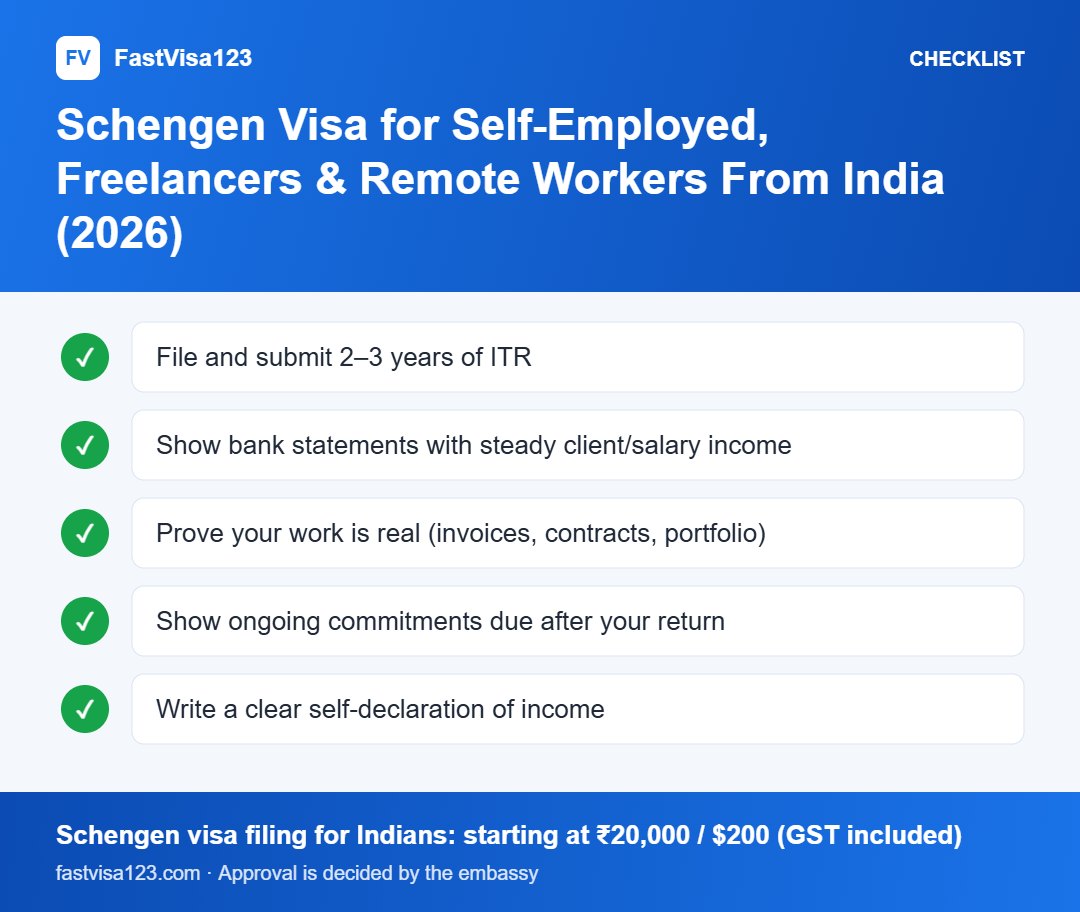
✅ What to do
- File and submit 2–3 years of ITR
- Show bank statements with steady client/salary income
- Prove your work is real (invoices, contracts, portfolio)
- Show ongoing commitments due after your return
- Write a clear self-declaration of income
❌ What to avoid
- Apply with no tax record at all
- Show a sudden lump sum instead of steady income
- Leave your work undocumented or vague
- Hint you may work or stay in Europe
- Ignore proof of ties to India
We make your income undeniable. FastVisa123 builds your self-employed or remote-worker file starting at ₹20,000 / $200 (GST included).
How FastVisa123 helps self-employed & remote applicants
FastVisa123 specialises in the harder profiles. We assemble your ITRs, bank statements, invoices, contracts and registration into a clear, consistent file, write your self-declaration and cover letter, and build a return-intent case around your ongoing work and ties to India — so your missing salary slip never becomes the reason for a refusal. For a fee starting at ₹20,000 / $200 (GST included). See also our FastVisa123 documents checklist and proof-of-funds guide.
Real problems self-employed applicants post about — and the fix
These are the worries people raise most often in visa communities. Here is the honest answer to each.
“I’m self-employed — won’t they just assume I won’t come back?”
FastVisa123: This is the number-one worry, and it is fair: because your work is portable, officers do look harder at return intent. You flip it by proving ongoing contracts with deliverables dated after your trip, plus property, family and consistent ITRs. Self-employment is not a rejection reason; weak return proof is.
“I have no registered business — what do I even submit?”
FastVisa123: You do not need a registered company. File your ITR as an individual and show 3-6 months of bank statements with visible client payments, 10-15 invoices, two or three solid contracts and your portfolio. A salaried person proves their job in two documents; you prove the same things in ten to fifteen, and that is completely normal.
“My income is different every single month — how do I show it?”
FastVisa123: Show the average over 6-12 months through your ITR and detailed bank statements. Consulates expect freelance income to fluctuate, so a steady pattern of credits over time matters far more than any single month.
“I started freelancing last month — am I doomed?”
FastVisa123: A brand-new business is the weakest case, but not hopeless. Ideally wait until you have one self-employed ITR; if you cannot, bridge the gap with your prior salaried history, current contracts, revenue proof and higher savings, all explained in your cover letter.
“I work remotely for a foreign company — can I just keep working from Europe?”
FastVisa123: Present the trip as tourism. A short-stay tourist visa is not a work permit, and working on it, even remotely for non-EU clients, is not allowed and can lead to deportation and bans. If you actually want to live and work from Europe, that is a separate digital-nomad or long-stay visa.
Frequently asked questions
1. Is being self-employed a reason for Schengen visa rejection?
FastVisa123: No. Self-employment is not a refusal ground; weak income proof or weak return intent is. Plenty of self-employed Indians are approved with the right documents.
2. Why do visa officers distrust self-employed applicants?
FastVisa123: Because your income is not on a payslip and your work is portable, so they worry it is undocumented or that you might not return. You counter both with ITR, client proof and strong ties.
3. What is the single most important document for me?
FastVisa123: Your ITR for 2-3 years, because it is a government-validated proof of declared income that carries more weight than anything else.
4. I have no business registration, what do I submit?
FastVisa123: You do not need registration. File your ITR as an individual and show 3-6 months of bank statements with client payments, 10-15 invoices, two or three solid contracts and a portfolio.
5. My income changes every month, how do I prove it?
FastVisa123: Show your average over 6-12 months via your ITR and detailed bank statements, because consulates expect freelance income to fluctuate.
6. How many client contracts should I include?
FastVisa123: Two or three significant, ongoing contracts are better than dozens of tiny ones; pick those showing established clients and good payment terms.
7. How many invoices should I show?
FastVisa123: Around 10-15 from the last six months, enough to demonstrate regular, real work.
8. Should I include an accountant’s certified statement?
FastVisa123: Yes if you can; a CA-certified income or accounts statement adds strong credibility alongside your ITR.
9. My clients are abroad and pay via PayPal or Wise, does that count?
FastVisa123: Yes; show the platform statements and the matching credits in your bank account, plus your ITR declaring that income.
10. Do I need a GST number?
FastVisa123: Only if your business legally requires it; many freelancers are approved with just an individual ITR and client proof.
11. I just left a salaried job to freelance, how do I show stability?
FastVisa123: Show your previous employment history alongside current contracts and savings, so the officer sees a credible career transition rather than a gap.
12. My business is less than a year old, am I doomed?
FastVisa123: It is the weakest case but not hopeless; ideally wait for one self-employed ITR, or compensate with strong contracts, revenue proof and higher savings, explained in your cover letter.
13. Is there a minimum income for self-employed applicants?
FastVisa123: There is no fixed figure, but your funds must comfortably cover the trip and look consistent with your ITR and bank history.
14. My ITR income is low but my bank balance is healthy, is that ok?
FastVisa123: It can work, but be ready to explain where the funds came from, because money that does not match your declared income raises doubts.
15. Can I show savings instead of income?
FastVisa123: Savings help, but officers want to see income too; a healthy balance with no visible earning pattern looks weaker than steady income plus savings.
16. How do I write a freelancer cover letter?
FastVisa123: It must do the heavy lifting a payslip normally would: state your profession, average income, how you fund the trip, your ongoing commitments and why you will return. See our FastVisa123 cover-letter guide.
17. Should I include my website, portfolio or LinkedIn?
FastVisa123: Yes; they are simple, powerful proof that your work and clients are real.
18. Can gig or app-based workers apply?
FastVisa123: Yes; show your platform earnings statements, bank credits and ITR as proof of regular income.
19. I am a content creator or YouTuber, what do I show?
FastVisa123: Show your platform payout statements such as AdSense and brand deals, bank credits, ITR and any contracts; it is treated like any other freelance income.
20. I work remotely for a foreign company, is a foreign offer letter and payslips enough?
FastVisa123: Largely yes; add your contract, salary credits in your bank statement, an employer letter with approved leave, and your ITR, then apply as a tourist.
21. Do I need an Indian employer to apply as a remote worker?
FastVisa123: No; a foreign remote employer is fine as long as you document the role, salary and leave, and show ties to India.
22. Can I just keep working remotely while I am in Europe?
FastVisa123: No. A tourist visa is not a work permit, and working on it even remotely for non-EU clients is not allowed and can lead to deportation and bans, so present the trip as tourism.
23. Should I get a digital nomad visa instead?
FastVisa123: If you actually want to live and work from Europe, yes; several countries offer national digital-nomad or long-stay visas, separate from the short-stay tourist visa.
24. The officer thinks self-employed means I will not return, how do I fix that?
FastVisa123: Flip it with proof: ongoing contracts with deliverables dated after your trip, property, family and consistent ITRs that root your income and life in India.
25. How do I prove ties to India as a freelancer?
FastVisa123: Through your registered business or office, property, family dependents, fixed deposits, and contracts you must return to fulfil.
26. Which Schengen country is easiest for self-employed applicants?
FastVisa123: There is no magic country; a strong, consistent file matters far more, though you must apply where you will spend the most nights.
27. Can a family member sponsor me if my income is modest?
FastVisa123: Yes; a sponsor can support your funds with their documents and a sponsorship letter, but showing your own income remains stronger.
28. How much bank balance should I keep?
FastVisa123: Enough to cover the trip comfortably, held steadily and matching your declared income, and avoid sudden large deposits.
29. Will a sudden deposit before applying hurt me?
FastVisa123: Yes; an unexplained lump sum looks like borrowed money and is a leading refusal trigger, so show genuine steady funds.
30. How far in advance should self-employed applicants apply?
FastVisa123: About 6-8 weeks before travel, leaving time to gather ITRs, contracts and statements and to book a VFS slot.
31. Does a previous refusal hurt my self-employed reapplication?
FastVisa123: It can, so the next file must be visibly stronger and fix the cited reason; our FastVisa123 rejection and appeal guides explain how.
32. Can I get a multiple-entry visa as a freelancer?
FastVisa123: Yes, especially with a clean travel history and strong documents, since it rewards a credible well-evidenced application.
33. What if I have foreign-currency income?
FastVisa123: Show it in your bank statements with conversions and declare it in your ITR; consistent documented foreign income is perfectly acceptable.
34. Do I need to show profit, or is revenue enough?
FastVisa123: Show both where possible; your ITR reflects taxable income and bank statements show cash flow, which together paint the full picture.
35. Can students who freelance apply on freelance income?
FastVisa123: Students usually apply with a sponsor, but freelance income and ITR can support the file; see our FastVisa123 student-visa guide.
36. I am a consultant billing one big client, is that risky?
FastVisa123: It is fine if documented; show the contract, invoices and payments, and ideally evidence the relationship is ongoing.
37. What if I can only get emails, not formal contracts?
FastVisa123: Email agreements are accepted as proof of work; keep them clear on scope, dates and payment.
38. Should I over-submit documents to be safe?
FastVisa123: Submit strong relevant proof, not a flood of tiny items; two or three solid contracts beat twenty trivial ones.
39. My spouse is salaried, can we apply together?
FastVisa123: Yes; a salaried co-applicant’s documents and joint funds can strengthen a family application, with each person’s file consistent.
40. Do I need travel insurance like everyone else?
FastVisa123: Yes; the same 30,000 euro cover applies, as our FastVisa123 travel insurance guide explains.
41. Will the consulate call my clients or check my business?
FastVisa123: They may verify details, so everything you submit must be genuine and consistent, and you should never fabricate contracts or income.
42. Is a longer trip harder to justify for self-employed?
FastVisa123: A longer trip needs more funds and a clearer story about who covers your work while away, so keep the plan realistic.
43. What is the biggest mistake self-employed applicants make?
FastVisa123: Applying with no tax record or undocumented income; filing and showing your ITR fixes the most common cause of refusal.
44. Can FastVisa123 build my self-employed or remote-worker file?
FastVisa123: Yes; we assemble your income proof, declaration, cover letter and return-intent case into one consistent application, for 20,000 rupees ($200, GST included).
45. Is 20,000 rupees ($200, GST included) the full cost?
FastVisa123: It is our starting service fee, set by the scope of your case; the 90 euro visa fee, VFS charge and insurance are separate and paid by you.
Sources & methodology
Document requirements for self-employed, freelance and remote applicants follow consular checklists and the EU Visa Code, with community pain points and proof strategies summarised from resources such as SchengenVisaSupport and applicant Q&A. A short-stay visa does not permit employment in Europe; always verify your destination consulate’s self-employed checklist before applying.
Apply for your visa — FastVisa123 country guides
- Germany visa from India
- France visa from India
- Switzerland visa from India
- Italy visa from India
- Spain visa from India
FastVisa123 builds your self-employed or remote-worker application starting at ₹20,000 / $200 (GST included).
Not sure which income documents to show? See how to show ITR & income proof.
Official source: European Commission — official Schengen visa policy