Heading to Europe for a summer school, language course, workshop or short exchange? If your programme is under 90 days, you don’t need a full study permit — you need a short-stay Schengen student visa (Type C), applied for much like a tourist visa but with an acceptance letter at its core. This FastVisa123 guide covers the short-course Schengen student visa from India in 2026: who needs it, the exact documents, funds and insurance, how to apply, and brief answers to the questions students ask most.
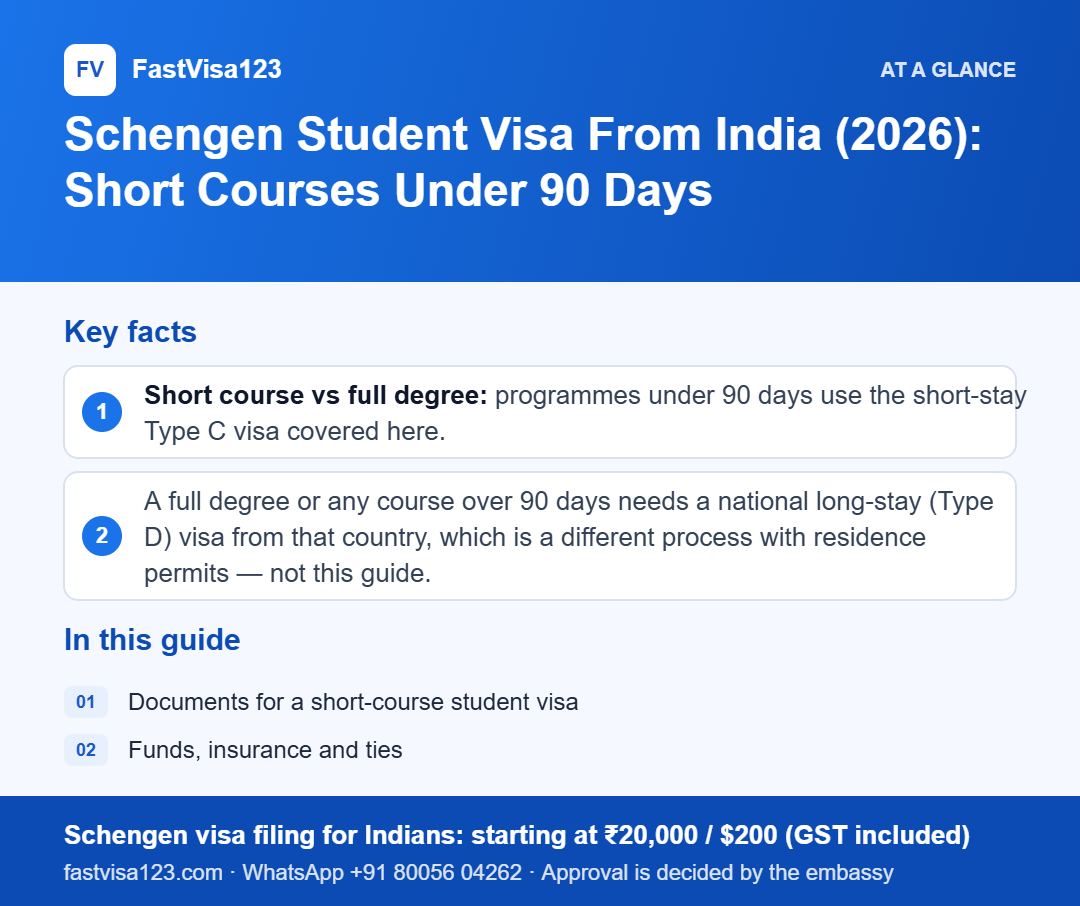
Short course vs full degree: programmes under 90 days use the short-stay Type C visa covered here. A full degree or any course over 90 days needs a national long-stay (Type D) visa from that country, which is a different process with residence permits — not this guide.
Got your acceptance letter? We’ll handle the rest. FastVisa123 builds your complete student-visa file — Starting at ₹20,000 / $200 (GST included).
Documents for a short-course student visa
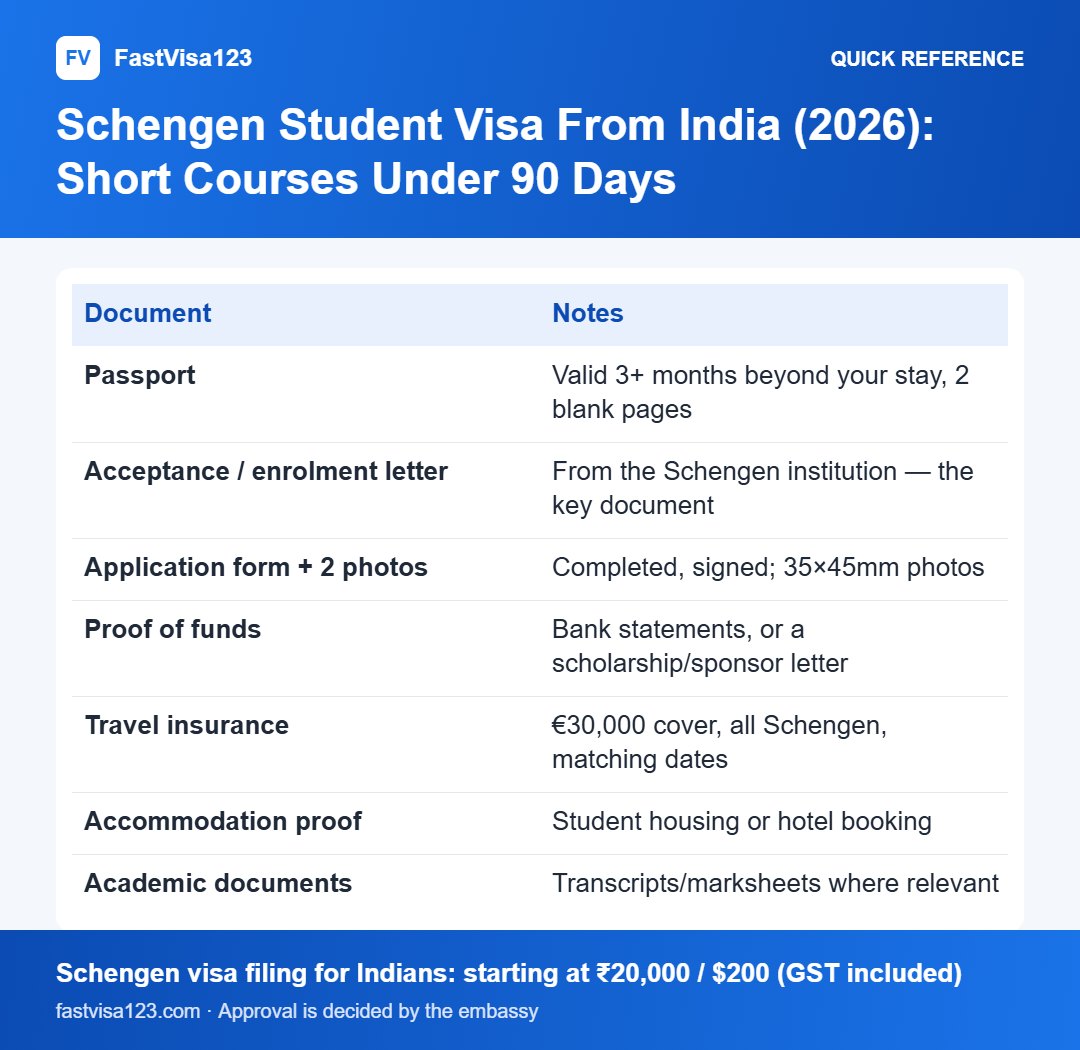
| Document | Notes |
|---|---|
| Passport | Valid 3+ months beyond your stay, 2 blank pages |
| Acceptance / enrolment letter | From the Schengen institution — the key document |
| Application form + 2 photos | Completed, signed; 35×45mm photos |
| Proof of funds | Bank statements, or a scholarship/sponsor letter |
| Travel insurance | €30,000 cover, all Schengen, matching dates |
| Accommodation proof | Student housing or hotel booking |
| Academic documents | Transcripts/marksheets where relevant |
| Ties to India | Proof you’ll return after the course |
Some consulates also ask for a police clearance certificate. Apply to the country where you’ll study, 3–6 weeks ahead.
Funds, insurance and ties
You must show enough money to cover tuition, living and accommodation — through your own statements or a sponsor (often a parent) with a sponsorship letter and proof of relationship. Insurance must be the standard €30,000 cover; see our FastVisa123 travel insurance guide. As with any short-stay visa, you must show proof of funds and clear ties to India so the officer is confident you’ll return.
Schengen student visa: what to do vs what to avoid
For a smooth short-course application.
✅ What to do
- Use Type C for courses under 90 days
- Lead with a clear acceptance letter
- Show funds or a sponsor for the full cost
- Prove ties to India and your study plan
❌ What to avoid
- Use Type C for a course over 90 days
- Apply without a confirmed enrolment
- Show only a sudden lump-sum deposit
- Hint that you plan to stay on
Transparent pricing from ₹20,000 / $200 (GST included), embassy-ready student file. FastVisa123 — Starting at ₹20,000 / $200 (GST included).
How FastVisa123 helps students
FastVisa123 builds your short-course student-visa file end to end — matching your acceptance letter, funds, insurance and ties to India into one consistent application, and choosing the right consulate. For a fee starting at ₹20,000 / $200 (GST included); government and VFS fees are separate.
Frequently asked questions
1. Which visa do I need for a short course in Europe?
FastVisa123: a short-stay Type C Schengen student visa, for programmes under 90 days.
2. What if my course is longer than 90 days?
FastVisa123: then you need a national long-stay (Type D) study visa from that country — a different process.
3. What is the most important document?
FastVisa123: the acceptance or enrolment letter from your Schengen institution.
4. How much money do I need to show?
FastVisa123: enough to cover tuition, living and accommodation, via your statements or a sponsor.
5. Can a parent sponsor me?
FastVisa123: yes, with their financial documents, a sponsorship letter and proof of relationship.
6. Do I need travel insurance?
FastVisa123: yes — €30,000 cover, valid in all Schengen states, matching your dates.
7. Which country do I apply to?
FastVisa123: the country where your course takes place.
8. How long does it take?
FastVisa123: usually 15–30 days; apply 3–6 weeks ahead, more in busy academic periods.
9. Do I need to show ties to India?
FastVisa123: yes — you must show you’ll return after the course, like any short-stay visa.
10. Do I need academic transcripts?
FastVisa123: usually yes, marksheets or transcripts relevant to your programme.
11. Is a police clearance certificate required?
FastVisa123: some consulates ask for one — check your destination’s checklist.
12. Can I work during a short course?
FastVisa123: a Type C study visa is not a work visa; don’t plan to work on it.
13. Can I travel to other Schengen countries during my course?
FastVisa123: yes, within the visa’s validity and the 90/180-day limit.
14. Do biometrics apply?
FastVisa123: yes, the same as any Schengen visa, and they’re reusable for five years.
15. Can I convert a short course visa to a long stay?
FastVisa123: no — for longer study you must apply for the national Type D visa separately.
16. What if I’m a minor student?
FastVisa123: minors also need parental consent letters and a birth certificate — see our minors guide.
17. Does FastVisa123 handle student files?
FastVisa123: yes — we build your complete short-course application starting at ₹20,000 / $200 (GST included).
18. Is ₹20,000+ / $200+ (GST included) the full cost?
FastVisa123: it’s our starting service fee; the €90 visa fee, VFS charge and insurance are separate.
Sources & methodology
Short-stay study visa requirements follow the EU Visa Code and consular checklists, summarised by resources such as SchengenVisaSupport. Long-stay (Type D) study visas are governed by national rules. Always confirm your destination consulate’s checklist.
Apply for your visa — FastVisa123 country guides
- Germany visa from India
- France visa from India
- Switzerland visa from India
- Italy visa from India
- Spain visa from India
FastVisa123 builds your short-course student application starting at ₹20,000 / $200 (GST included).
Official source: European Commission — official Schengen visa policy