A child’s Schengen visa is usually refused for one avoidable reason: a missing or wrong parental consent letter. Minors (under 18) need everything an adult does, plus extra documents that prove who has custody and who has permitted the trip. This FastVisa123 guide explains the Schengen visa for minors and children from India in 2026 — the birth certificate, the consent letter for every travel scenario, and the rules that catch parents out — with brief answers to the most common questions.
The two documents that matter most: the child’s birth certificate (original + copy, with parents’ names matching their passports), and a notarised parental consent letter whenever the child travels with one parent, a guardian, or alone.
Travelling with your kids? FastVisa123 prepares the child’s full file, including the consent letter, so nothing is missed — Starting at ₹20,000 / $200 (GST included).
Consent letter by travel scenario
| Who the child travels with | Consent needed |
|---|---|
| Both parents | Usually no separate consent; both sign the forms |
| One parent only | Notarised consent from the non-travelling parent |
| A guardian / relative | Notarised consent from both parents |
| Unaccompanied (alone) | Notarised consent from both parents/guardians |
| Single parent (sole custody) | Proof of sole custody instead of the other parent’s consent |
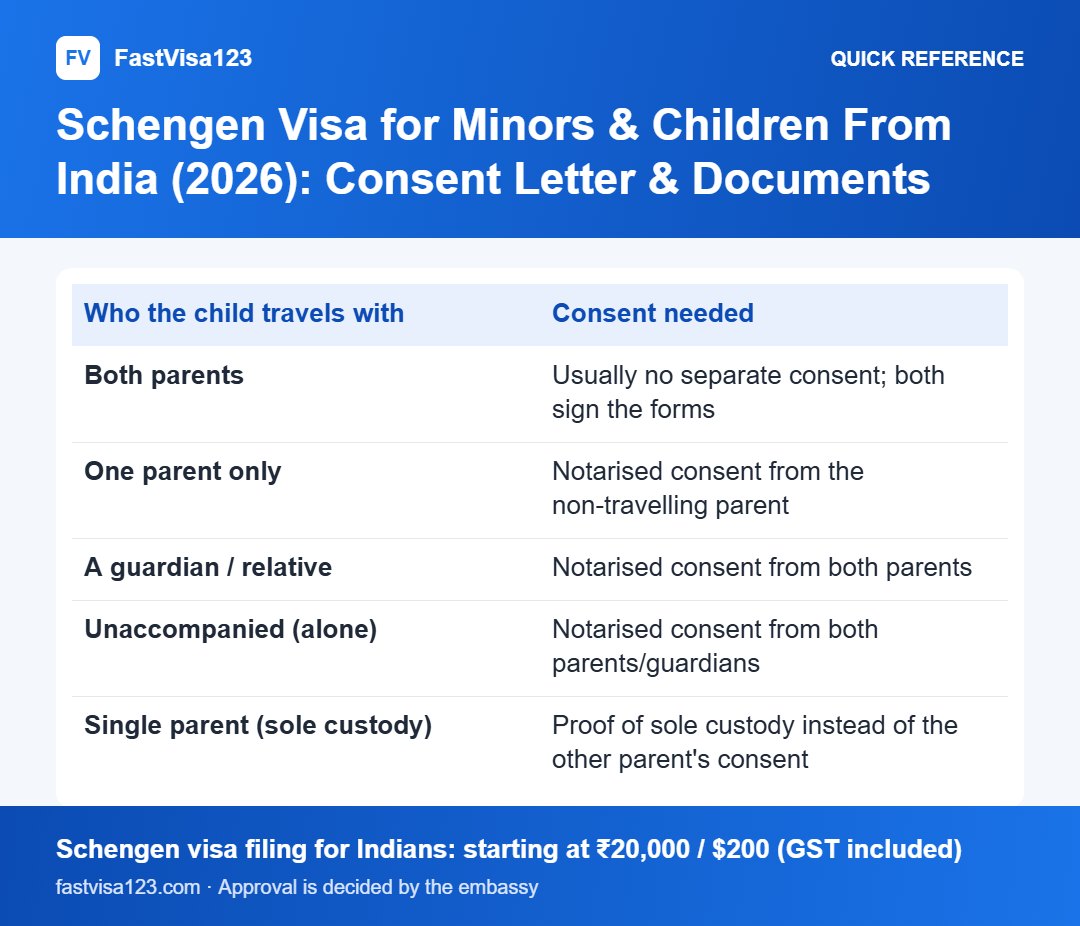
Notarisation, legalisation or in-person signing rules vary by country — always check your consulate’s checklist first.
Documents for a minor’s application
Alongside the standard documents, a minor needs: the birth certificate (original + clear copy), passport copies of both parents, the application form signed by both parents (Germany is strict on this), the relevant consent letter, and proof of who funds the trip (usually the parents). Insurance and accommodation rules are the same as for adults — see our FastVisa123 documents checklist.
Schengen visa for minors: what to do vs what to avoid
Get the child’s file right the first time.
✅ What to do
- Get the right consent for the travel scenario
- Notarise the consent letter
- Submit the birth certificate (original + copy)
- Match parents’ names exactly across documents
❌ What to avoid
- Skip the non-travelling parent’s consent
- Use an unsigned or un-notarised letter
- Mismatch names on certificate vs passport
- Assume rules are identical in every country
We make sure the consent letter is right. FastVisa123 — Starting at ₹20,000 / $200 (GST included).
How FastVisa123 helps with children’s visas
FastVisa123 prepares the child’s complete file — the correct consent letter for your exact travel situation, the birth certificate, both parents’ documents and proof of funds — so the application isn’t refused on a technicality. For a fee starting at ₹20,000 / $200 (GST included); government and VFS fees are separate.
Frequently asked questions
1. Do children need their own Schengen visa?
FastVisa123: yes — every minor needs their own visa and their own application.
2. What’s the most common reason a child’s visa is refused?
FastVisa123: a missing or incorrect parental consent letter.
3. When is a consent letter required?
FastVisa123: whenever the child travels with one parent, a guardian, or alone.
4. Does the consent letter need to be notarised?
FastVisa123: usually yes, and some consulates also require legalisation or in-person signing.
5. What if only one parent is travelling?
FastVisa123: the non-travelling parent must give notarised consent.
6. What if the child travels with a relative or alone?
FastVisa123: both parents must give notarised consent.
7. Is a birth certificate required?
FastVisa123: yes — original plus a copy, with parents’ names matching their passports.
8. What if I’m a single parent with sole custody?
FastVisa123: submit proof of sole custody instead of the other parent’s consent.
9. Who signs the application form for a minor?
FastVisa123: both parents/guardians sign; Germany is especially strict on this.
10. Do I need both parents’ passport copies?
FastVisa123: yes, copies of both parents’ passports or IDs are usually required.
11. Who shows the funds for a child?
FastVisa123: the parents, as the child’s sponsors, with their financial documents.
12. Does a child need travel insurance?
FastVisa123: yes — the same €30,000 cover, valid in all Schengen states.
13. Do children pay the visa fee?
FastVisa123: 6–12 year-olds pay a reduced fee; under-6s are usually exempt from the embassy fee.
14. Do minors give biometrics?
FastVisa123: children under 12 are generally exempt from fingerprints; older minors give them.
15. Does the consent letter format differ by country?
FastVisa123: yes — notarisation and signing rules vary, so check the consulate’s checklist.
16. Can grandparents take a child to Europe?
FastVisa123: yes, with both parents’ notarised consent naming the grandparents.
17. Does FastVisa123 prepare the consent letter?
FastVisa123: yes — we draft the right consent letter and the child’s full file.
18. Is ₹20,000+ / $200+ (GST included) the full cost?
FastVisa123: it’s our starting service fee; the visa fee, VFS charge and insurance are separate.
Sources & methodology
Minor-applicant rules follow consular checklists and the EU Visa Code, including the German Federal Foreign Office checklist and minor-specific guidance from visa resources. Consent, notarisation and custody rules vary by country — always confirm your destination consulate’s requirements.
Apply for your visa — FastVisa123 country guides
- Germany visa from India
- France visa from India
- Switzerland visa from India
- Italy visa from India
- Spain visa from India
FastVisa123 prepares your child’s full application starting at ₹20,000 / $200 (GST included).
One-word name or spelling mismatch? See single name or name mismatch on your visa.
Official source: European Commission — official Schengen visa policy