Travel medical insurance is mandatory for every Schengen applicant, and the requirement does not change with age: €30,000 of medical cover including repatriation, valid across all Schengen states, for the full trip. What changes for applicants over 60 is the market. Standard Indian travel policies stop at 60 or 70, senior plans cost several times more, and pre-existing conditions are the difference between a policy that satisfies the consulate and one that actually pays a hospital in Munich.
This guide covers what the consulate checks, which kinds of policies are accepted at which ages, what they cost in 2026, and the mistakes that get a parent’s application refused on box 16.
What the consulate checks on the certificate
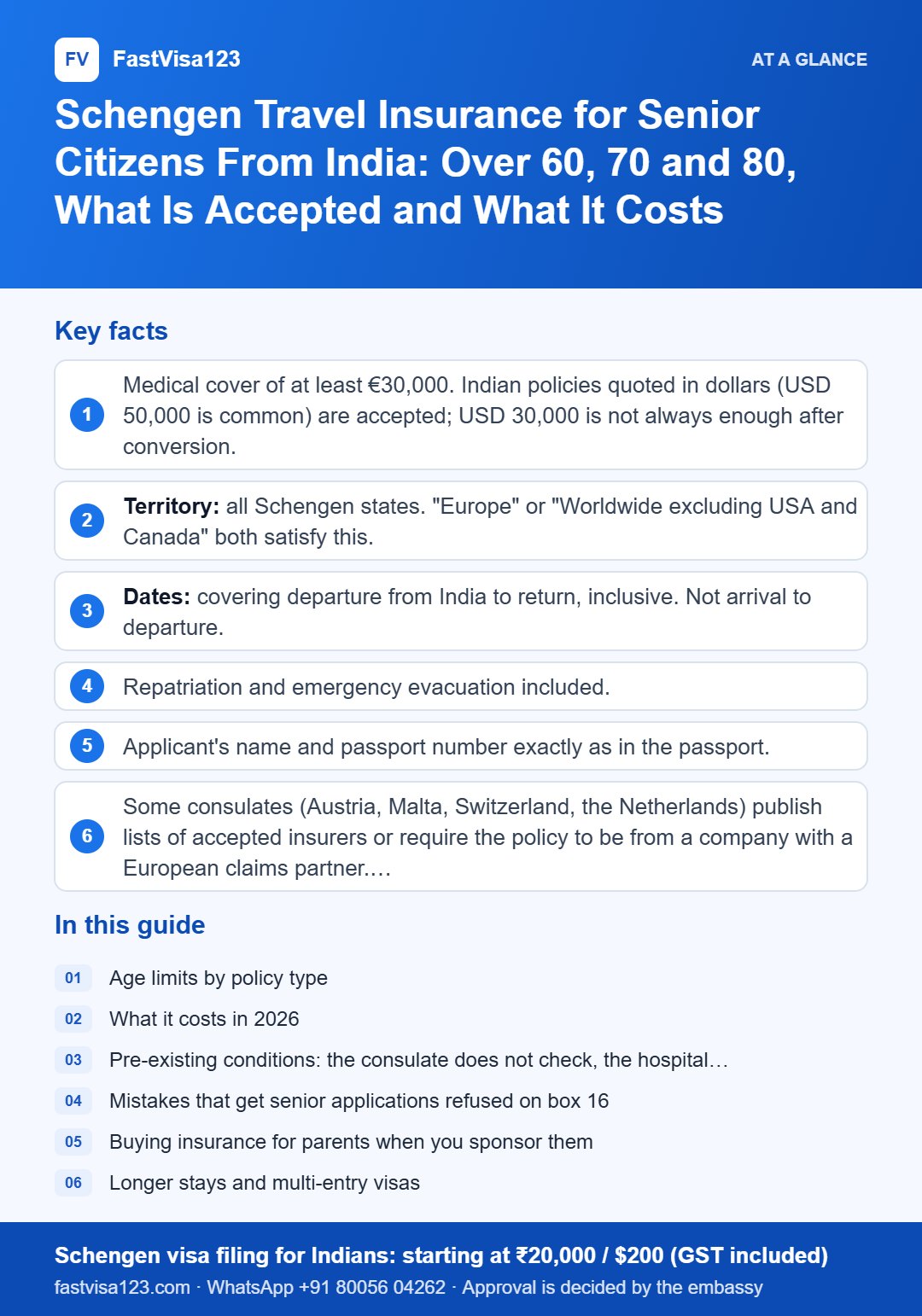
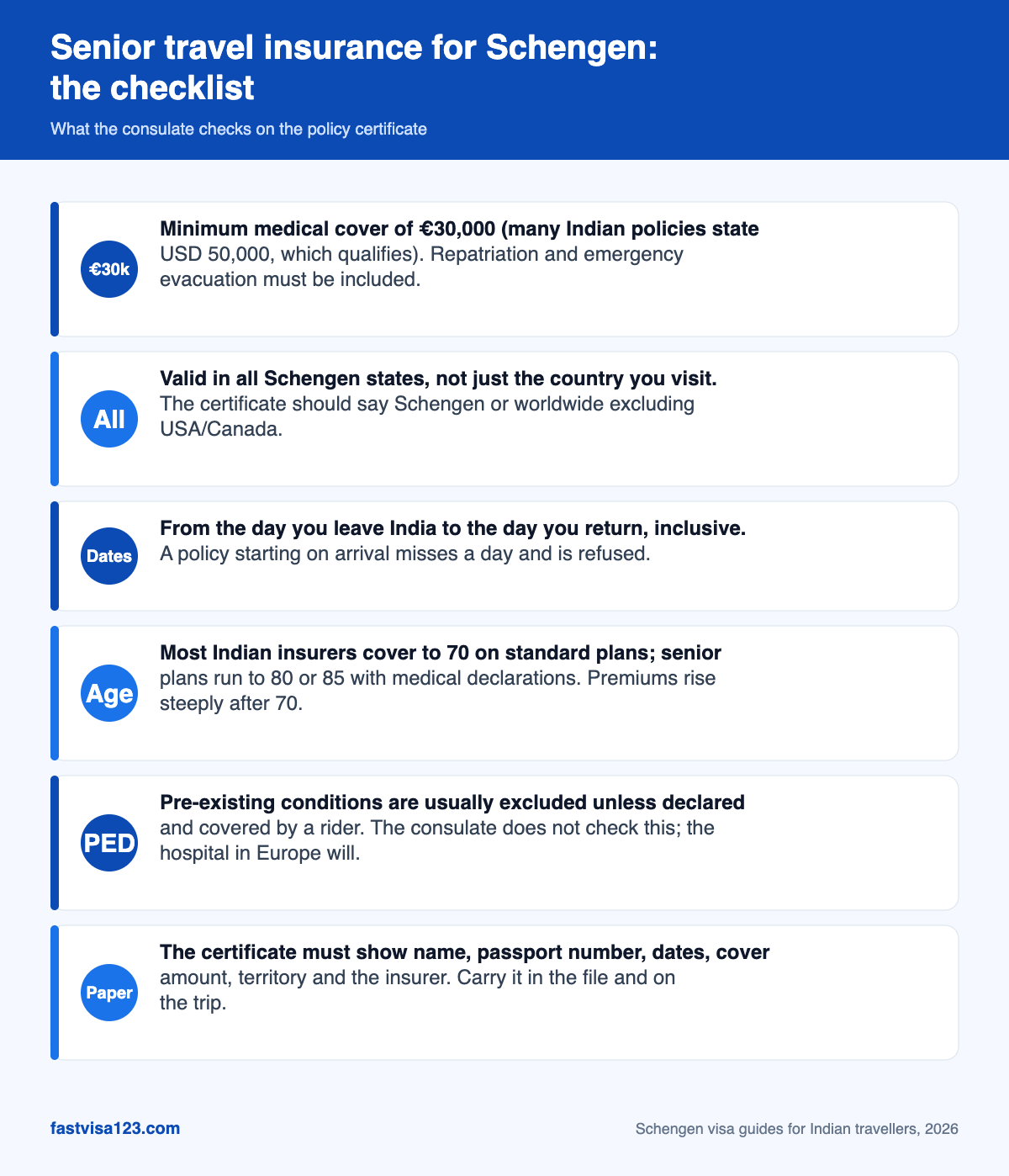
- Medical cover of at least €30,000. Indian policies quoted in dollars (USD 50,000 is common) are accepted; USD 30,000 is not always enough after conversion.
- Territory: all Schengen states. “Europe” or “Worldwide excluding USA and Canada” both satisfy this.
- Dates: covering departure from India to return, inclusive. Not arrival to departure.
- Repatriation and emergency evacuation included.
- Applicant’s name and passport number exactly as in the passport.
- Some consulates (Austria, Malta, Switzerland, the Netherlands) publish lists of accepted insurers or require the policy to be from a company with a European claims partner. Check the checklist.
Age limits by policy type
| Policy type | Typical age range | Medical declaration | Notes |
|---|---|---|---|
| Standard single-trip travel policy (Indian insurers) | Up to 60 or 70 | Usually none below 60 | Cheapest; check the Schengen wording on the certificate |
| Senior citizen travel policy | 61 to 80, some to 85 or 90 | Health questionnaire; sometimes a doctor’s certificate | Higher premium; pre-existing cover available as a rider on some |
| Family floater covering parents | Varies; parents often capped at 70 | As above for the senior member | Convenient for a family trip; confirm the senior’s cover is individually €30,000 |
| European insurer’s Schengen policy bought online | Often to 85 or no limit | Minimal | Accepted everywhere; claims handled in Europe; premiums higher for seniors but transparent |
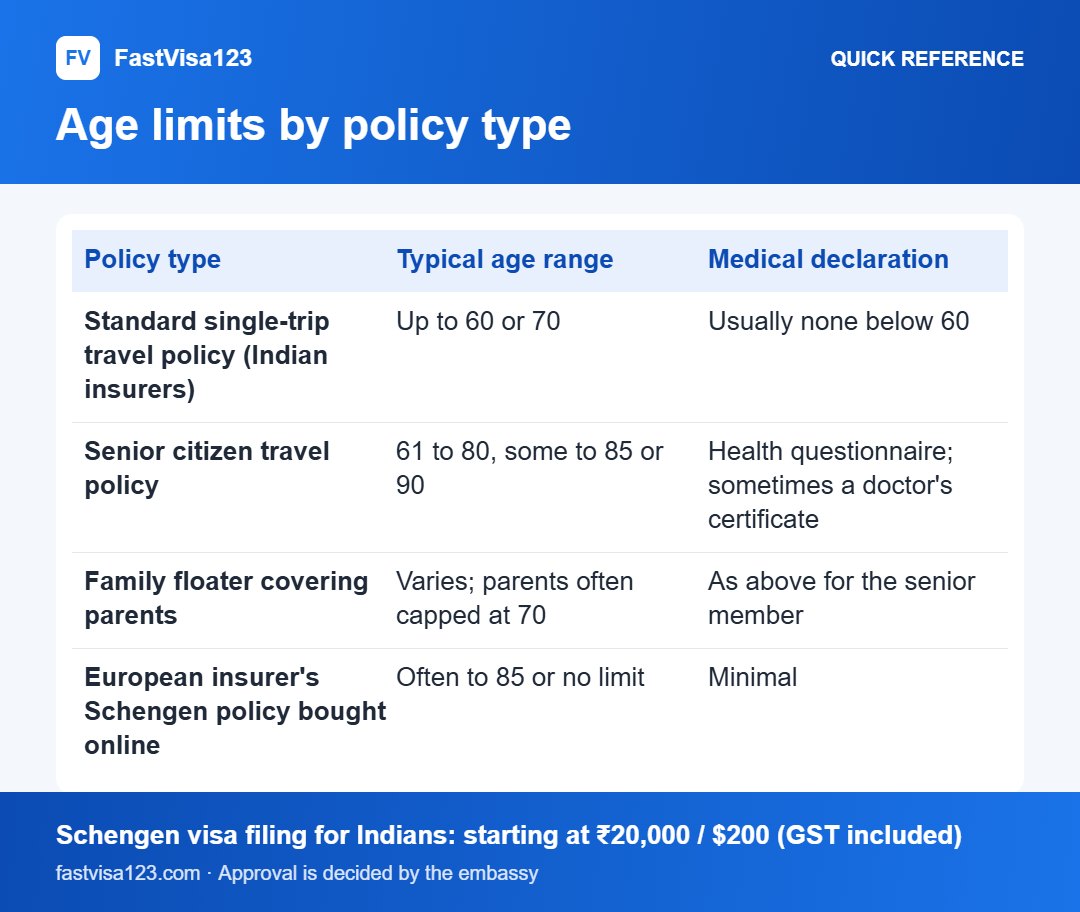
Most major Indian insurers (public and private) sell senior plans that satisfy the Schengen requirement. The certificate wording matters more than the brand: it must state the cover amount, Schengen validity, dates and repatriation on one page.
What it costs in 2026
Indicative premiums for a 15-day trip, €30,000-equivalent medical cover, no pre-existing rider:
| Age | Typical premium, 15 days | With pre-existing condition rider (where offered) |
|---|---|---|
| Under 60 | ₹1,200 to ₹2,000 | Rarely offered or needed |
| 61 to 70 | ₹2,500 to ₹5,000 | ₹4,000 to ₹8,000 |
| 71 to 80 | ₹5,000 to ₹12,000 | ₹9,000 to ₹18,000 |
| 81 and over | ₹10,000 to ₹25,000, limited insurers | Often unavailable |
Premiums scale with trip length; a 30-day family visit at 75 can cost ₹15,000 to ₹25,000. That is a small fraction of a European hospital bill, which is the reason the requirement exists.
Pre-existing conditions: the consulate does not check, the hospital does
The consulate verifies amount, territory and dates. It does not ask whether the policy covers a parent’s diabetes, hypertension or cardiac history. A standard policy excludes pre-existing conditions, which means it satisfies the visa and then pays nothing if the condition causes a hospital admission in Europe. For a parent with any chronic condition, buy a senior plan with a pre-existing disease rider, declare everything honestly on the questionnaire, and keep the declaration with the policy. This is not a visa point; it is the difference between a covered emergency and a ₹20 lakh bill.
Mistakes that get senior applications refused on box 16
Refused
Policy starts on the arrival date, missing the outbound travel day. Cover stated as USD 30,000 (converts to under €30,000 some months). Certificate says “India and worldwide” without naming Schengen or Europe. Applicant’s age above the policy’s limit, so the certificate is void. Name spelt differently from the passport.
Accepted
Cover €30,000 or USD 50,000 stated on the certificate. “Schengen” or “Worldwide excluding USA/Canada” territory. Dates from departure from India to return, inclusive, with a day’s margin each side. Repatriation named. Insurer on the consulate’s accepted list where one exists.
Buying insurance for parents when you sponsor them
A child in Europe sponsoring parents’ visit can buy the policy from a European insurer in the parents’ names; this is common and accepted. The certificate must still carry the parents’ names and passport numbers and satisfy the amount, territory and dates. Include it in the parents’ files with the sponsorship documents; see our parents and seniors guide and the family-visit cover letter.
Longer stays and multi-entry visas
For a multi-entry visa, the consulate needs insurance for the first trip only; you must buy cover for each later trip yourself (and border officers under EES may ask for it). For a single long stay, the policy must cover every day up to the 90-day maximum. If a parent’s stay is extended in Europe for a medical reason, extend the policy from Europe before it lapses; most insurers allow it by email.
A checklist for the policy certificate
- Full name and passport number as in the passport.
- Cover amount: €30,000 or more (or USD 50,000).
- Territory: Schengen, Europe, or worldwide excluding USA/Canada.
- Start date: day of departure from India. End date: day of return, or later.
- Repatriation of remains and emergency medical evacuation listed.
- Insurer name, policy number and a 24-hour assistance phone number.
- For seniors: age at travel within the policy’s limit; any pre-existing declaration attached.
Our general Schengen insurance guide covers the €30,000 rule for all ages.
Parents visiting Europe? We build their file with the right insurance
We check the policy certificate against the consulate checklist, prepare the sponsorship documents and file the complete application. Starting at ₹20,000 / $200 (GST included) per applicant.
Frequently asked questions
Is travel insurance mandatory for senior citizens applying for a Schengen visa?
Yes, for every applicant of any age: at least €30,000 medical cover with repatriation, valid in all Schengen states, for the whole trip.
Can a 75-year-old get Schengen travel insurance from India?
Yes. Several Indian insurers sell senior plans to 80 or 85 with a health questionnaire, and European insurers sell Schengen policies with higher or no age limits.
How much does senior travel insurance cost for Europe?
For a 15-day trip in 2026, roughly ₹2,500 to ₹5,000 at 61 to 70 and ₹5,000 to ₹12,000 at 71 to 80, more with a pre-existing condition rider.
Does the consulate check pre-existing condition cover?
No. It checks amount, territory and dates. Pre-existing cover matters when a hospital in Europe asks who is paying; buy the rider for any parent with a chronic condition.
Is USD 50,000 cover accepted instead of €30,000?
Yes. USD 50,000 comfortably exceeds €30,000. USD 30,000 may fall short after conversion and is risky.
Can my child in Europe buy the insurance for me?
Yes. A policy from a European insurer in your name, meeting the amount, territory and dates, is accepted. Include it with the sponsorship documents.