A “new filing” is any Schengen application that is not a straight repeat of a previous successful one: your first ever application, a fresh application after a refusal, a first application on a new passport, or a first application for a new travel purpose. Consulates look at these files more carefully than at a repeat applicant with a clean history, and the majority of Indian refusals (15.8% of all applications in 2025) fall on exactly these files.
This guide is the complete process for a fresh filing from India in 2026: what to decide first, what to gather, in what order, and how long it takes. If you are reapplying after a refusal, read this alongside our reapply guide, which covers what to change.
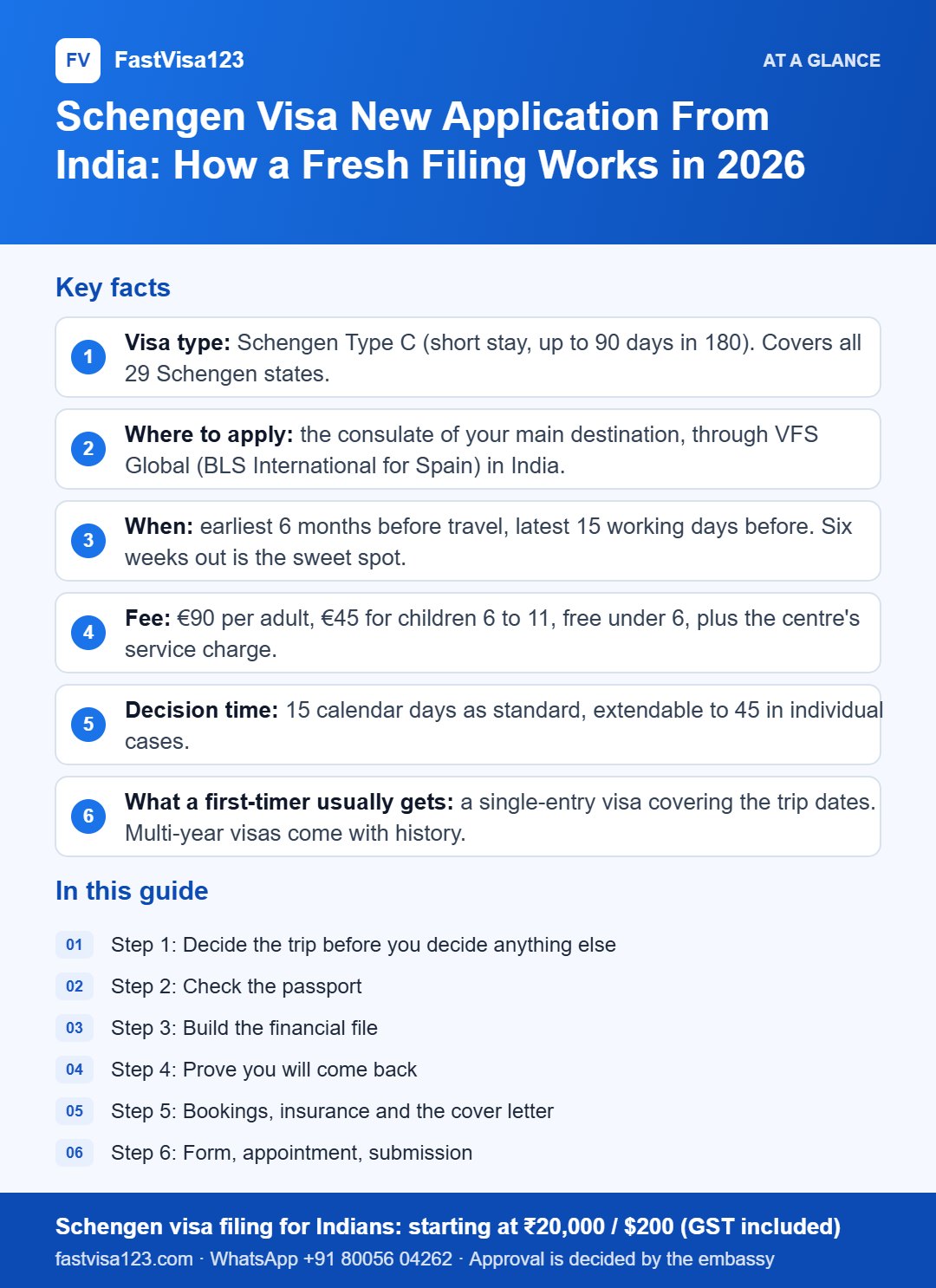
Fresh filing at a glance
- Visa type: Schengen Type C (short stay, up to 90 days in 180). Covers all 29 Schengen states.
- Where to apply: the consulate of your main destination, through VFS Global (BLS International for Spain) in India.
- When: earliest 6 months before travel, latest 15 working days before. Six weeks out is the sweet spot.
- Fee: €90 per adult, €45 for children 6 to 11, free under 6, plus the centre’s service charge.
- Decision time: 15 calendar days as standard, extendable to 45 in individual cases.
- What a first-timer usually gets: a single-entry visa covering the trip dates. Multi-year visas come with history.
Step 1: Decide the trip before you decide anything else
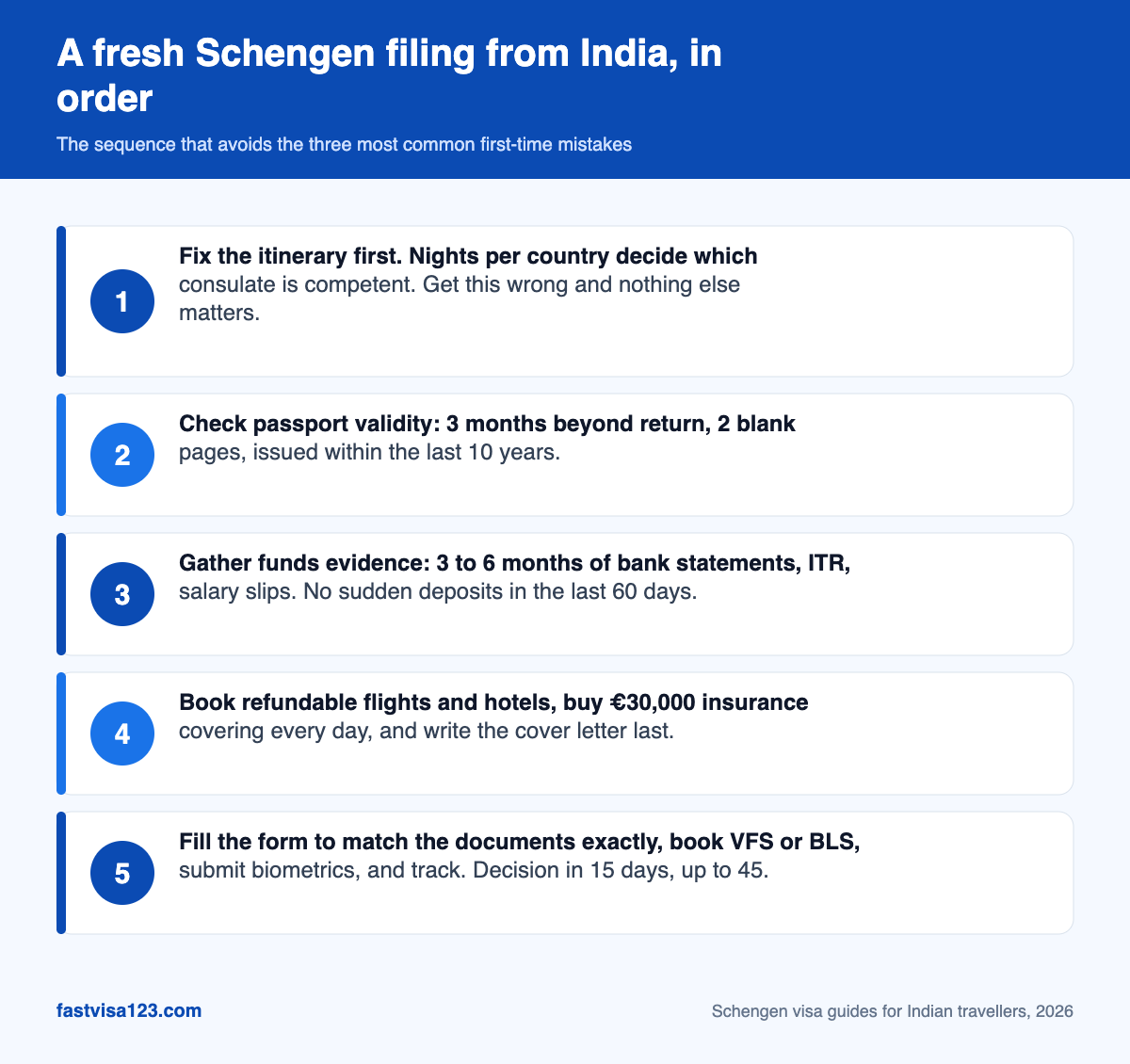
The itinerary is not paperwork you produce at the end. It determines which consulate is competent to decide your file, and applying to the wrong one is a refusal in itself. The rule: apply to the country where you will spend the most nights. If nights are equal, apply to the country of first entry. A 10-night trip with 5 nights in Italy, 3 in Switzerland and 2 in France is an Italian application, even if you fly into Paris.
Fix the nights per country first, then build the bookings around it. Our main-destination guide covers the edge cases, and our itinerary template gives you a format consulates accept.
Step 2: Check the passport
Three rules, all fatal if missed: validity of at least three months beyond your planned return date, at least two blank pages, and a passport issued within the last ten years. If you renewed recently, carry the old passport too; it holds your travel history. If your name is spelt differently across documents, or you have a single name, sort that out before filing: see our name mismatch guide.
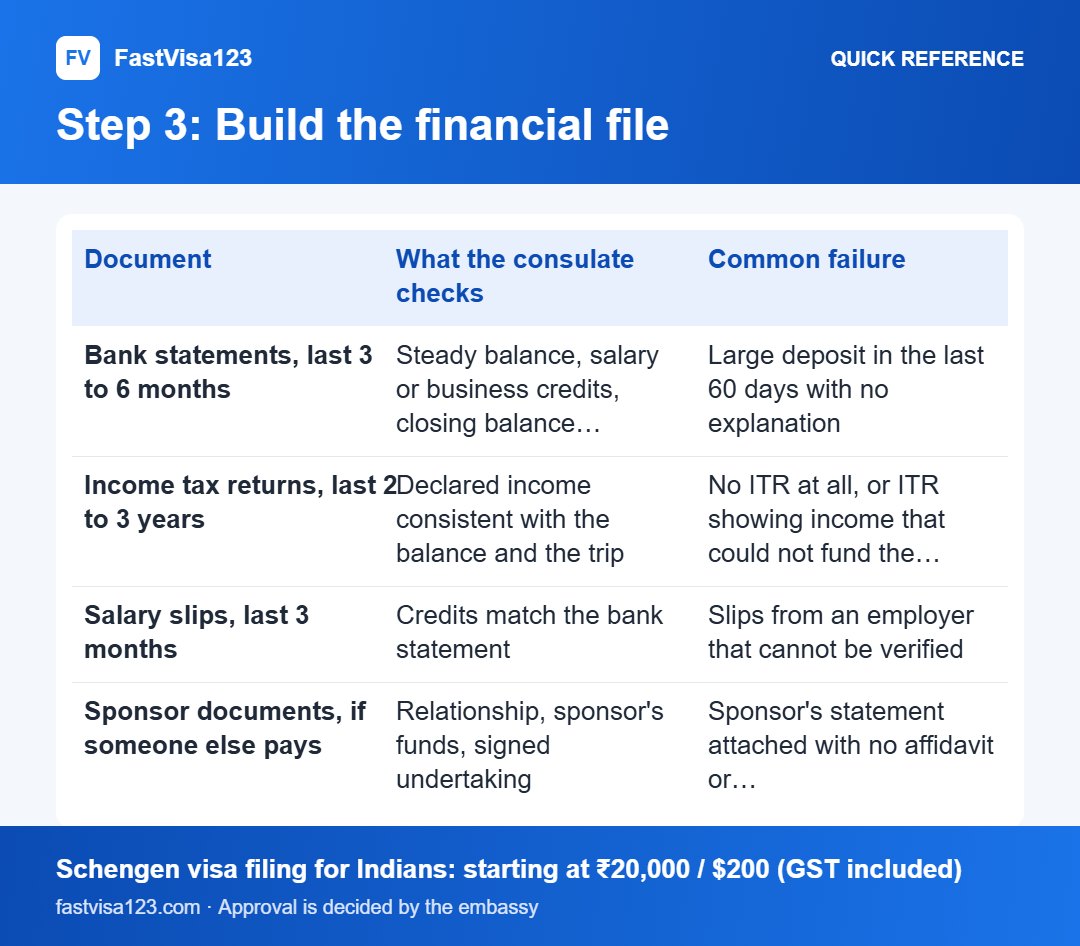
Step 3: Build the financial file
This is where most new Indian filings fail. The consulate wants to see that you can fund the trip from money that is genuinely yours, and that your financial life in India continues after you return.
| Document | What the consulate checks | Common failure |
|---|---|---|
| Bank statements, last 3 to 6 months | Steady balance, salary or business credits, closing balance comfortably above the trip cost | Large deposit in the last 60 days with no explanation |
| Income tax returns, last 2 to 3 years | Declared income consistent with the balance and the trip | No ITR at all, or ITR showing income that could not fund the trip |
| Salary slips, last 3 months | Credits match the bank statement | Slips from an employer that cannot be verified |
| Sponsor documents, if someone else pays | Relationship, sponsor’s funds, signed undertaking | Sponsor’s statement attached with no affidavit or relationship proof |
How much is “enough” depends on the country, from about €24 per day in Hungary to over €100 per day in Austria. We list the per-day figures in proof of funds by country, and the statement rules in bank statement rules for Schengen visas.
Step 4: Prove you will come back
For a fresh filing with no Schengen history, intention to return is judged entirely on your Indian life. The consulate wants evidence that leaving India for good would cost you something:
- Employment: an employer letter stating your designation, salary, date of joining, approved leave dates and expected return. Template and wording in our employment letter guide.
- Business: registration, GST returns, company bank statements, and a letter on letterhead explaining who runs the business while you travel.
- Property and family: property papers, spouse and children remaining in India, elderly dependants.
- Travel history: previous visas to any country, used correctly. A blank passport is not a refusal ground, but it removes a positive; see our guide to applying on a new passport.
Step 5: Bookings, insurance and the cover letter
Book refundable flights and hotels that match the itinerary night for night. Buy travel medical insurance with at least €30,000 cover, valid in all Schengen states, for every day from departure to return; our insurance guide explains what gets rejected. Write the cover letter last, once every other document exists, so it can reference them: purpose, dates, who pays, why you will return. Free template in our cover letter guide.
Step 6: Form, appointment, submission
Fill the application form to match the documents exactly: the same dates as the tickets, the same surname format as the passport, the same address as the bank statement. Our field-by-field guide covers the traps. Book the earliest appointment at the correct centre; if slots are scarce, our slots-full guide has the workarounds. On the day: biometrics, photo, documents in the checklist order, fees. Then track the file; the standard is 15 days.
Timeline for a fresh filing
| Weeks before travel | What happens |
|---|---|
| 8 to 10 | Itinerary fixed, passport checked, bank statements clean, appointment booked |
| 6 to 7 | Bookings, insurance, employer letter, cover letter, form |
| 5 to 6 | Submission at VFS/BLS with biometrics |
| 3 to 4 | Decision (15 days standard). Passport collected or couriered |
| 0 to 2 | Buffer for a 45-day extension or a reapplication if refused |
What we do in a fresh filing
FastVisa123 prepares the complete file starting at ₹20,000 / $200 (GST included): we check jurisdiction, review your statements for red flags before the consulate sees them, produce the itinerary, reservations and cover letter, fill the form, book the appointment and support you on WhatsApp until the decision. Profile-specific guidance for salaried applicants, business owners, students, homemakers and retirees is on the linked pages.
First Schengen application? We file it end to end
Jurisdiction check, statement review, itinerary, bookings, cover letter, form and appointment, all starting at ₹20,000 / $200 (GST included). WhatsApp support until the decision.
Frequently asked questions
What does a “new” or “fresh” Schengen visa filing mean?
Any application that is not a repeat of a previous successful one: a first application, a fresh application after a refusal, or a first application on a new passport or for a new purpose. Consulates examine these more closely.
How early can I file a new Schengen visa application?
Up to six months before travel, and no later than 15 working days before. Six to eight weeks out is ideal for a first-time file.
How long does a first Schengen visa take from India?
The standard is 15 calendar days from submission, extendable to 45 days if the consulate needs more time or documents. Plan for the longer figure.
Will a first-time applicant get a multiple-entry visa?
Usually not. A first visa is typically single-entry for the trip dates. Two visas used correctly within three years make Indians eligible for a two-year multi-entry visa.
Can I file a new application immediately after a refusal?
Yes, there is no waiting period. But file only after fixing the reason given on the refusal letter, or the same box will be ticked again.
Which consulate should a first-timer apply to?
The one competent for your trip under the main-destination rule. Picking a consulate for its low refusal rate is itself a refusal ground if it is not your main destination.