Every Schengen consulate refuses a visa using the same standard form, set out in Annex VI of the EU Visa Code. It has 17 numbered reasons, and the officer ticks one or more. There is usually no free-text explanation, which is why the letter feels cryptic. It is not. Each box has a precise meaning, and once you know which box is ticked you know exactly what to fix.
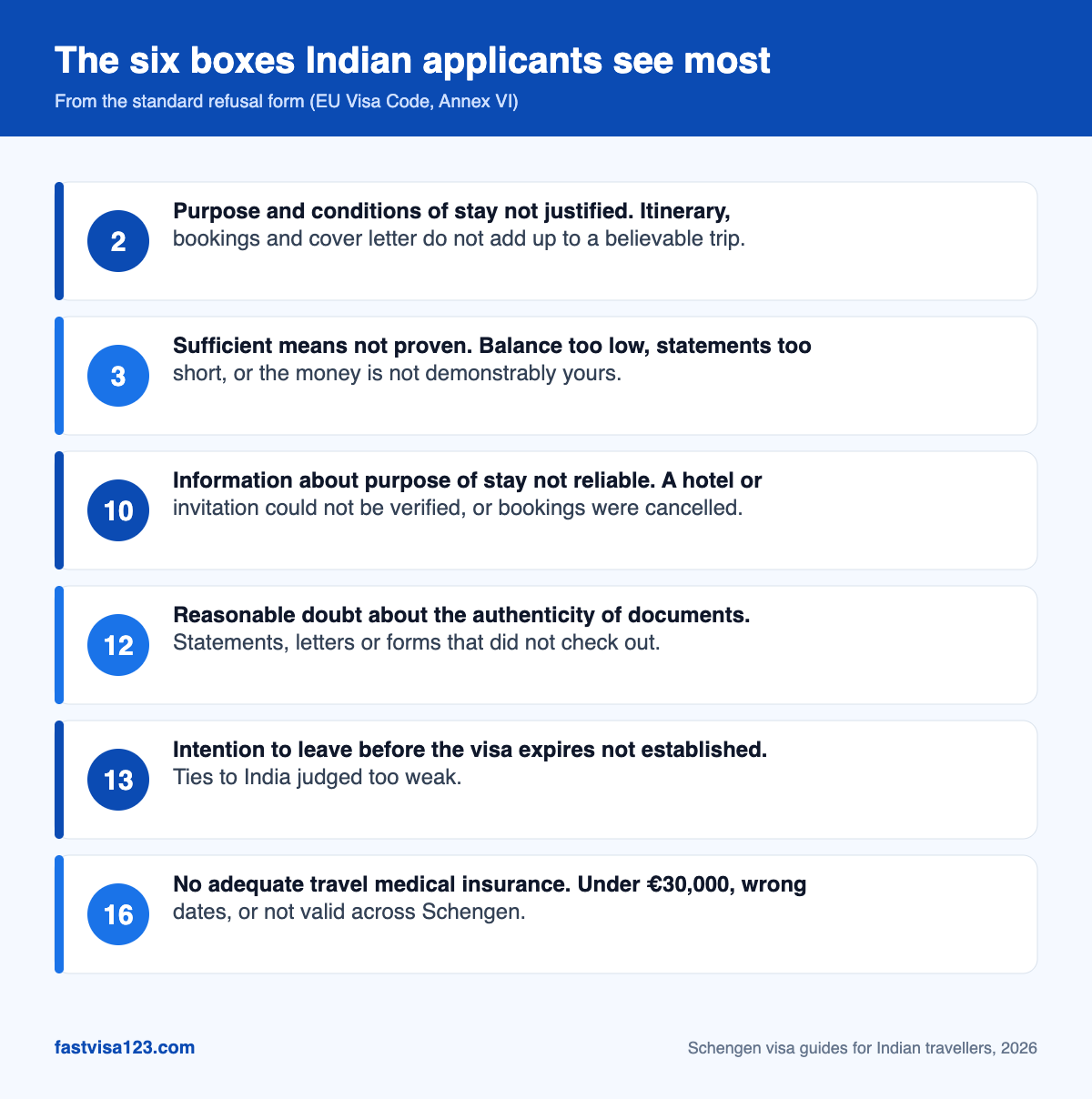
This guide goes through all 17, in plain language, with what each one means for an Indian applicant and what changes the outcome. Six of them account for the overwhelming majority of Indian refusals; those get the most attention. Wording below is paraphrased from the form, not quoted.
Before you read the boxes
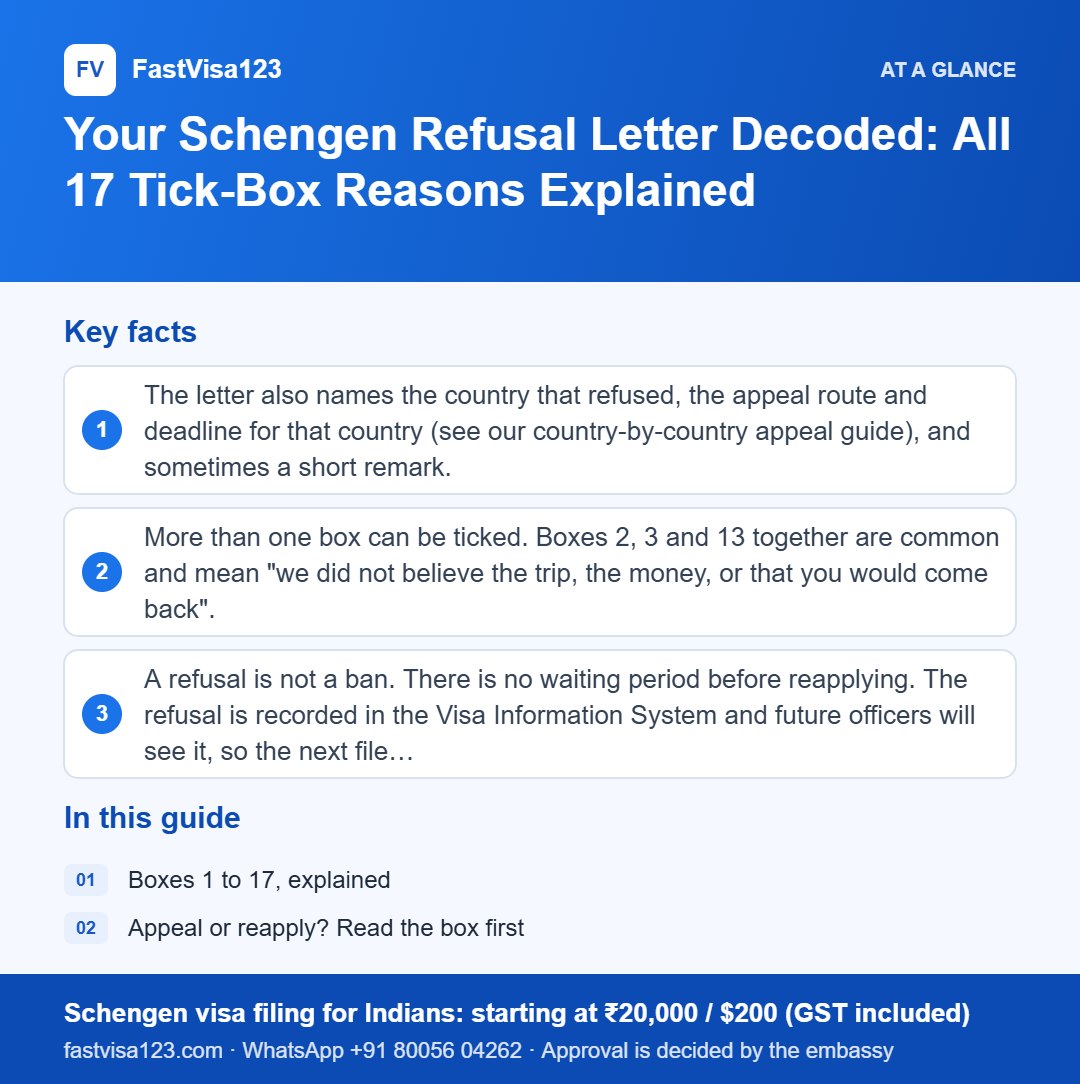
- The letter also names the country that refused, the appeal route and deadline for that country (see our country-by-country appeal guide), and sometimes a short remark.
- More than one box can be ticked. Boxes 2, 3 and 13 together are common and mean “we did not believe the trip, the money, or that you would come back”.
- A refusal is not a ban. There is no waiting period before reapplying. The refusal is recorded in the Visa Information System and future officers will see it, so the next file must visibly answer it.
Boxes 1 to 17, explained
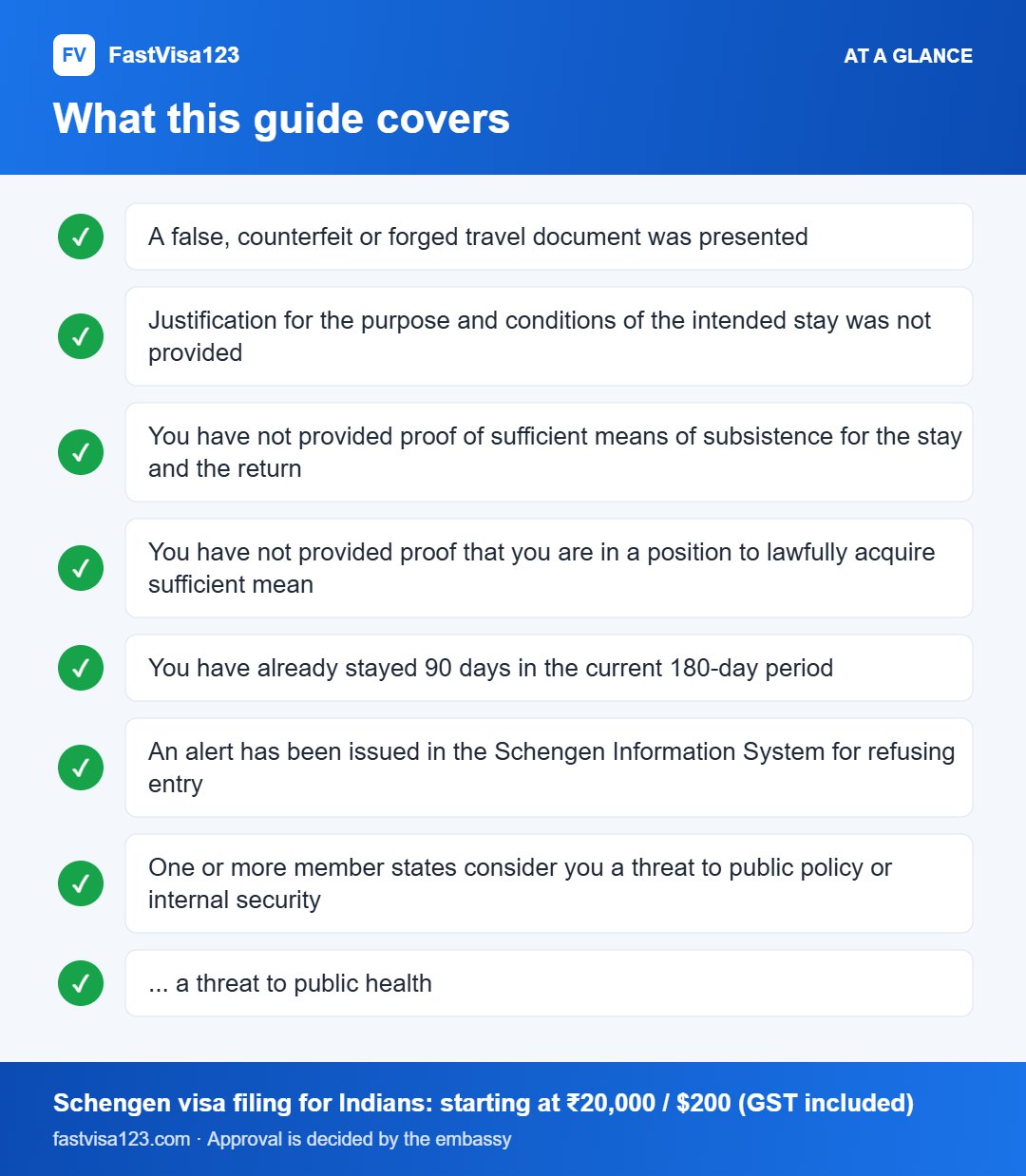
1. A false, counterfeit or forged travel document was presented
Rare and serious. Ticked when the passport itself is suspected. If you see this on a genuine passport, it is almost always a data or verification error; contact the consulate in writing immediately with the passport details.
2. Justification for the purpose and conditions of the intended stay was not provided
The most common box for Indian tourists. It means the file did not convince the officer that the trip is what you say it is. Typical causes: an itinerary that does not match the hotel bookings; flights on dates different from the form; a cover letter that says “tourism” with no plan; a business visit with no invitation. Fix: a day-by-day itinerary where every night has a booking, and a cover letter that walks the officer through it.
3. You have not provided proof of sufficient means of subsistence for the stay and the return
The second most common. The consulate applies a per-day amount for its country (from about €24 in Hungary to over €100 in Austria) and checks it against your closing balance and the pattern of your statements. Sudden deposits, statements shorter than three months, or money clearly belonging to someone else all trigger this box. Fix: see proof of funds by country and the bank statement rules.
4. You have not provided proof that you are in a position to lawfully acquire sufficient means
Ticked less often, usually alongside box 3, when the officer doubts where the money comes from: income on the ITR that does not match the balance, or no income evidence at all. Fix: ITR, salary slips or business accounts that explain the balance; see ITR and income proof.
5. You have already stayed 90 days in the current 180-day period
Only possible if you have recently been in Schengen. Count your days with our 90/180 guide; EES now does this automatically at the border.
6. An alert has been issued in the Schengen Information System for refusing entry
A member state has flagged you, usually after an overstay, deportation or a criminal matter in Europe. This cannot be fixed with documents; it requires a formal request to the state that issued the alert. Get legal advice.
7. One or more member states consider you a threat to public policy or internal security
8. … a threat to public health
9. … a threat to their international relations
Boxes 7, 8 and 9 are almost never ticked for Indian tourists. If one is, it relates to a specific record, not to your documents, and needs a written enquiry to the consulate.
10. The information submitted regarding the purpose and conditions of the stay was not reliable
Different from box 2: here the officer checked something and it failed. A hotel that had no record of your booking, an invitation letter from a host who did not confirm, a company that could not be reached, or a flight reservation cancelled before the decision. Fix: only submit bookings that will still exist when the consulate calls, and warn your host or employer that they may be contacted. Our guide to refundable bookings explains how to do this without losing money.
11. There are reasonable doubts as to the reliability of the statements made
Something you said, on the form or in the cover letter, contradicted something else. The classic: “visiting friends” on the form, “tourism” in the letter, and a hotel booking that suggests neither. Fix: one story, told identically everywhere.
12. There are reasonable doubts as to the authenticity of the supporting documents or the veracity of their contents
The officer believes a document is fake or altered. Bank statements that could not be verified with the bank, employer letters from unverifiable companies, edited PDFs. This box is serious: it is recorded and colours every future application. Fix: only original, verifiable documents, and a letter with the next application explaining exactly how each can be checked. Our page on recovering from an unreliable-information refusal covers the approach.
13. There are reasonable doubts as to your intention to leave before the visa expires
The third of the big three. The consulate is not convinced you will return to India. Weak employment evidence, no assets, thin family ties, a long leave for a short trip, or a profile the officer associates with overstays. Fix: a stronger ties file: employer letter with return date, property, dependants, previous travel used correctly. See how to prove your ties.
14. Sufficient proof that you could not apply for a visa in advance was not provided
Only applies to visas requested at the border. Not relevant to applications lodged in India.
15. Justification for the purpose and conditions of the intended airport transit was not provided
Applies only to airport transit visas (Type A). Ignore for tourist and business files.
16. You have not provided proof of holding adequate and valid travel medical insurance
The easiest refusal to get and the easiest to fix. Cover below €30,000, a policy not valid in all Schengen states, dates that do not cover the full trip, or a policy the consulate’s checklist does not accept. Fix: a compliant policy; see our insurance guide.
17. Revocation or annulment of the visa was requested by the visa holder
Administrative. Appears when you yourself asked for a visa to be cancelled.
Appeal or reapply? Read the box first
Usually reapply
Boxes 2, 3, 4, 13 and 16. These are file-quality problems. A stronger file submitted fresh is faster and more likely to succeed than an appeal arguing the officer was wrong.
Consider appealing
Boxes 10, 11 and 12 when you can prove the document was genuine and the check failed for a reason outside your control. Boxes 6 to 9 need legal advice, not a reapplication.
Deadlines and authorities differ by country, from 8 days in Hungary and Slovenia to 3 months in Luxembourg; they are in our appeal guide and the country pages.
Not sure which box was ticked, or what to do about it?
Send us a photo of the letter on WhatsApp. We tell you free whether to appeal or reapply, and what the next file must contain.
Frequently asked questions
Why does my Schengen refusal letter not explain the reason?
The form is standardised across all consulates and uses 17 numbered tick-boxes rather than free text. The ticked box is the reason. This guide explains each one.
Which refusal reasons are most common for Indians?
Boxes 2 (purpose of stay), 3 (means of subsistence), 10 and 12 (unreliable information or documents), 13 (intention to return) and 16 (insurance) account for almost all Indian refusals.
Can I reapply immediately after a refusal?
Yes. There is no waiting period. The refusal is recorded, so the new file must visibly fix the ticked reason.
Is a refusal a ban from Schengen?
No. Only box 6 (a SIS alert) indicates an entry ban, and that is rare. A normal refusal simply means that application was declined.
Should I appeal or reapply?
For file-quality boxes (2, 3, 4, 13, 16) reapplying with a corrected file is usually faster and more effective. Appeal when you can prove a document was genuine and the consulate erred (boxes 10, 11, 12).
Does the refusal letter tell me the appeal deadline?
Yes, it names the appeal authority and deadline for that country. They vary from 8 days to 3 months.