Bank statements are the document Schengen consulates read most carefully, and the one Indian applicants get wrong most often. In 2025, “means of subsistence not proven” was among the top reasons for the 181,111 Indian refusals. The problems are rarely about being poor; they are about statements that are too short, unstamped, or that show money arriving just before the application.
This guide answers the practical questions: how many months, what format, what balance, which deposits are dangerous, and what to do if you are sponsored, self-employed, or have your savings in fixed deposits.
The rules, condensed
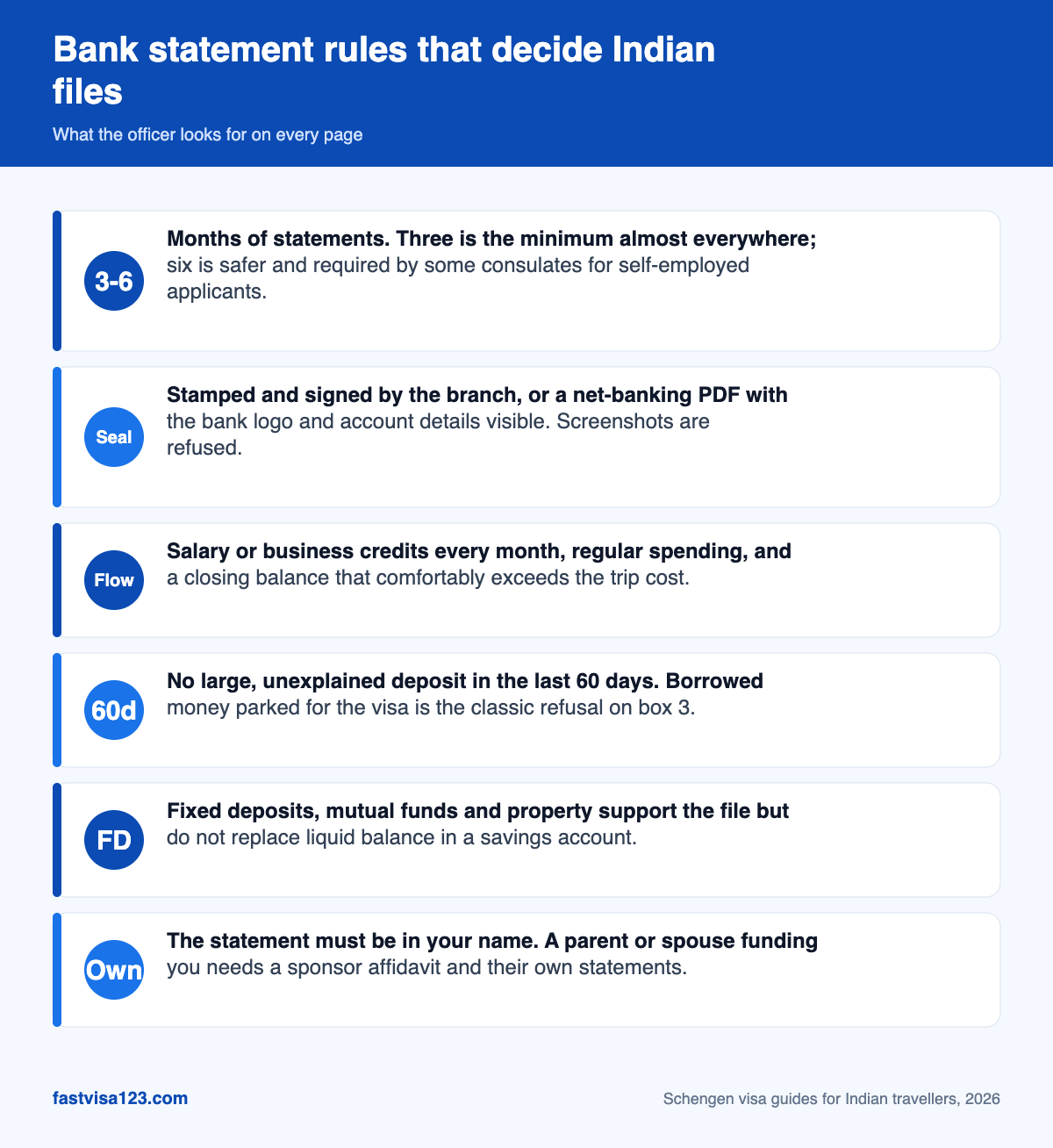
- Months: last 3 months minimum for every consulate; 6 months for self-employed applicants and for several consulates (Netherlands, Belgium, Switzerland and Austria commonly ask for 6).
- Format: bank-stamped and signed printouts, or an e-statement downloaded from net banking with the bank’s logo, your name, account number and the statement period visible. No screenshots, no passbook photos.
- Balance: closing balance above the trip cost plus a margin: flights, hotels, the country’s daily amount for every day, and at least ₹1 to 1.5 lakh left over.
- Deposits: no large unexplained credit in the last 60 days. If there is one, explain it with evidence in the cover letter.
- Currency: INR statements are fine. Do not convert on the statement; the officer converts.

How many months of bank statements do you need?
Every Schengen consulate in India asks for at least the last three months. Several ask for six, and six months is the safe default for anyone self-employed, anyone between jobs, and anyone whose balance rose sharply in the last quarter. The reason is simple: three months can be dressed up; six months shows a pattern.
| Consulate (deciding country) | Months typically required | Notes |
|---|---|---|
| Germany, France, Italy, Spain | 3 | Six months strengthens self-employed files |
| Netherlands, Belgium, Austria, Switzerland | 3 to 6 | Checklists often say 6; bring 6 |
| Greece, Portugal, Czech Republic, Hungary, Poland | 3 to 6 | Greece scrutinises closing balance closely |
| Nordics (Denmark, Sweden, Norway, Finland, Iceland) | 3 | High per-day funds expectation offsets the shorter period |
| Malta, Slovenia, Estonia, Latvia, Lithuania | 3 to 6 | Small consulates, strict reading |
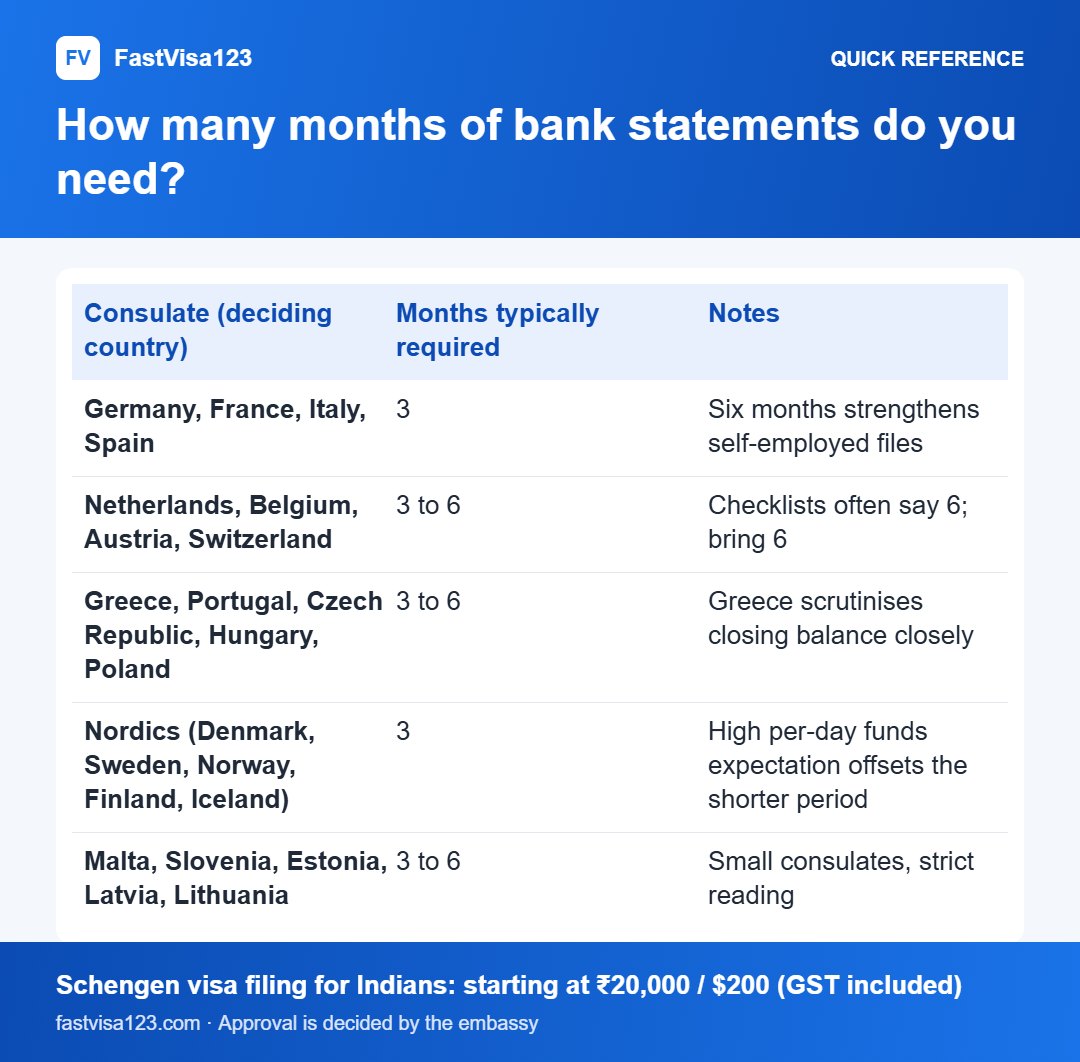
The country-specific checklist on the VFS or BLS page for your consulate is the final word. When in doubt, submit six months: nobody has ever been refused for providing more history.
Stamped or not? What format is accepted
Two formats are accepted everywhere:
- Branch-issued statements printed by the bank, with the bank’s stamp and an officer’s signature on each page. Ask for “statement of account for visa purposes”; most branches issue it the same day.
- Net-banking e-statements downloaded as PDF, showing the bank logo, your full name, account number, statement period and the bank’s standard footer. Most consulates accept these unstamped in 2026, but a few checklists (and a few VFS counters) still ask for a stamp. If your consulate’s checklist says “stamped”, get the stamp.
Not accepted: screenshots of the banking app, passbook photographs, Excel exports, and statements with transactions blacked out. Redacting anything is treated as hiding something.
How much balance should the statement show?
There is no single number. The officer works from the deciding country’s per-day amount (our proof of funds guide lists them, from roughly €24 a day in Hungary to over €100 in Austria) multiplied by your days, plus the flights and hotels you have not already paid, plus a reserve. A practical formula for a tourist:
Example: 10 days in Italy (about €60 a day) → €600 ≈ ₹58,000
+ flights ₹70,000 + hotels ₹60,000 + reserve ₹1,20,000
≈ ₹3,10,000 closing balance
What matters as much as the closing figure is the pattern: monthly credits that explain the balance, regular spending that shows the account is real, and no month where the balance drops to near zero. We cover country-by-country expectations in how much bank balance Indians need.
The 60-day deposit rule
This is the rule that catches the most well-meaning applicants. A large credit in the weeks before the application, especially one that roughly equals the amount the visa “needs”, looks like borrowed money parked to pass the check. Officers see it constantly and refuse on box 3 without further enquiry.
Deposits that are fine, with evidence
Salary and bonus (payslip shows it). Fixed deposit maturity (FD certificate shows it). Sale of an asset (sale deed or broker statement). Gift from a parent for the trip (sponsor affidavit plus the parent’s statement showing the debit).
Deposits that get refused
Cash deposits with no source. Transfers from friends or relatives without an affidavit. A loan credited to the account. Money moved in from another account you have not submitted.
The rule of thumb: if a credit in the last 60 days is more than about 25% of your closing balance, explain it in one sentence in the cover letter and attach the proof. Silence is what gets refused, not the deposit itself.
Fixed deposits, mutual funds and property
Consulates want liquid funds you can spend on the trip. Fixed deposits, mutual fund statements, PPF and property papers strengthen your ties to India and show overall wealth, but most officers do not count them towards the daily amount. Submit them as supporting documents, keep the savings-account balance as the primary evidence. If most of your money is locked in FDs, break or partially withdraw one at least 60 days before applying so the credit is not “recent”.
Sponsored applicants: whose statements?
If a parent, spouse or child pays for the trip, the consulate needs three things: proof of the relationship, the sponsor’s own statements (same 3 to 6 month rule), and a signed sponsorship undertaking. Your own statement should still be submitted even if the balance is small; an applicant with no account at all raises questions. Our sponsor affidavit guide has the wording and document list.
Self-employed and business owners
Submit both personal and business account statements for six months, plus GST returns and the last two ITRs. The officer wants to see business income flowing into the business account and then to you, not a business account being used for personal spending or vice versa. See our profile guide for self-employed applicants and the ITR and income proof guide.
Checklist before you print
- Statement period ends within the last 7 to 14 days of the appointment date.
- Every page has your name and account number; every page is stamped if the checklist requires it.
- No large deposit in the last 60 days, or each one is explained with proof.
- Closing balance covers the formula above for the deciding country.
- Salary credits match the payslips; business credits match the GST returns.
- All accounts you rely on are submitted in full; no cherry-picking one good account.
Want us to read your statements before the consulate does?
We check for the 60-day deposit problem, the closing balance and the pattern, then build the rest of the file around what your finances actually show. Starting at ₹20,000 / $200 (GST included).
Frequently asked questions
How many months of bank statements are required for a Schengen visa from India?
A minimum of three months for every consulate. Six months is required by several (Netherlands, Belgium, Austria, Switzerland often) and is the safe choice for self-employed applicants.
Do bank statements need to be stamped for a Schengen visa?
Branch-printed statements must be stamped and signed. Net-banking PDFs with the bank logo and account details are accepted by most consulates in 2026, but if your consulate’s checklist says stamped, get the stamp.
What is the minimum bank balance for a Schengen visa?
It depends on the deciding country’s daily amount and your trip length. A practical formula: daily amount times days, plus unpaid flights and hotels, plus a reserve of ₹1 to 1.5 lakh. For a 10-day Italy trip that is roughly ₹3 lakh.
Can I deposit money into my account before applying?
Any large credit in the last 60 days must be explained with evidence (payslip, FD maturity, sale deed, sponsor affidavit). Unexplained deposits are the most common cause of a box 3 refusal.
Are fixed deposits counted as proof of funds?
They support the file but most officers do not count them as liquid funds for the trip. Keep the primary balance in a savings account.
Can I submit my parent’s bank statement instead of mine?
Only with a sponsorship affidavit and proof of relationship, and you should still submit your own statement. See the sponsor guide.
Do e-statements need to be notarised?
No. Notarisation is not required for bank statements. A bank stamp is the only attestation any consulate asks for.