Unmarried couples, engaged couples and live-in partners travel to Europe from India constantly, and consulates have no objection to it. The Schengen visa is an individual document: there is no couples visa, no family visa, and no rule that partners must be married. What trips couples up is not the relationship but the paperwork: two forms that do not match, a partner described as a spouse without evidence, or one file strong and the other thin.
This guide explains how to prepare two applications for one trip, what to write about the relationship, how shared payment works, and the specific refusals couples run into.
Key facts
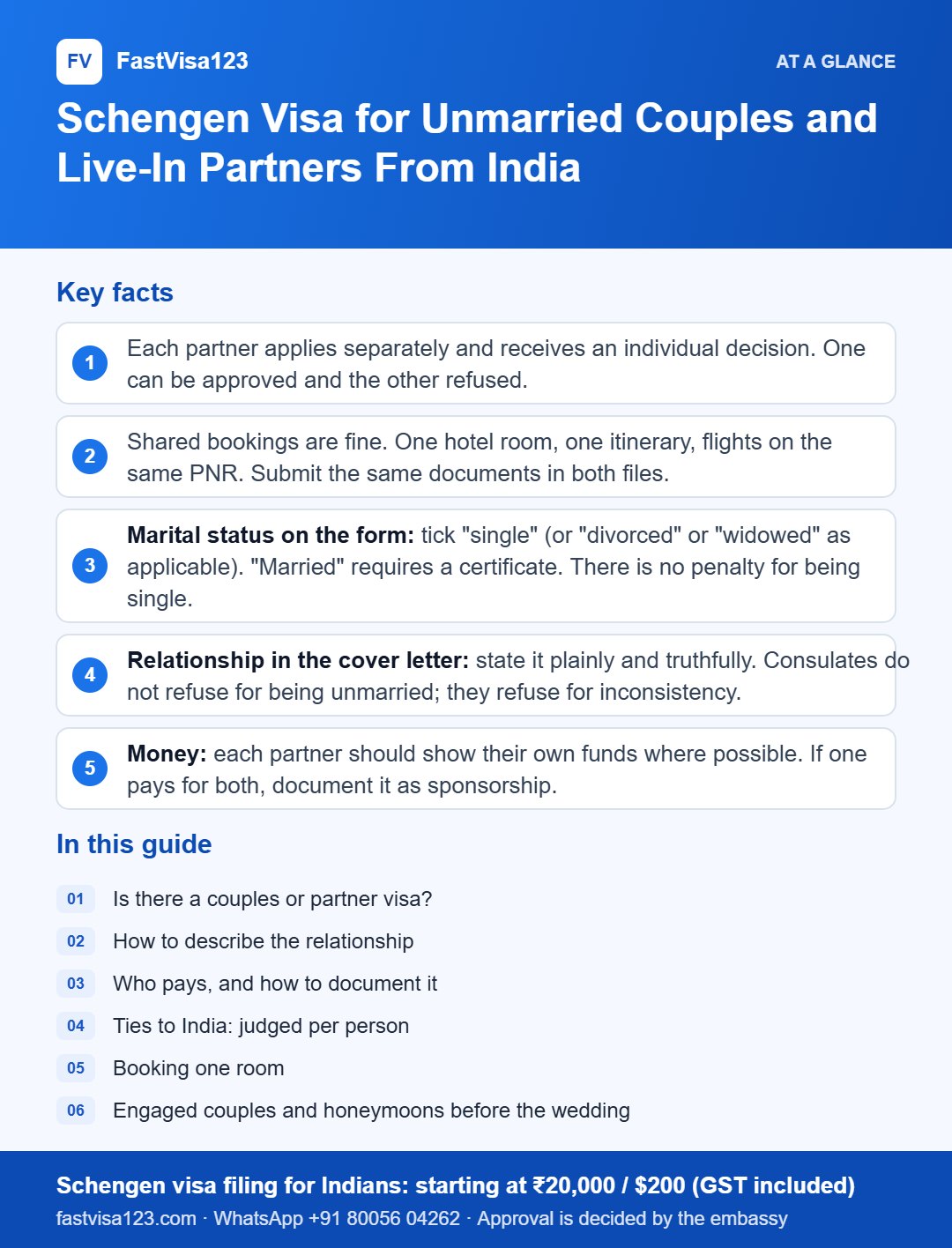
- Each partner applies separately and receives an individual decision. One can be approved and the other refused.
- Shared bookings are fine. One hotel room, one itinerary, flights on the same PNR. Submit the same documents in both files.
- Marital status on the form: tick “single” (or “divorced” or “widowed” as applicable). “Married” requires a certificate. There is no penalty for being single.
- Relationship in the cover letter: state it plainly and truthfully. Consulates do not refuse for being unmarried; they refuse for inconsistency.
- Money: each partner should show their own funds where possible. If one pays for both, document it as sponsorship.
Is there a couples or partner visa?
No. The only relationship-based route in Schengen rules is for family members of EU citizens, and even that is an individual application with a lighter document list. Two Indian partners travelling as tourists are two tourist applicants. That is not a disadvantage: it simply means each file must stand alone on purpose, funds and ties, exactly as it would for a solo traveller.
How to describe the relationship
Use the true word. “My partner”, “my girlfriend”, “my fiancé”, “my live-in partner of three years”. Officers in India read hundreds of couple files and none of these phrases raises a flag. What does raise a flag:
- Writing “spouse” or “wife” on the form or in the letter with no marriage certificate. That is a false statement (box 11 on the refusal form) and it follows you to the next application.
- Two cover letters that describe the relationship differently, or one that does not mention the other person at all while the hotel booking is for two.
- Different trip dates or destinations on the two forms.
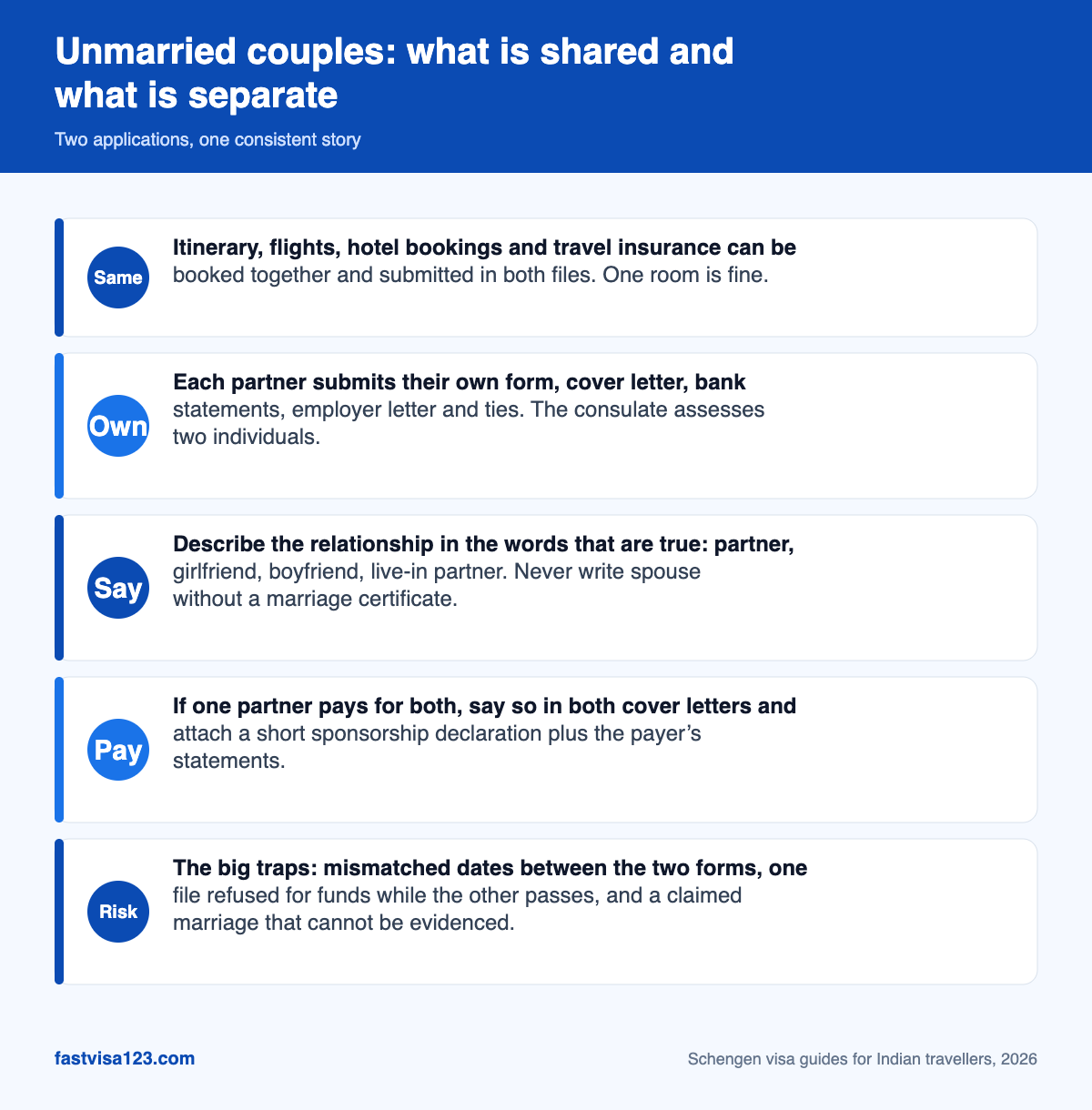
A single shared paragraph, copied into both cover letters, solves most of this: “I am travelling with my partner, [name], passport [number], who is applying separately at the same centre. We have booked the same flights and hotels (enclosed).”
Who pays, and how to document it
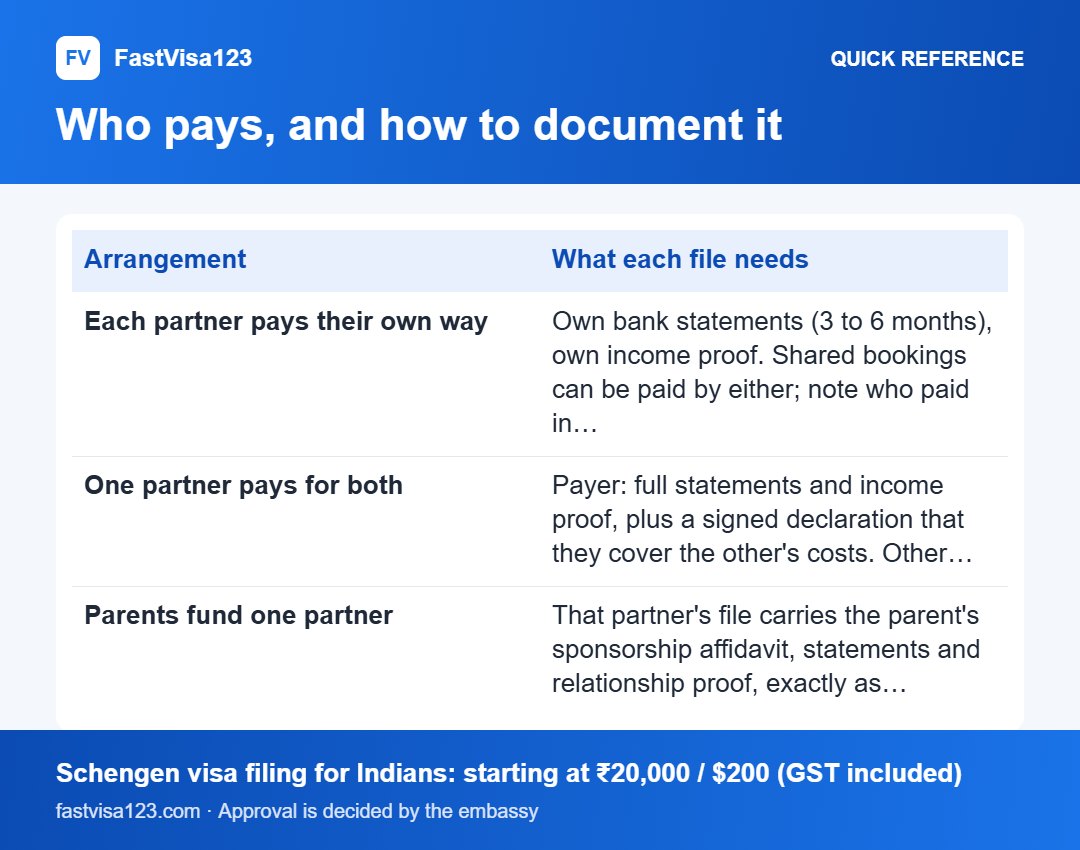
| Arrangement | What each file needs |
|---|---|
| Each partner pays their own way | Own bank statements (3 to 6 months), own income proof. Shared bookings can be paid by either; note who paid in the letter. |
| One partner pays for both | Payer: full statements and income proof, plus a signed declaration that they cover the other’s costs. Other partner: own statements (even if modest) and the payer’s declaration and statements in their file too. |
| Parents fund one partner | That partner’s file carries the parent’s sponsorship affidavit, statements and relationship proof, exactly as for any sponsored applicant. |
The weakest common pattern: one partner with strong finances and employment, the other with a small balance and no income proof, and no sponsorship paperwork linking them. The first is approved, the second refused on box 3. Our sponsor affidavit guide has the declaration wording; the bank statement rules apply to both.
Ties to India: judged per person
Intention to return is assessed for each applicant. A couple where one partner has a strong job and property and the other is between jobs will see the second file examined on its own merits. Each partner needs their own employer letter (or business documents), and each should list their own ties. It helps to mention that you are returning together, but it does not substitute for evidence. See the between-jobs guide if one partner is in transition.
Booking one room
Book whatever you would actually book. A double room for two adults is unremarkable to a European consulate. Do not book two rooms to look “proper”; a booking that does not match your plan is worse than the plan. Make sure both names appear on the hotel confirmations and the flight reservation, and that the total nights match the itinerary in both files.
Engaged couples and honeymoons before the wedding
A pre-wedding trip is a normal purpose. Mention the engagement and the wedding date in the letter if it exists; it is a strong return tie for both. Do not call the trip a honeymoon unless the marriage has happened; the officer may ask for the certificate. For married couples, see our honeymoon and couples guide.
Live-in partners with a shared address
If you share a home, your address proofs will match, which is fine and even useful: it evidences a settled life in India. A rental agreement in both names, or one name with the other on utility bills, can go in both files as a tie document. There is no requirement to explain or justify cohabitation.
Do
Submit both files at the same appointment or on the same day. Copy the same relationship paragraph into both letters. Match every date. Give each partner their own funds and ties evidence. Say who paid for the shared bookings.
Don’t
Claim marriage you cannot evidence. Let one partner rely entirely on the other without a sponsorship declaration. File weeks apart with different itineraries. Hide the other traveller from your file.
If one partner is refused
It happens, and the reason is almost always on the refused partner’s own file (funds or ties). The approved partner’s visa stays valid. Read the refusal letter with our tick-box guide, fix that file, and reapply; the approved partner may need to adjust dates if the visa window is tight.
Travelling as a couple? We file both applications together
Two consistent files, one shared itinerary, the right sponsorship wording if one of you pays. Starting at ₹20,000 / $200 (GST included) per applicant, submitted at the same appointment.
Frequently asked questions
Can an unmarried couple from India get a Schengen visa together?
Yes. Each partner applies individually; there is no couples visa. Shared bookings and a shared itinerary are fine and should be submitted in both files.
Do I have to say I am unmarried?
You tick your true marital status on the form. Being single is not a refusal ground. Claiming to be married without a certificate is a false statement and is.
Can we book one hotel room?
Yes. Book what you will actually use. Both names should appear on the booking, and the nights must match the itinerary in both applications.
Can my partner pay for my trip?
Yes, with a signed sponsorship declaration and the payer’s bank statements in your file. You should still submit your own statements.
What if my partner is approved and I am refused?
Decisions are individual. The refusal reason is on your own file, usually funds or ties. Fix it and reapply; your partner’s visa remains valid.
Do live-in partners need to prove the relationship?
No proof of relationship is required for two tourist applications. A shared address proof helps as a tie to India but is not mandatory.