Short answer: no. ETIAS is a travel authorisation for people who can enter the Schengen area without a visa. Indian passport holders need a Schengen visa, and that visa already does everything ETIAS is designed to do. You will never be asked for an ETIAS at check-in or at the border, in 2026 or after it launches.
What has confused a lot of Indian travellers this year is that two different EU systems were announced together, and the headlines rarely separate them. One of them, the Entry/Exit System, does affect you. The other, ETIAS, does not. This guide explains both, what the current launch dates are, and what to actually prepare for.
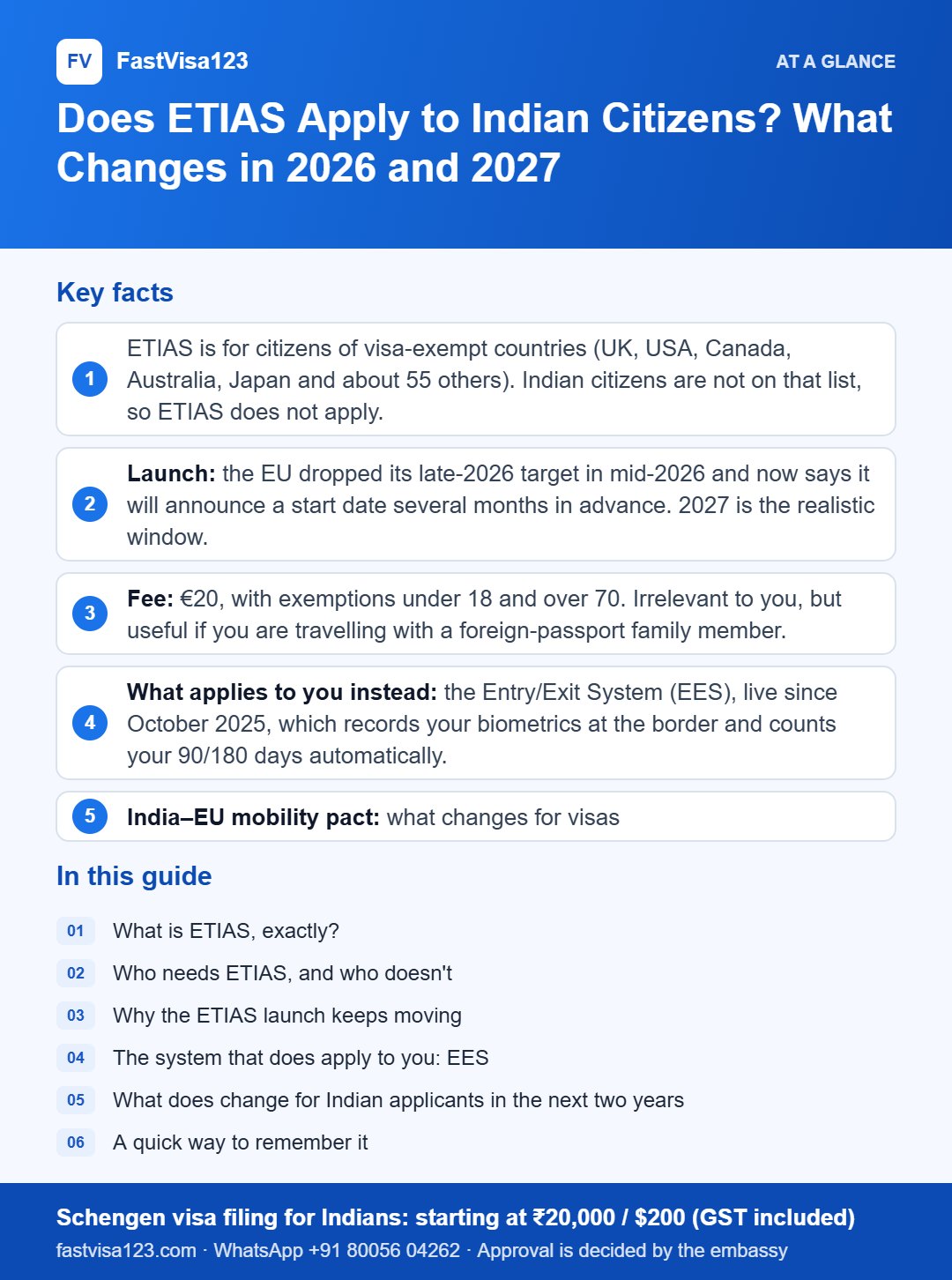
Key facts at a glance
- ETIAS is for citizens of visa-exempt countries (UK, USA, Canada, Australia, Japan and about 55 others). Indian citizens are not on that list, so ETIAS does not apply.
- Launch: the EU dropped its late-2026 target in mid-2026 and now says it will announce a start date several months in advance. 2027 is the realistic window.
- Fee: €20, with exemptions under 18 and over 70. Irrelevant to you, but useful if you are travelling with a foreign-passport family member.
- What applies to you instead: the Entry/Exit System (EES), live since October 2025, which records your biometrics at the border and counts your 90/180 days automatically.
- India–EU mobility pact: what changes for visas
What is ETIAS, exactly?
ETIAS stands for European Travel Information and Authorisation System. It is the EU’s version of the American ESTA or Canada’s eTA: an online pre-screening for travellers who do not need a visa. Before travelling, a visa-exempt visitor fills in an online form, pays €20, and receives an authorisation linked to their passport, usually within minutes. It is valid for three years or until the passport expires.
The purpose is security screening of people who would otherwise arrive with no advance check at all. That is the whole point: it exists because those travellers don’t go through a consulate. You do. When a consulate in India examines your bank statements, itinerary, employment letter and travel history before issuing a Schengen visa, that examination is far more thorough than anything ETIAS does. Requiring both would be redundant, and the regulation explicitly excludes visa holders.
Who needs ETIAS, and who doesn’t
| Traveller | Needs ETIAS? | Needs a Schengen visa? |
|---|---|---|
| Indian passport holder | No | Yes (Type C) |
| Indian citizen with a valid EU residence permit | No | No (the permit covers short stays) |
| Indian citizen with a UK, US or Canadian passport (dual national) | Yes, when travelling on that passport | No, on that passport |
| OCI card holder travelling on an Indian passport | No | Yes |
| Child of Indian parents born abroad with a visa-exempt passport | Yes, after launch | No |
The one situation where an Indian family will meet ETIAS in practice: a family member who holds a visa-exempt passport. If your spouse or child travels on a British, American, Canadian, Australian or Singaporean passport, they will need an ETIAS once it goes live, while you travel on your Schengen visa. Plan for both.
Why the ETIAS launch keeps moving
ETIAS was originally announced for 2021, then 2023, then 2024, then late 2026. In July 2026 the EU removed the 2026 date altogether. The reason is the Entry/Exit System: EES launched in October 2025 with a phased rollout and caused long queues at several airports. Officials decided not to add a second new system on top of it until EES is stable, and there were reported IT issues with ETIAS itself. The EU now says it will give several months’ notice before ETIAS starts, which points to 2027 at the earliest.
For you this is academic, but it matters for one reason: many Indian travellers have been sold “ETIAS assistance” by websites that charge a fee for a form that does not apply to them. If a site asks an Indian passport holder to pay for ETIAS, it is either mistaken or a scam. Close the tab.
The system that does apply to you: EES
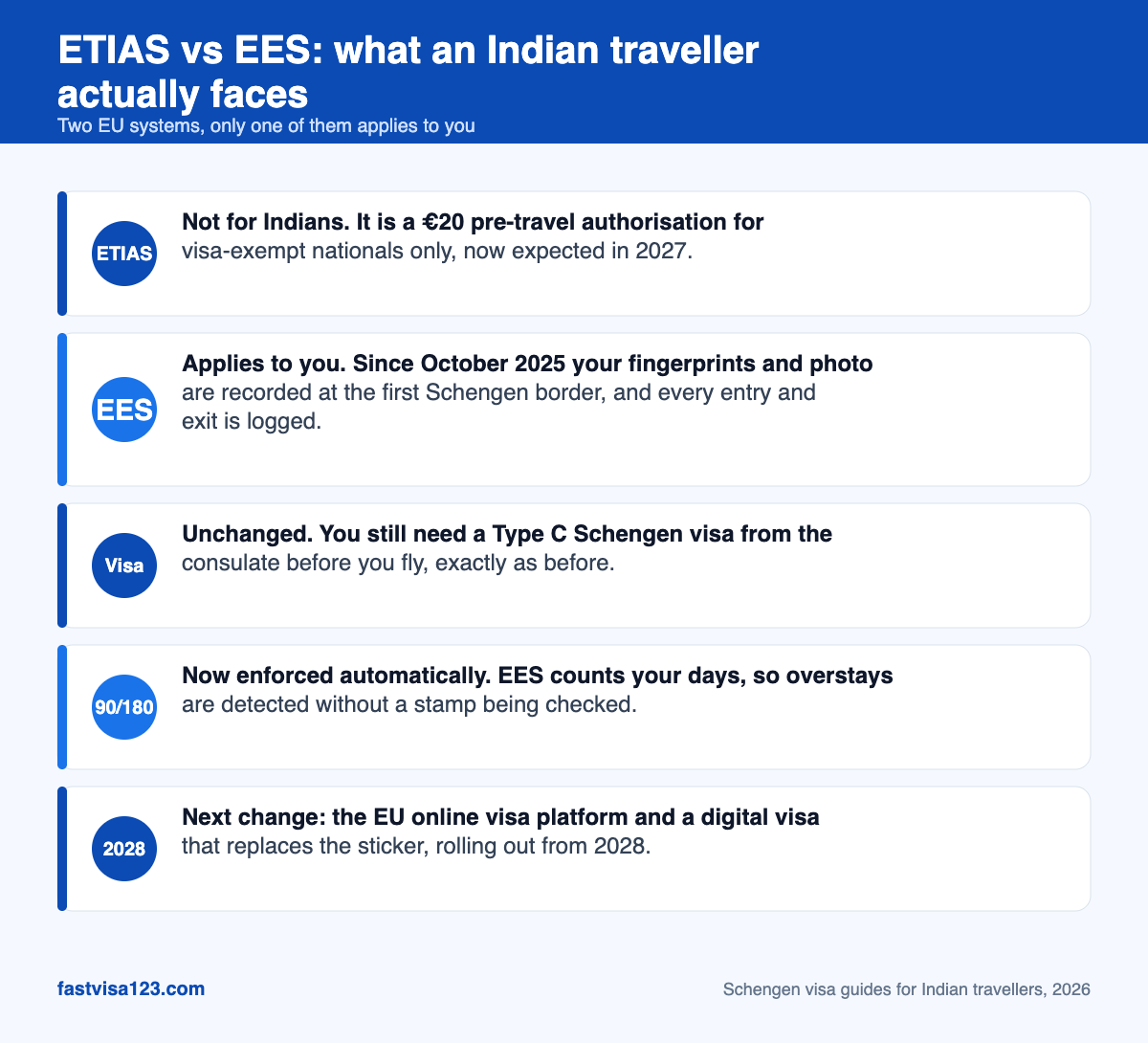
The Entry/Exit System replaced passport stamping at the external Schengen border. When you first arrive after its rollout, the border officer takes your fingerprints and a facial image and creates a record linked to your passport. On later trips, the check is faster because your biometrics are already on file. Each entry and exit is logged centrally, which means:
- Your 90-day limit in any 180-day period is counted by the system, not by an officer flipping through stamps. Overstays are flagged automatically.
- Border checks on your first entry take longer. Budget extra time at your first arrival airport, especially in summer.
- Children under 12 give a facial image only, not fingerprints.
- Your EES record is separate from the fingerprints you gave at VFS for the visa itself. Both exist; they serve different databases.
We cover EES in depth, including what happens at the kiosk and how it interacts with your visa validity, in our EU Entry/Exit System guide for Indian travellers.
What does change for Indian applicants in the next two years
ETIAS is a non-event for you, but three real changes are worth tracking:
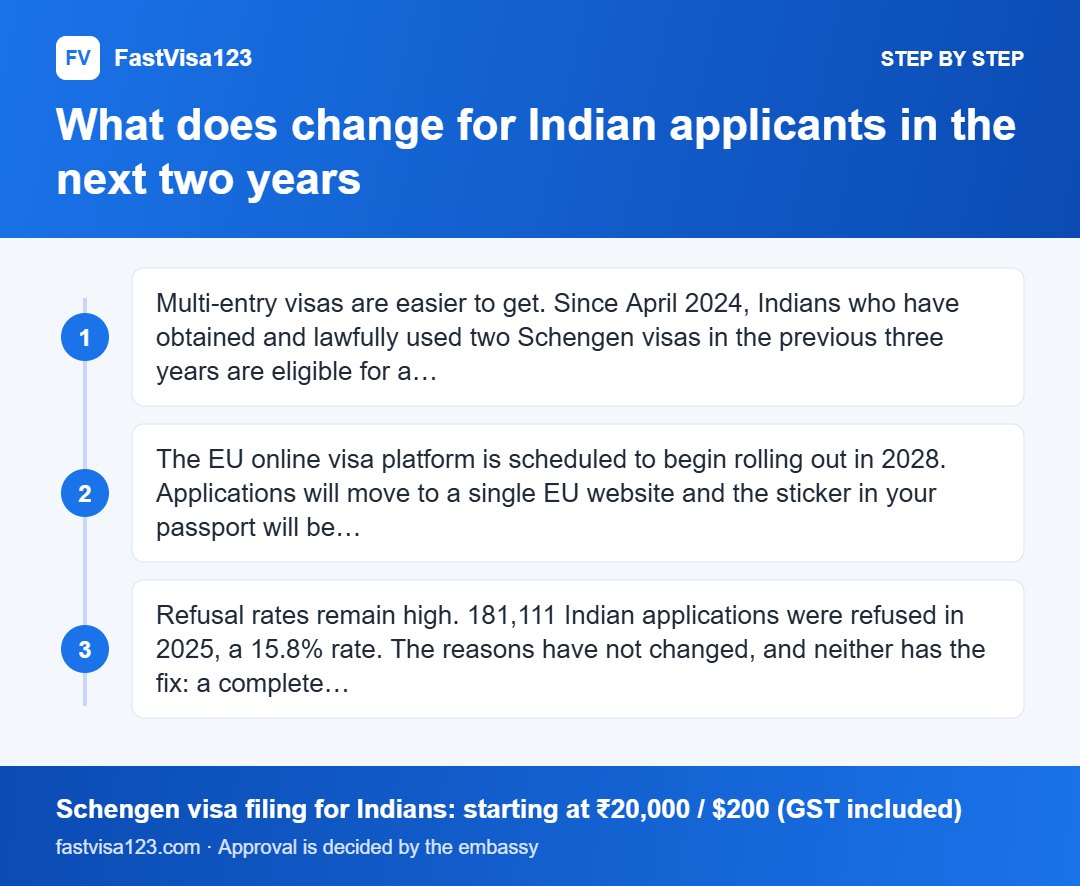
- Multi-entry visas are easier to get. Since April 2024, Indians who have obtained and lawfully used two Schengen visas in the previous three years are eligible for a two-year multiple-entry visa, normally followed by a five-year one. Details in our cascade visa guide.
- The EU online visa platform is scheduled to begin rolling out in 2028. Applications will move to a single EU website and the sticker in your passport will be replaced by a digital visa. First-time applicants will still visit a centre for biometrics. We explain what this means for Indians in our digital Schengen visa guide.
- Refusal rates remain high. 181,111 Indian applications were refused in 2025, a 15.8% rate. The reasons have not changed, and neither has the fix: a complete, consistent file. See why Schengen visas get refused for Indians.
Do
Apply for your Schengen visa exactly as before. Arrive early for your first border crossing to allow for EES enrolment. Check which passport each family member is travelling on.
Don’t
Pay any website for an “ETIAS for Indians”. Assume a visa-exempt relative can enter on your visa arrangements. Rely on passport stamps to count your days; EES counts them for you.
A quick way to remember it
ETIAS is a substitute for a visa. If you already need a visa, you are already covered. EES is a substitute for a passport stamp. Everyone gets it, visa or not. The Schengen visa itself is unchanged until the digital platform arrives in 2028.
Applying for a Schengen visa from India?
ETIAS is not your problem; the file is. FastVisa123 prepares your complete, consulate-ready application starting at ₹20,000 / $200 (GST included), with WhatsApp support until the decision.
Frequently asked questions
Do Indian citizens need ETIAS to visit Europe?
No. ETIAS applies only to nationals of visa-exempt countries. Indian passport holders need a Schengen visa, and visa holders are excluded from ETIAS by the regulation itself.
When does ETIAS start?
The EU removed its late-2026 launch date in July 2026 and has said it will announce a start date several months in advance. 2027 is the realistic expectation. It makes no difference to Indian visa holders either way.
I have an OCI card. Do I need ETIAS?
Not if you travel on your Indian passport; you need a Schengen visa as usual. OCI is an Indian document and has no bearing on EU entry rules.
My child has a British passport. Does she need ETIAS?
Yes, once ETIAS is live, any traveller using a visa-exempt passport will need it, including children (though under-18s are exempt from the €20 fee). Apply on the official EU site only.
What is the difference between ETIAS and EES?
ETIAS is a pre-travel authorisation for visa-free visitors. EES is the border system that records biometrics and entries/exits for all non-EU visitors, including Indians on a Schengen visa. EES is live; ETIAS is not yet.
Will EES affect my Schengen visa application?
No. EES operates at the border after your visa is issued. It does not change the documents, fees or process for applying in India.
Can a website apply for ETIAS on my behalf?
Indian citizens have nothing to apply for. Any site charging Indians an ETIAS fee is either wrong or fraudulent.