Last updated: June 2026 · Reviewed by the FastVisa123 documentation team · Written for Indian applicants.
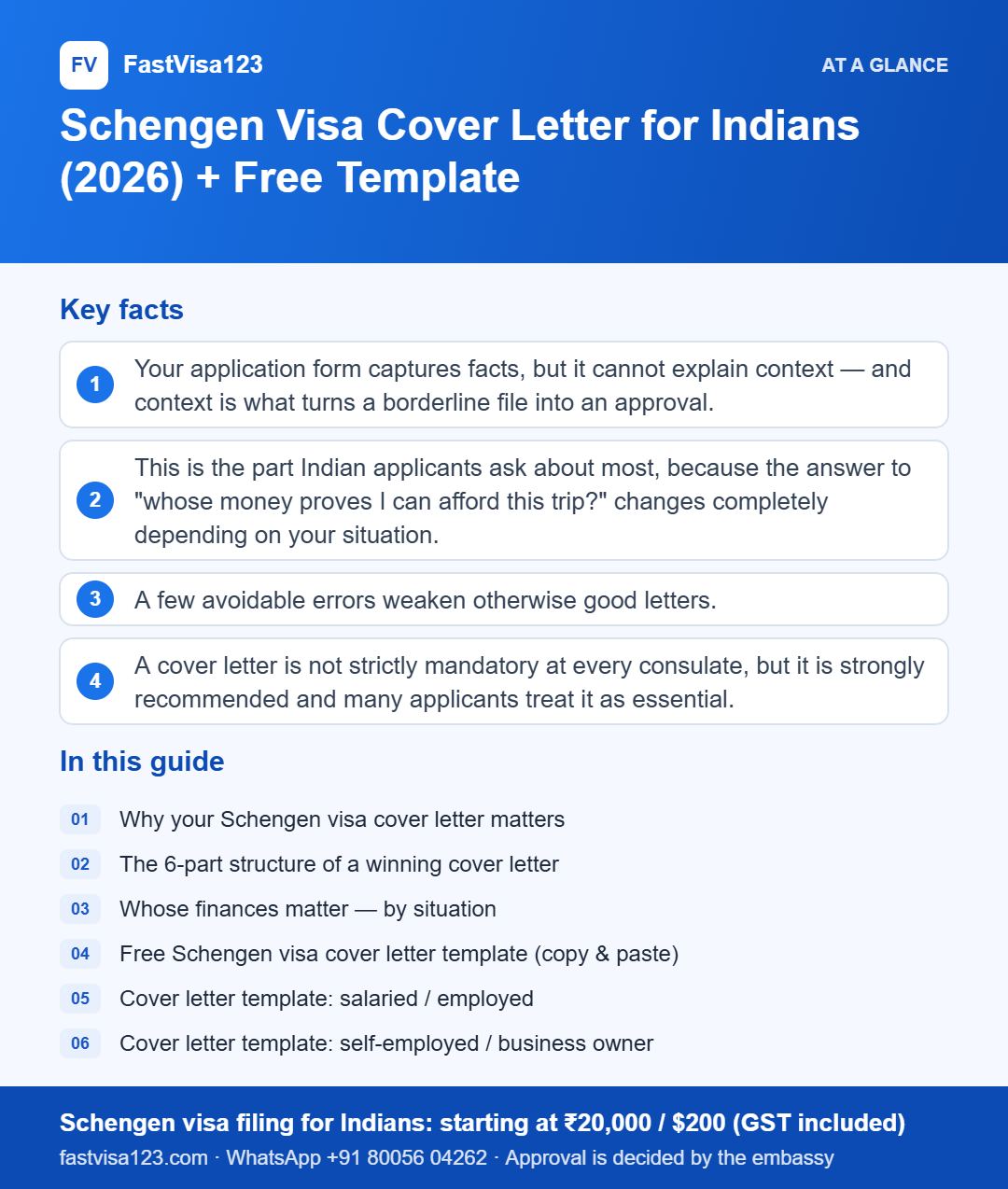
A strong Schengen visa cover letter is the one document where you get to speak directly to the visa officer — and it is far more powerful than most Indian applicants realise. It is not mandatory at every consulate, but a clear, well-structured cover letter ties your whole file together, explains anything unusual, and answers the officer’s biggest question before they even ask it: will you come back? This guide shows you exactly how to write a Schengen visa cover letter, gives you a free copy-paste template, explains whose finances matter in each situation, and includes tailored versions for salaried, self-employed, student and sponsored applicants.
Quick answer: A Schengen visa cover letter should be one page, addressed to “The Visa Officer,” and cover six things: who you are, your purpose of travel, your exact dates and itinerary, how the trip is funded, your travel insurance, and — most importantly — your strong ties to India that prove you will return. Whose finances you show depends on your situation: if you work, your own income; if you are a student or homemaker, your sponsor’s (usually a parent or spouse); and if someone in Europe is inviting you, their invitation letter and financial proof. Keep every name, date and amount identical to your documents.
Want a cover letter written around your exact profile?
FastVisa123 writes a consulate-style cover letter — plus your full file — starting at ₹20,000 / $200 (GST included).
- Why the cover letter matters
- The 6-part structure
- Whose finances matter — by situation
- Free copy-paste template
- Template: salaried
- Template: self-employed
- Template: student (parents’ income)
- Template: sponsored / invitation
- Mistakes to avoid
- Detailed FAQs
Why your Schengen visa cover letter matters
Your application form captures facts, but it cannot explain context — and context is what turns a borderline file into an approval. A Schengen visa cover letter lets you connect the dots: why you are travelling, how your documents prove you can afford it, and why you have every reason to return to India. For Indian applicants facing refusal rates of around 15%, that explanation is not a nice-to-have; it is your chance to pre-empt the officer’s doubts.
It is especially valuable when something in your file needs explaining — a recent large deposit, a gap in employment, a sponsor paying for your trip, or a complex multi-country itinerary. A good cover letter addresses these head-on, in plain language, so the officer is never left guessing.
The 6-part structure of a winning cover letter
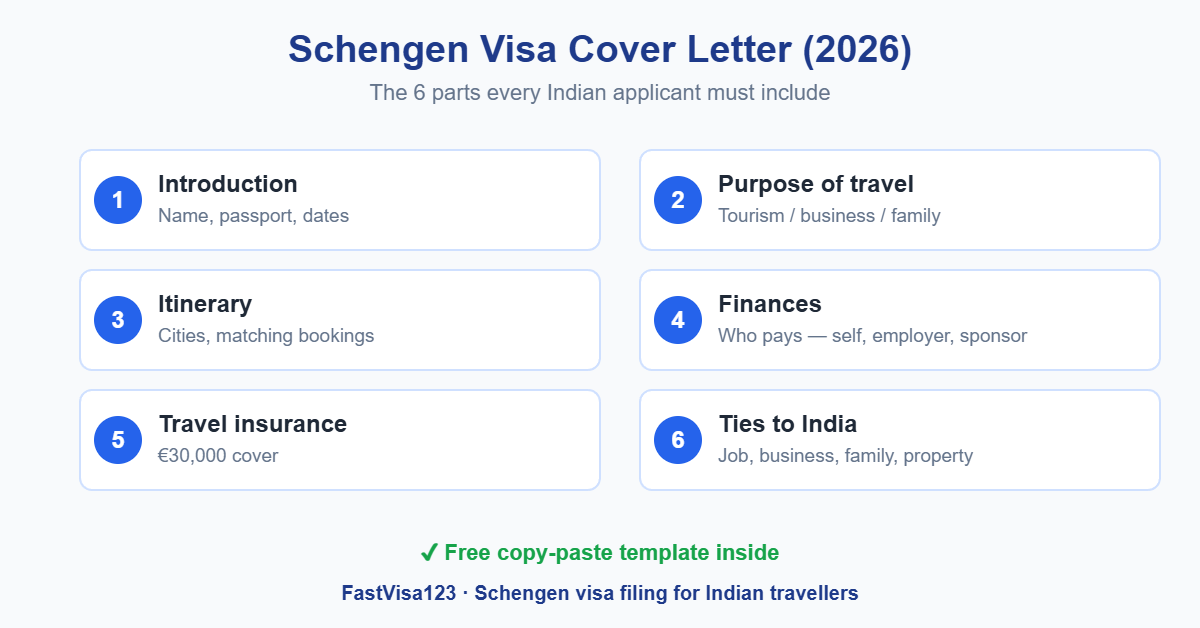
Keep it to a single page, in a clean font (Arial or Times New Roman, 12pt), addressed to “The Visa Officer.” Work through these six parts in order:
1. Introduction — your full name, passport number, nationality, visa type and travel dates, with your main destination and entry point.
2. Purpose of travel — tourism, business or family visit, plus any specific event.
3. Itinerary — a brief city-wise outline that matches your flights and hotels.
4. Financial means — how the trip is funded, referencing your bank statements and ITR.
5. Travel insurance — €30,000 cover valid across the Schengen area for the whole trip.
6. Ties to India — your job or business, family, property and commitments that guarantee your return.
Whose finances matter — by situation
This is the part Indian applicants ask about most, because the answer to “whose money proves I can afford this trip?” changes completely depending on your situation. Here is exactly how it works.
If you are actively working (salaried). Your own income is the centre of the file. Show your salary slips (last 3–6 months), your salary-account bank statements, Form 16/ITR, and an employer’s No-Objection Certificate confirming your job and approved leave. In the cover letter, state your designation, employer and that you are self-funding from your salary — your active employment is also your strongest tie to India.
If you are self-employed. Your business income is the proof. Show business registration (GST/Udyam/partnership/incorporation), business and personal bank statements, 2–3 years of ITR and GST returns, and write the letter on company letterhead. Your running business is both your funding and your reason to return.
If you are not working (student or homemaker). Because you have little or no income of your own, the consulate looks at your sponsor’s finances — almost always a parent or spouse. For a student, your parents’ income is central: include their bank statements, ITR/Form 16, a signed sponsorship letter, and proof of relationship (such as your birth certificate). For a homemaker, the spouse usually sponsors, with the same set of documents. Your cover letter should clearly name the sponsor, your relationship, and that they are covering all costs.
If someone in Europe is inviting you. When a host abroad — for example, your child or a relative — invites you, they provide an invitation letter with their address and your dates, a copy of their residence permit/passport proving legal status, and, if they are paying, their financial documents (bank statements and income proof) plus proof of your relationship. If you are self-funding despite the invitation, you still show your own funds. Either way, the cover letter must state who is paying and reference the host’s invitation and finances.
If you are retired. Use your pension statements, savings and fixed deposits, ITR if you file, and property/asset proof for ties. If children are funding the trip, add their sponsorship letter and financial documents, just like any sponsored case.
Confused about whose finances to show?
Tell us your situation and we’ll set up the right financial proof and write the cover letter to match — Starting at ₹20,000 / $200 (GST included).
Free Schengen visa cover letter template (copy & paste)
Replace everything in [brackets] with your details. This general version suits most tourist applications; profile-specific versions follow.
The Visa Officer
[Consulate / Embassy of the Country], [City]
Subject: Application for a Schengen short-stay (Type C) tourist visa — [Your Name], Passport [Number]
Dear Visa Officer,
I am [Your Name], an Indian national holding passport [Number]. I am applying for a Schengen short-stay tourist visa to visit [Country] from [entry date] to [exit date], entering through [city/airport].
The purpose of my trip is tourism. I plan to visit [cities], where I will [brief activities]. My day-wise itinerary, confirmed flight reservations and hotel bookings for the entire stay are enclosed.
The trip is self-funded from my personal savings. I enclose bank statements for the last [3–6] months and my income-tax returns as proof of sufficient funds for all travel, accommodation and expenses. I also hold travel medical insurance of €30,000, valid across all Schengen states for the full trip (enclosed).
I have strong ties to India that ensure my return: [your job/business], [family responsibilities] and [property/financial commitments]. I will return to India on [exit date] to resume my responsibilities.
I kindly request a Schengen visa for the stated dates and have enclosed all required documents.
Sincerely,
[Your Name] · [Signature]
A template gets you started — a tailored letter gets results
We customise every line to your profile and itinerary, included in our package starting at ₹20,000 / $200 (GST included).
Cover letter template: salaried / employed
Swap the funding and ties paragraphs with these, which lean on your job:
My ties to India are strong: I hold a stable, full-time position at [company] to which I must return on [date], and I have [family/property] in India.
Cover letter template: self-employed / business owner
Write this on your company letterhead:
My ties to India are strong: I own and actively run [business name], which requires my presence, and I have [family/property] in India. My business commitments guarantee my return on [exit date].
Cover letter template: student (parents’ income)
Students reference their studies and their parents as sponsor — parents’ income is central:
My ties to India are strong: I am enrolled in an ongoing course at [institution] that I must return to continue, and my family resides in India. I will return on [exit date].
Cover letter template: sponsored / invitation from family in Europe
When a host in Europe invites and/or funds you, name them and reference their invitation and finances:
My ties to India are strong: [your job/business/family/property in India], to which I will return on [exit date]. This is a temporary family visit and I will return as planned.
Not sure which version fits you?
Send us your profile and itinerary and we’ll write the right cover letter — Starting at ₹20,000 / $200 (GST included), 100% online.
Cover letter mistakes that cause refusals
A few avoidable errors weaken otherwise good letters. The most common is a generic, copy-pasted letter that doesn’t address your specific profile or itinerary. Close behind are details that don’t match the rest of your file — dates, cities, amounts or sponsor names that differ from your bookings and statements, which create exactly the “reasonable doubt” that leads to refusal.
Other pitfalls: making the letter too long (keep it to one page), being vague about who pays, leaving out the ties-to-India paragraph, and failing to explain anything unusual such as a recent large deposit or a sponsor relationship. For the bigger picture, see our guide to why Schengen visas get rejected, and make sure your full documents checklist is complete.
Detailed FAQs — including finances and sponsorship
Is a cover letter mandatory for a Schengen visa?
A cover letter is not strictly mandatory at every consulate, but it is strongly recommended and many applicants treat it as essential. It is the only place in your file where you can explain your purpose, your finances and your ties to India in your own words, helping the officer make sense of your documents quickly.
For Indian applicants in particular, where refusal rates hover around 15%, a clear cover letter is one of the cheapest and most effective ways to strengthen an application, so including a well-written one is almost always worth it.
Whose bank statements do I submit — mine or the sponsor’s?
It depends on who is paying. If you fund the trip yourself, you submit your own bank statements (last 3–6 months, bank-stamped) and ITR. If a sponsor pays — a parent for a student, a spouse for a homemaker, or a host abroad — then the sponsor’s bank statements and income proof are the key financial documents, along with a sponsorship letter and proof of relationship.
In many cases it helps to show both: the sponsor’s strong finances as the main proof, plus whatever savings you have of your own. The cover letter should state clearly whose money is funding the trip.
Does it matter whether I am actively working?
Yes, a great deal. If you are actively employed or running a business, your income and your job/business are both your funding and your strongest tie to India, which is exactly what the officer wants to see. Your NOC or business registration, salary slips or ITR, and bank statements carry the application.
If you are not working — a student, homemaker or between jobs — you cannot rely on your own income, so the file must lean clearly on a sponsor’s finances and on other ties to India such as family, property or ongoing study. Being upfront about your employment status in the cover letter is far better than leaving it ambiguous.
I am a student with no income — how do I show funds?
Through your sponsor, who is almost always a parent. Your parents’ income is central to the application: include their bank statements for the last three to six months, their ITR or Form 16, a signed sponsorship letter stating they will cover all your expenses, and proof of your relationship such as your birth certificate.
Your own contribution is your enrolment proof — a bonafide certificate and an institutional NOC for the travel dates — which shows you have a course to return to. The cover letter ties these together by naming your parent as sponsor and confirming they are funding the trip.
Someone in Europe is inviting me — what do they need to provide?
Your host provides an invitation letter with their full address and your dates of stay, plus a copy of their residence permit, visa or passport proving they live there legally. If the host is also paying for your trip, they provide their financial documents — bank statements and income or salary proof — and you include proof of your relationship to them.
Some consulates have an official invitation or sponsorship form issued by the host’s local authority; check your specific consulate. Your cover letter should name the host, state your relationship, confirm the invitation, and say clearly whether the host or you are funding the visit.
Can my parents or spouse sponsor me even if I have some income?
Yes. A sponsor can cover all or part of your trip regardless of whether you also earn, and showing a strong sponsor alongside your own funds only strengthens the file. Include the sponsor’s bank statements and income proof, a sponsorship letter, and proof of relationship, and reference all of it in your cover letter.
What matters to the officer is certainty about whose money is available for the trip, so make the funding arrangement explicit rather than leaving them to guess.
How much money or balance should be shown?
There is no single official figure, and it depends on your destination and trip length, but a common guide for Indian applicants is to show enough to comfortably cover the whole trip plus return — often around ₹1.5–3 lakh visible for a short trip, scaled up for longer stays. The balance should look stable over the last few months, not topped up suddenly just before applying.
When a sponsor pays, the sponsor’s account should show that comfortable, stable balance. The cover letter should reference these statements rather than quoting a specific number.
How long should the cover letter be and who do I address it to?
Keep it to a single page of four to six short paragraphs, and address it to “The Visa Officer” of the specific consulate or embassy you are applying to, rather than “To Whom It May Concern.” Naming the actual consulate and including a clear subject line with your name, passport number and visa type shows the letter was written for this application.
Concise and specific always beats long and generic — officers review many files a day and value a letter that makes its case quickly.
Does a strong cover letter guarantee approval?
No. A cover letter strengthens your application and can tip a borderline decision in your favour, but approval depends on your whole file — finances, ties, documents and consistency — and the final decision always rests with the consulate. No letter can rescue a fundamentally weak application or a missing requirement.
Think of it as the thread that ties strong documents into a convincing story; it works best when the documents behind it, including your financial proof, are already solid.
Can FastVisa123 write my Schengen visa cover letter?
Yes. A consulate-style cover letter is part of our service starting at ₹20,000 / $200 (GST included), written around your exact profile — salaried, self-employed, student with parental sponsorship, retired, or visiting family on an invitation — and your itinerary. We set up the right financial proof for your situation and make sure every name, date and amount matches your file.
We also build the rest of your application — appointment, flights, hotels, itinerary, insurance and a full document check — so the cover letter sits on top of a complete, consistent file. We never guarantee approval, as that is the embassy’s decision, but we present you in the strongest possible light.
Get a cover letter that does its job
Written around your profile, finances and itinerary — part of your complete ₹20,000+ / $200+ (GST included) file.
Sources & methodology
Primary reference: the EU Visa Code (Regulation 810/2009).
Based on standard Schengen consulate cover-letter expectations for Indian applicants and the EU Visa Code’s emphasis on purpose, means of subsistence and intention to return. The templates are starting points; requirements vary by consulate and visa type, so always tailor your letter and confirm document requirements with the relevant consulate or VFS before applying. FastVisa123 is a private visa-filing consultancy; visa approval is at the sole discretion of the embassy and we do not influence consular decisions.
Schengen visa cover letter: what to do vs what to avoid
Writing a cover letter that works — at a glance.
✅ What to do
- State a specific purpose and your exact dates
- Prove concrete ties to India
- Keep it fully consistent with your other documents
- Keep it concise, factual and polite
❌ What to avoid
- Use a generic, agent-written template
- Contradict your itinerary or finances
- Ramble, exaggerate or sound desperate
- Leave out your return-to-India reasons
Apply for your tourist visa — country guides
- Germany tourist visa from India
- France tourist visa from India
- Switzerland tourist visa from India
- Italy tourist visa from India
- Spain tourist visa from India
We file your complete, embassy-ready Schengen application starting at ₹20,000 / $200 (GST included).
Salaried applicant? See employment letter & NOC for your visa.
Official source: European Commission — official Schengen visa policy