Last updated: June 2026 · Reviewed by the FastVisa123 documentation team · Based on official EU information on the Entry/Exit System (EES).
The EU Entry/Exit System (EES) is the biggest change to how Indians actually enter Europe in years — and unlike most visa news, it affects you at the airport, not on the application form. Since it became fully operational on 10 April 2026, the familiar passport stamp has been replaced by a digital, biometric record of every entry and exit. This guide explains exactly what the EU Entry/Exit System means for Indian travellers, what you must do at the border, and how it differs from ETIAS — and answers the most commonly asked questions in detail.
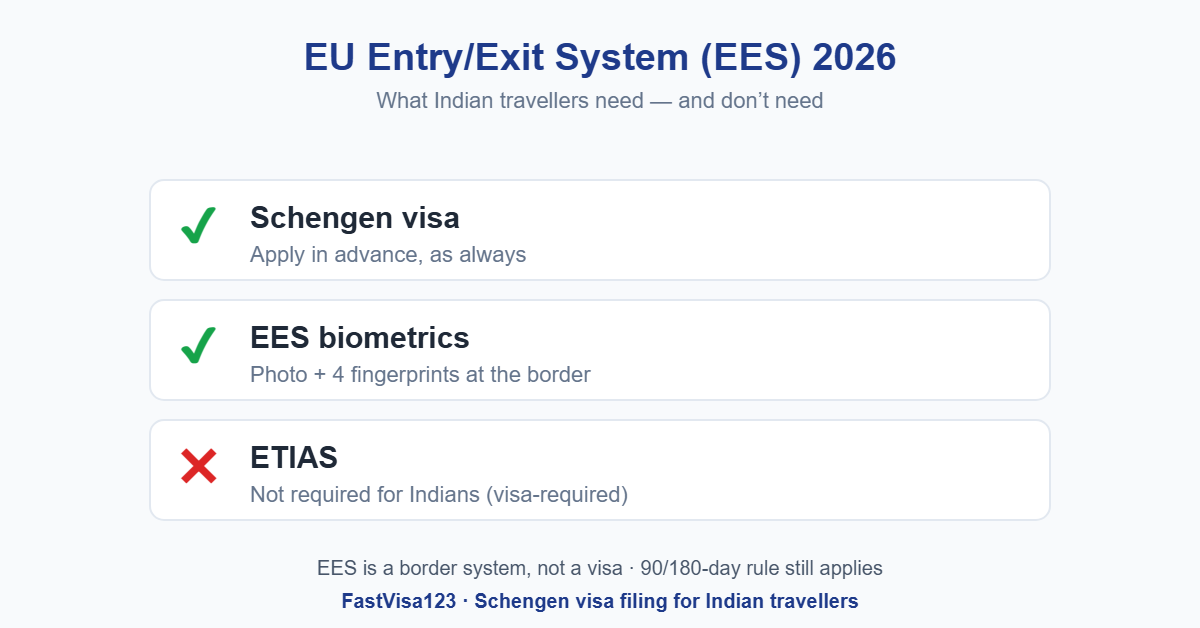
Quick answer: The EU Entry/Exit System (EES) is an automated border system, not a visa and not a travel authorisation. As an Indian traveller you still need a Schengen visa exactly as before. On your first entry under EES you give a facial photo and four fingerprints — a one-time registration valid for three years — and the system then records each entry and exit digitally instead of stamping your passport. There is no separate EES application and no EES fee; it all happens at the border.
EES doesn’t replace your visa — you still need one
FastVisa123 builds your complete, embassy-ready Schengen file for a flat ₹10,000 so the only thing left is a quick biometric scan at the border.
What is the EU Entry/Exit System (EES)?
The EU Entry/Exit System is a centralised, EU-wide digital border system that records the entries and exits of non-EU (third-country) nationals each time they cross an external Schengen border. It went live in phases from October 2025 and became fully operational at all air, land and sea borders on 10 April 2026. In simple terms, the EU Entry/Exit System replaces the manual passport stamp with an automated electronic record linked to your biometrics.
For every trip, the system logs the date and place of your entry and exit, your passport details, and whether you were refused entry. The first time you cross the border after the rollout, it also captures your biometric data — a facial image and four fingerprints — and stores it for three years. This is what allows the EU Entry/Exit System to recognise you quickly on later trips and to calculate your permitted stay automatically.
The goal is twofold: faster, more reliable border checks over time, and accurate enforcement of how long visitors stay. Because the system tracks your days electronically, the era of an officer squinting at faded stamps to work out whether you have overstayed is over.
Does the EU Entry/Exit System apply to Indian travellers?
Yes. The EU Entry/Exit System applies to all non-EU nationals travelling to the Schengen area for a short stay, and that includes Indian passport holders. The single most important point is this: the EU Entry/Exit System does not change the fact that you still need a Schengen visa. India is not on the visa-exempt list, so you must apply for and obtain your short-stay (Type C) visa exactly as before, then your entries and exits on that visa are recorded by EES at the border.
In other words, EES is an extra step that happens after you already hold a valid visa and arrive at the border — not a replacement for the visa, and not something you apply for in advance.
Get the visa right first
EES is quick at the border — the real work is a strong visa file. We prepare yours end to end for a flat ₹10,000.
What you do at the border under EES, step by step
Step 1 — Present your passport and visa. Your passport is scanned and your visa details are read and linked to a new EES record created in your name.
Step 2 — Give your biometrics. You provide a facial photograph and four fingerprints. This biometric registration is a one-time step that stays valid for three years, so you will not repeat the full process on every trip.
Step 3 — Answer a few basic questions. As before, you may be asked about the purpose of your visit, how long you intend to stay, and where you are staying. Your answers should match your visa application and documents.
Step 4 — Entry is recorded. Instead of a stamp, the system logs your entry electronically. On exit, the same happens in reverse, completing the record for that trip.
On your later trips within the three-year window, you simply have your fingerprints or face matched against the data already stored, which makes the crossing quicker than the first time.
How much longer will EES take?
For your very first entry after the rollout, the biometric registration can add roughly 5 to 10 minutes per traveller, and queues at busy airports may be longer than usual while everyone adjusts. It is sensible to arrive with extra time in hand — many advisories suggest reaching the airport three to four hours before a long-haul flight during this transition period. Subsequent crossings, where your biometrics are simply matched, are designed to be faster than the old manual checks once the system settles in.
EES and the 90/180-day rule
The EU Entry/Exit System does not change the 90/180 rule, but it does enforce it far more precisely. You may still stay a maximum of 90 days within any rolling 180-day period across the Schengen area. The difference is that the system now counts your days automatically and accurately from your recorded entries and exits, so there is no room for the small miscalculations that manual stamps sometimes allowed. The practical takeaway is to track your own days carefully, because overstaying is now recorded instantly — and an overstay can hurt future visa applications and your eligibility for long-term cascade multiple-entry visas.
EES vs ETIAS — the key difference for Indians
These two are constantly confused, so here is the clear distinction. EES is a border system that registers your entries and exits using biometrics — it happens at the border and applies to you as an Indian visa holder. ETIAS, expected later in 2026, is a pre-travel authorisation for visa-exempt nationalities only. Because Indians require a Schengen visa, ETIAS does not apply to you — you will not need to apply for ETIAS, and you should be wary of any website asking you to pay for an “ETIAS for India.” Your path remains: obtain a Schengen visa, then complete EES biometrics at the border.
In one line: Indians need a Schengen visa (apply in advance) and complete EES (biometrics at the border). Indians do not need ETIAS.
How to prepare for EES as an Indian traveller
There is no EES application to fill in and no EES fee to pay, so preparation is mostly about smooth travel. Make sure your Schengen visa is valid and correct for your trip, carry your supporting documents (accommodation, return travel, funds and €30,000 travel insurance) as you always would, and arrive early at the airport for your first post-rollout entry to allow for biometric registration. Keep an eye on your own day count under the 90/180 rule, and be ready for the kiosk to capture your photo and fingerprints. That is genuinely all there is to it from the EES side.
Planning a Europe trip in 2026?
We’ll handle the visa — appointment, cover letter, flights, hotels, itinerary and document check — for a flat ₹10,000, 100% online.
Most commonly asked questions about the EU Entry/Exit System
Do Indians still need a Schengen visa now that EES is live?
Yes, absolutely. The EU Entry/Exit System is a border-control system, not a visa or a replacement for one. India is not on the Schengen visa-exempt list, so every Indian traveller still has to apply for and obtain a short-stay (Type C) Schengen visa before travelling, exactly as before. EES simply records your entries and exits on that visa once you reach the border. Anyone telling you that EES removes the need for a visa is mistaken.
When did EES start, and is it active everywhere?
EES began a phased rollout from October 2025 and became fully operational across all Schengen external borders — air, land and sea — on 10 April 2026. That means whichever Schengen country you fly into, drive into, or arrive by sea, the EES process now applies on entry and exit. During the early transition some borders ran more smoothly than others, so allowing extra time remains wise for now.
What biometric data does EES collect, and how long is it kept?
On your first entry after the rollout, EES captures a facial image and four fingerprints, along with your passport details and travel information. This biometric registration is a one-time step that remains valid for three years, after which it would be captured again. On trips within that three-year window, the system simply matches your stored biometrics rather than re-enrolling you, which speeds up the crossing.
Is there a fee to register for EES?
No. There is no separate EES application and no EES registration fee for travellers — it is a border process that happens automatically when you arrive. This is one of the main differences from ETIAS, which is a paid pre-travel authorisation for visa-exempt nationalities. For Indians, you pay your normal Schengen visa fee when you apply, and EES at the border costs nothing extra.
Do I need to register online or do anything before I travel for EES?
No. Unlike ETIAS, EES has no online application and no advance steps — there is nothing to fill in, pay, or upload beforehand. The entire EES process is completed at the border on arrival, when a kiosk or officer captures your biometrics and links them to your passport and visa. Your only advance task as an Indian traveller is the one you already know: obtaining your Schengen visa.
How much extra time should I allow at the airport?
For your first entry under EES, the biometric registration can add about 5 to 10 minutes per traveller, and overall queues may be longer than usual during the transition while the system and staff settle in. It is wise to arrive at the airport with plenty of buffer — commonly suggested as three to four hours before a long-haul departure during this period. Once your biometrics are on file, later crossings are designed to be quicker.
Does EES change the 90/180-day rule?
No, the rule itself is unchanged — you may still stay a maximum of 90 days in any rolling 180-day period. What changes is enforcement: EES now counts your days automatically and precisely from your recorded entries and exits, leaving no room for the rough counting that manual stamps sometimes allowed. This makes it more important than ever to track your own days, because an overstay is now logged instantly and can damage future visa applications.
Do I need ETIAS as an Indian traveller?
No. ETIAS is a pre-travel authorisation designed for visa-exempt nationalities, and because Indians require a Schengen visa, ETIAS does not apply to you. You should not pay any website claiming to sell “ETIAS for Indians.” Your requirements remain a valid Schengen visa obtained in advance and EES biometric registration completed at the border on arrival.
Are children also registered under EES?
Children are included in the EES, but with one key difference: those below the age of 12 do not have to give fingerprints, although a facial image is still recorded. Older children and adults provide both the facial image and four fingerprints. Families should still factor in a little extra time at the border for the first registration, since each traveller in the group needs their own record created.
What happens at EES when I leave the Schengen area?
Your exit is recorded the same way your entry was — your passport is scanned and your biometrics matched, and the system logs the date and place of departure. This entry-and-exit pairing is what allows EES to calculate exactly how many days you spent inside the Schengen area. Making sure your exit is properly recorded is important, because a missing exit could otherwise make it look like you overstayed.
Can I be refused entry because of EES?
EES itself does not decide who enters — that remains the border officer’s decision based on your visa, documents and the usual entry conditions. What EES does is make the officer’s information more complete and accurate, including your travel history and any past overstays or refusals. So while EES will not refuse you on its own, travelling with a valid visa, honest answers and a clean record matters as much as ever.
Is EES the same as the new digital Schengen visa?
No, they are separate things. EES is a biometric border system that records entries and exits. The digital Schengen visa, being rolled out separately, refers to applying for and receiving the visa online rather than via paper and stickers. You could eventually apply for your visa digitally and still complete EES biometrics at the border — they address different stages of the journey, the application and the crossing.
What if the EES kiosk can’t read my fingerprints?
If a self-service kiosk cannot capture your biometrics cleanly, a border officer will complete the registration manually, so you will still be processed — it may simply take a little longer. This is one more reason to allow extra time at the airport for your first post-rollout entry. Minor issues like dry skin can affect fingerprint scans, and staff are equipped to handle them.
Will EES affect my connecting flight within Europe?
EES registration happens when you first cross an external Schengen border, so if your first Schengen entry point is also where you connect, build in extra time for the biometric step before your onward flight. If you transit through a non-Schengen hub and enter the Schengen area later, EES applies at that later entry point instead. Either way, the safest approach during the transition is generous connection times.
How can FastVisa123 help me travel smoothly under the new system?
EES itself is handled at the border and needs no application, so where we help is the part that genuinely decides whether your trip happens: the Schengen visa. For a flat ₹10,000, all-inclusive, we assess your profile, choose the correct country for your itinerary, and build your complete embassy-ready file — VFS appointment, a tailored cover letter, verifiable flight and hotel reservations, a day-wise itinerary, travel insurance and a full document check. We also guide you on the 90/180 rule and on keeping a clean record, which protects your eligibility for long-term cascade visas later. We never guarantee approval, as that is the embassy’s decision, but we make sure nothing is missing on your appointment day.
Ready for Europe in 2026?
Let us build your Schengen visa file so the border is the easy part.
Sources & methodology
Based on official EU information on the Entry/Exit System (EES) from the Council of the EU and the European Commission, plus reputable reporting (Euronews and others). EES became fully operational on 10 April 2026. Procedures and timings can change and may vary by border — always check official guidance and your airline before travelling. FastVisa123 is a private visa-filing consultancy; visa approval is at the sole discretion of the embassy and we do not influence consular or border decisions.
EU Entry/Exit System: what to do vs what to avoid
Staying compliant under EES — at a glance.
✅ What to do
- Complete biometrics calmly on first entry
- Track your days under the 90/180 rule
- Exit before your permitted limit
- Keep your entry and exit history clean
❌ What to avoid
- Assume passport stamps still apply — they do not
- Overstay; it is auto-flagged across all 29 states
- Ignore the 90/180-day calculation
- Treat an unintentional overstay as harmless
Apply for your tourist visa — country guides
- Germany tourist visa from India
- France tourist visa from India
- Switzerland tourist visa from India
- Italy tourist visa from India
- Spain tourist visa from India
We file your complete, embassy-ready Schengen application for a flat ₹10,000.
Planning your route? See new Schengen members: Croatia, Bulgaria & Romania.
Worried about the 90-day limit? See what happens if you overstay a Schengen visa.
Official source: European Commission — official Schengen visa policy