The European Commission published its 2025 Schengen visa statistics on 28 May 2026. For Indian applicants the headline numbers are: 1.15 million applications, 181,111 refusals, and a 15.8% refusal rate. India remained the third-largest source of Schengen applications in the world, behind China (1.8 million) and Turkey (1.25 million).
Globally the picture was slightly better: nearly 12 million applications, over 10 million visas issued, and a refusal rate of 14.8% (unchanged from 2024). Indians were refused a little more often than the world average, and far more often at some consulates than others. This guide breaks the numbers down and, more usefully, explains what to do with them.
2025 in numbers
- Indian applications: 1,150,000+ (third globally)
- Refused: 181,111 (15.8%)
- Fees lost on refused applications: roughly €16 million, around ₹150 crore, since the €90 fee is never refunded
- Highest refusal rate: Slovenia, 46.1%
- Lowest among major consulates: Germany, 10.5%
- Most Indian applications processed: Germany, 153,000+
- Share of all visas issued worldwide that were multiple-entry: 51.2%

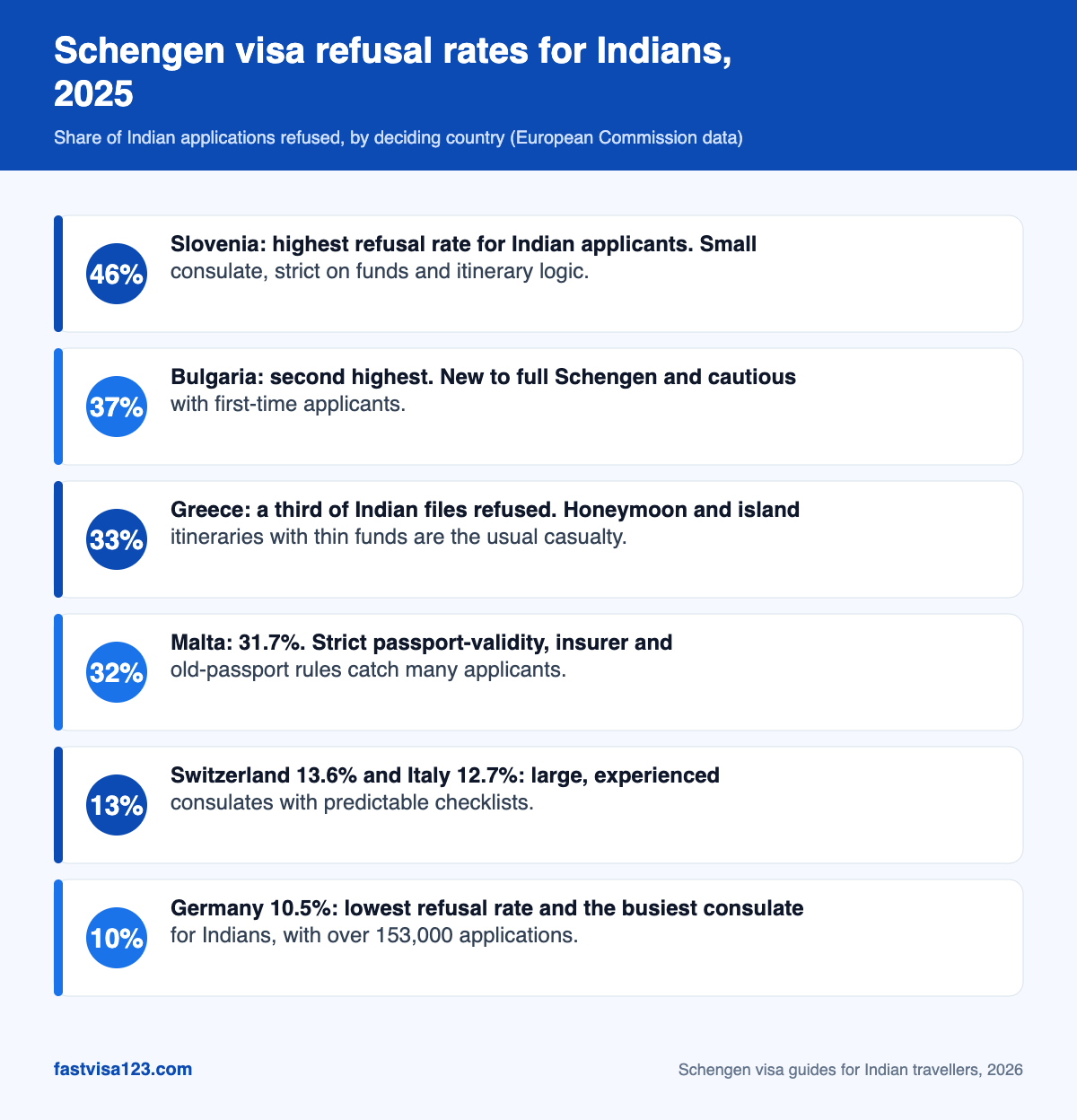
Refusal rate by country: where Indians get refused most
The single most useful thing in the dataset is the spread between consulates. The same Indian applicant, with the same documents, faces a very different probability of refusal depending on which country decides the file.
| Deciding country | 2025 refusal rate for Indian applicants | What drives it |
|---|---|---|
| Slovenia | 46.1% | Tiny consulate; treats itinerary logic and funds strictly; many “main destination” mismatches |
| Bulgaria | 37.0% | Full Schengen member only since 2025; conservative with new applicants |
| Greece | 33.0% | Very high volume of honeymoon and island trips; refuses on funds and return intent |
| Malta | 31.7% | Extra rules: 8 months’ passport validity, old passports, approved insurers |
| Estonia | 30.1% | Small consulate, strict on purpose of stay |
| Switzerland | 13.6% | Large, experienced; predictable checklist; decides in Bern |
| Italy | 12.7% | High volume, clear regional jurisdiction, consistent decisions |
| Germany | 10.5% | Biggest processor of Indian files; clear rules; strong on documentation, forgiving on presentation |
Two cautions. First, refusal rate is not the same as “easiness”: Germany refuses fewer people partly because Germany-bound applicants tend to be better prepared (business travel, family visits with formal invitations). Second, you cannot simply choose Germany: the main-destination rule decides which consulate is competent for your trip. What the numbers tell you is where a marginal file is most likely to be turned down, and therefore where the file needs to be strongest.
Why 181,111 Indians were refused
The Commission does not publish refusal reasons by nationality, but the refusal form is standardised across all consulates and the reasons Indian applicants report are consistent year after year. From the refusal letters we review, the grounds cluster into four groups:
- Means of subsistence not proven (box 3 on the refusal form). Bank statements too short, balance too low for the trip length, or sudden deposits that look borrowed. See our guide to proof of funds by country.
- Purpose and conditions of stay not justified (box 2 and box 10). Itineraries that do not match bookings, cover letters that do not explain the trip, unverifiable hotel reservations.
- Intention to leave not established (box 13). The consulate is not convinced you will return: weak employment evidence, no property, first trip abroad, single applicant with family ties abroad.
- Documents not reliable (box 12). Bank statements that cannot be verified, invitation letters with inconsistencies, dummy bookings that were cancelled before the decision.

Every one of these is visible in the file before submission. We decode each tick-box, with the fix for each, in Your refusal letter decoded.
What changed between 2024 and 2025
- Volume rose. Indian applications grew again as post-pandemic travel normalised, keeping India in third place worldwide.
- The refusal rate barely moved. 2024 was around 15%; 2025 was 15.8%. Consulates did not get softer.
- Multi-entry visas became more common. Just over half of all visas issued worldwide in 2025 were multiple-entry. For Indians, the April 2024 cascade rules (two visas used in three years earns a two-year visa, then a five-year one) are now flowing through. Our cascade guide explains eligibility.
- Bulgaria and Romania appear for the first time as full Schengen deciders, and Bulgaria’s 37% rate shows a consulate still calibrating.
How to use these numbers when you plan a trip
Do
Build the itinerary so that the main-destination rule points at a consulate with a track record you can prepare for. If the trip must go through Greece or Slovenia, treat the funds and itinerary sections as the whole application. Read the country’s own refusal guide before you file.
Don’t
Apply to Germany for a trip that is mostly Greece; that is a jurisdiction refusal, not a shortcut. Assume a low refusal rate means a light check. Treat a first refusal as a random event; the letter tells you exactly what to fix.
Where the data comes from
All figures are from the European Commission’s annual short-stay visa statistics for 2025, released on 28 May 2026, as reported by Indian and international press. Country-level rates are calculated as refusals divided by applications decided, for applicants lodging in India. Refusal reasons are from the standard Annex VI form of the EU Visa Code and from refusal letters shared with us by applicants; the Commission does not publish reasons by nationality.
Refused in 2025 or 2026? Send us the letter
We read your refusal letter free, tell you honestly whether to appeal or reapply, and rebuild the file so the same box is not ticked twice.
Frequently asked questions
How many Indians applied for Schengen visas in 2025?
More than 1.15 million, making India the third-largest source of applications after China and Turkey.
What was the Schengen visa refusal rate for Indians in 2025?
15.8%. 181,111 applications were refused. The global average was 14.8%.
Which country refuses Indian applicants the most?
Slovenia, at 46.1% in 2025, followed by Bulgaria (37%), Greece (33%), Malta (31.7%) and Estonia (30.1%).
Which country has the lowest refusal rate for Indians?
Among major consulates, Germany at 10.5%, then Italy (12.7%) and Switzerland (13.6%). Germany also processed the most Indian applications, over 153,000.
How much money did Indians lose on refused applications?
The €90 fee is non-refundable. 181,111 refusals multiplied by €90 is roughly €16 million, around ₹150 crore, before VFS charges, insurance and bookings.
Can I choose to apply to Germany because its refusal rate is low?
Only if Germany is your main destination under the Schengen rules. Applying to a consulate that is not competent for your trip is itself a refusal ground.
Are the 2025 refusal reasons published?
Not by nationality. The reasons come from the standard refusal form, which is the same for all consulates; funds, purpose of stay, intention to return and document reliability dominate for Indian applicants.