The European Union is building a single online platform for Schengen visa applications, and a digital visa that replaces the sticker in your passport. The Council adopted the regulation in November 2023; the platform is scheduled to begin a gradual rollout in 2028, country by country. Until it reaches the consulate you apply to, nothing changes: you still apply through VFS Global or BLS International in India, on paper, and receive a sticker visa.
This guide explains what the digital platform will do, what it will not do, and, most importantly for Indian applicants, why the biggest source of refusals is untouched by any of it.
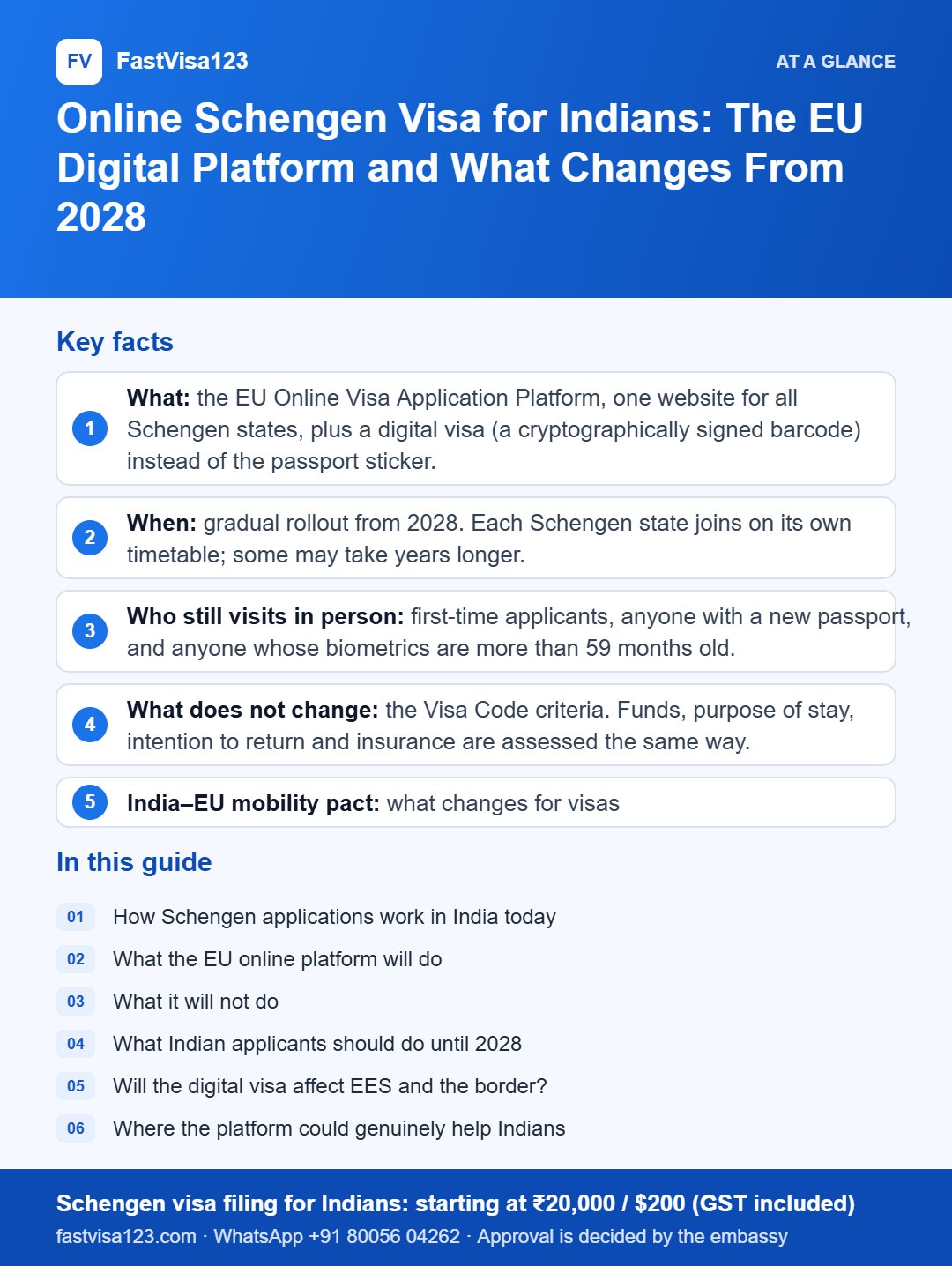
Key facts at a glance
- What: the EU Online Visa Application Platform, one website for all Schengen states, plus a digital visa (a cryptographically signed barcode) instead of the passport sticker.
- When: gradual rollout from 2028. Each Schengen state joins on its own timetable; some may take years longer.
- Who still visits in person: first-time applicants, anyone with a new passport, and anyone whose biometrics are more than 59 months old.
- What does not change: the Visa Code criteria. Funds, purpose of stay, intention to return and insurance are assessed the same way.
- India–EU mobility pact: what changes for visas
How Schengen applications work in India today
Every Schengen state runs its own process through an outsourced centre. In India that is VFS Global for almost every country and BLS International for Spain. You choose the consulate of your main destination, fill the country’s form, book an appointment, submit paper documents and biometrics at the centre, and wait for a decision. The visa arrives as a sticker in your passport. Our step-by-step application guide walks through the whole thing.
The friction is obvious: 29 countries, 29 forms, appointment scarcity at peak season, and no way to apply without a physical visit. The digital platform is meant to remove most of that.
What the EU online platform will do
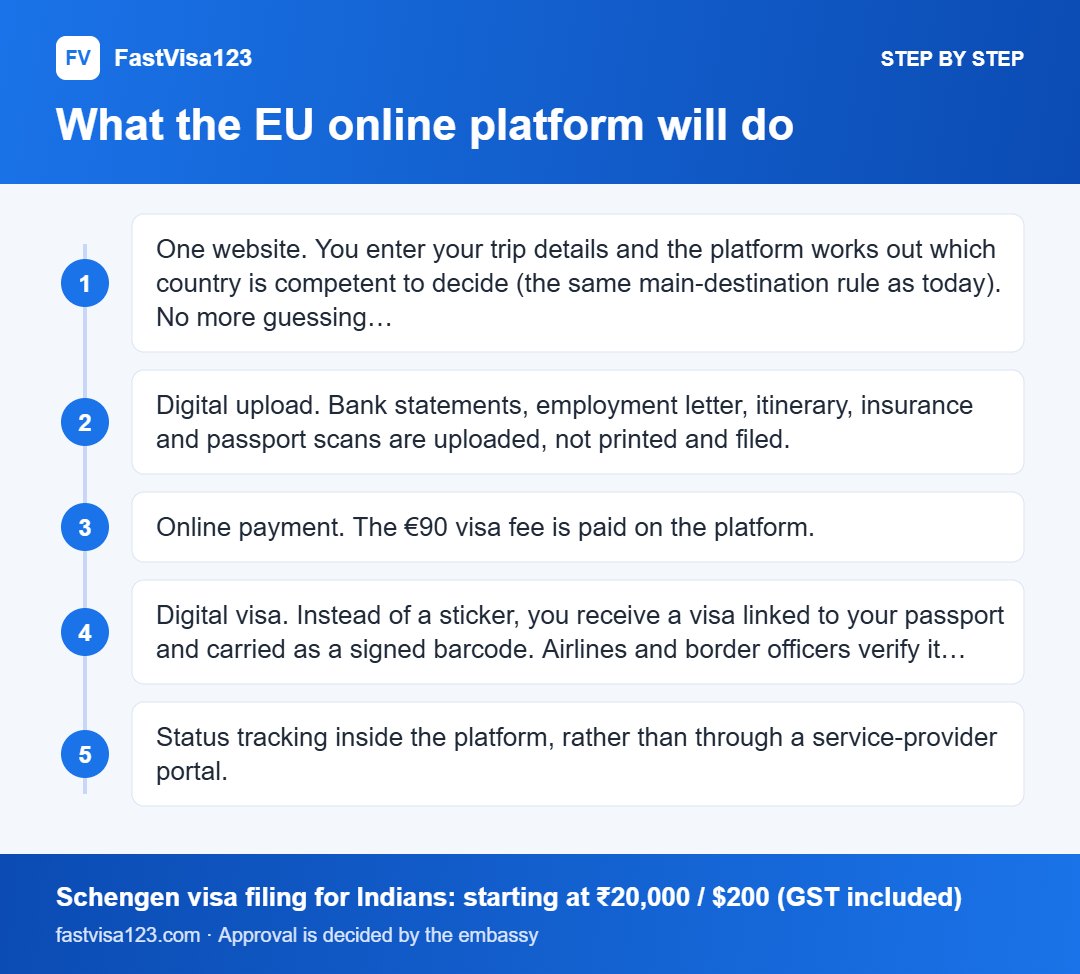
- One website. You enter your trip details and the platform works out which country is competent to decide (the same main-destination rule as today). No more guessing which consulate is yours.
- Digital upload. Bank statements, employment letter, itinerary, insurance and passport scans are uploaded, not printed and filed.
- Online payment. The €90 visa fee is paid on the platform.
- Digital visa. Instead of a sticker, you receive a visa linked to your passport and carried as a signed barcode. Airlines and border officers verify it electronically.
- Status tracking inside the platform, rather than through a service-provider portal.
What it will not do
This is where the marketing claims you may have seen (“Schengen visa fully online, no more VFS!”) go wrong.
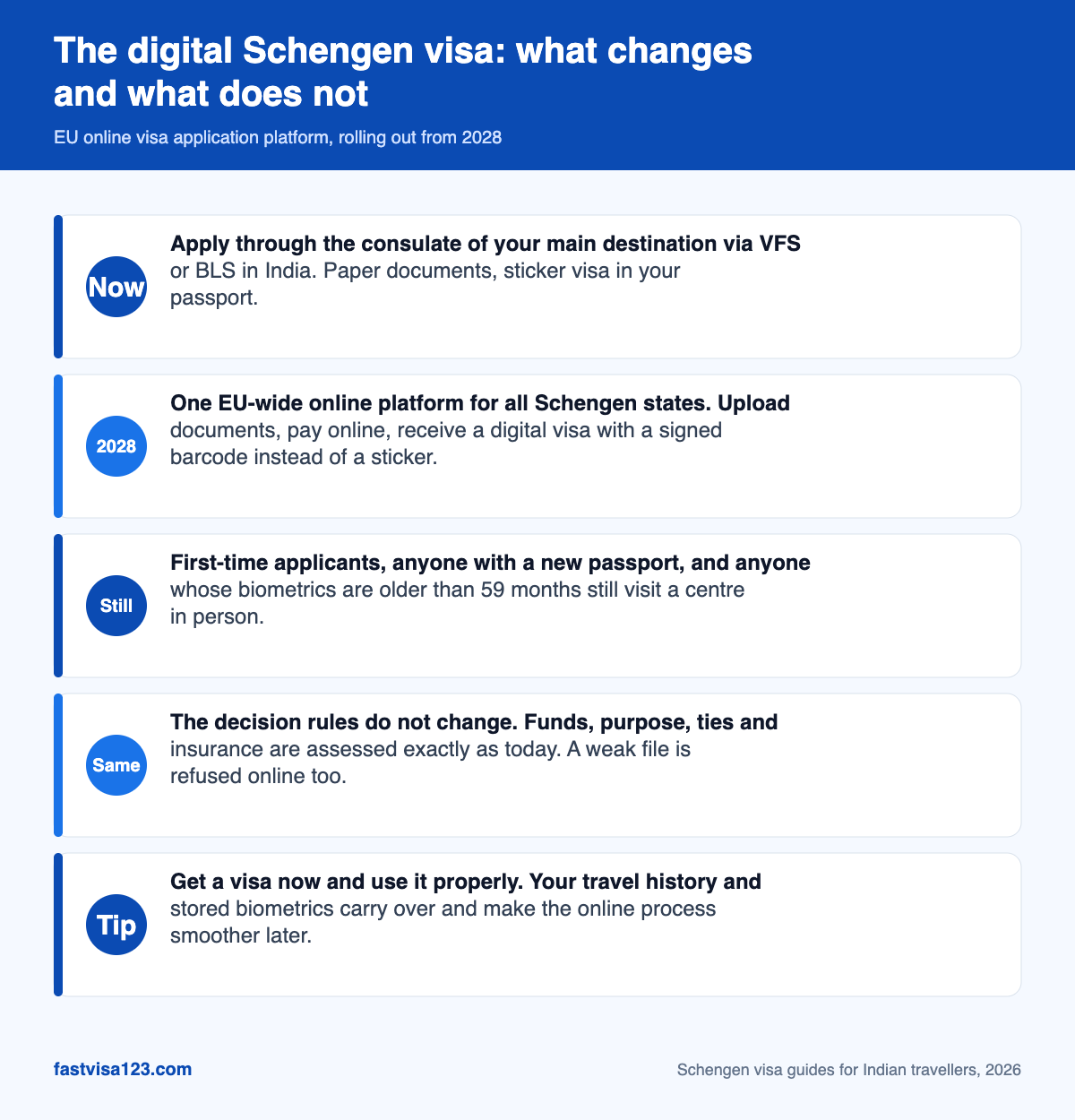
- It will not remove the in-person visit for first-timers. If you have never given fingerprints for a Schengen visa, or your last set is more than 59 months old, or you hold a new passport, you will still visit a centre for biometric enrolment and passport verification. Only repeat applicants with valid biometrics on file get a fully remote process. See our 59-month fingerprint reuse guide for how that rule already works.
- It will not change what gets you approved. The platform is a delivery mechanism. The consulate officer still applies Article 21 of the Visa Code: purpose, means, intention to return, insurance, and the reliability of your documents. A thin bank statement is refused online exactly as it is refused on paper.
- It will not arrive everywhere at once. The regulation allows a transition period. A consulate that is slow to join keeps its current process. Expect a patchwork through 2028 and beyond.
- It will not speed up decisions on its own. The 15-day processing standard (extendable to 45) is unchanged.
What Indian applicants should do until 2028
Do
Apply and travel now. Every visa you obtain and use correctly builds the history that earns multi-entry visas under the cascade rule, and your stored biometrics make the future online process smoother. Keep your passport valid for the long term so the biometric link is not broken by a renewal.
Don’t
Wait for the platform before planning a trip. Pay any site that claims to offer “the new online Schengen visa” today; it does not exist yet. Assume a digital visa means a lighter document check.
Will the digital visa affect EES and the border?
The digital visa is designed to work with the Entry/Exit System. Your visa is linked to your passport number and biometrics, and the EES record created at the border is linked to the same passport. Airlines check the barcode at boarding; border officers see your visa and your EES history on one screen. For you it means less paper, but the same rules: the 90/180-day limit is counted automatically, and the visa’s validity and permitted stay are exactly what the consulate decided. Our EES guide explains the border side.
Where the platform could genuinely help Indians
Three pain points are specific to applying from India, and the platform addresses two of them:
| Pain point today | After the platform |
|---|---|
| Appointment slots at VFS run out weeks ahead in summer | Repeat applicants with valid biometrics skip the centre entirely; slot pressure falls for everyone else |
| Wrong-consulate refusals when itineraries cover several countries | The platform calculates the competent state from your itinerary before you submit |
| High refusal rates on funds and ties | No change. This is a file-quality problem, not a process problem |
That last row is the one to focus on. In 2025, 181,111 Indian applications were refused, a 15.8% rate. The reasons are documented, predictable and fixable in advance, which is exactly what we do for every file we prepare.
Want the file done right, today?
The platform is years away and the assessment rules will not change. FastVisa123 prepares your complete Schengen application from India starting at ₹20,000 / $200 (GST included), appointment included.
Frequently asked questions
Can Indians apply for a Schengen visa online right now?
No. In 2026 every Schengen application from India goes through VFS Global (or BLS International for Spain) with an in-person appointment. Some countries let you fill the form online first, but submission is still physical.
When will the online Schengen visa platform launch?
The EU regulation sets a gradual rollout starting in 2028. Individual countries join on their own schedule, so the exact date for the consulate you use may be later.
Will first-time applicants still have to visit VFS after 2028?
Yes. First-time applicants, people with new passports, and anyone whose biometrics are older than 59 months must still attend a centre for fingerprints and passport checks.
What is a digital Schengen visa?
A visa issued as a cryptographically signed barcode linked to your passport, instead of a sticker. It is verified electronically by airlines and border officers.
Does the digital platform make approval easier?
No. The platform changes how you submit, not how you are assessed. Funds, purpose, ties and insurance are judged exactly as they are today.
Should I wait for the platform before applying?
No. Travelling now builds the visa history that earns multi-entry visas and stores biometrics that simplify later applications.