The UK left the EU and is not in Schengen, so Indians living in the UK on a Skilled Worker, Student, Graduate, dependant or ILR status still need a Schengen visa for Europe. The good news: Europe is next door and UK applicants are well served by visa centres. The new complication: since the UK replaced physical BRP cards with eVisas, proving your UK residence works differently.
Key points
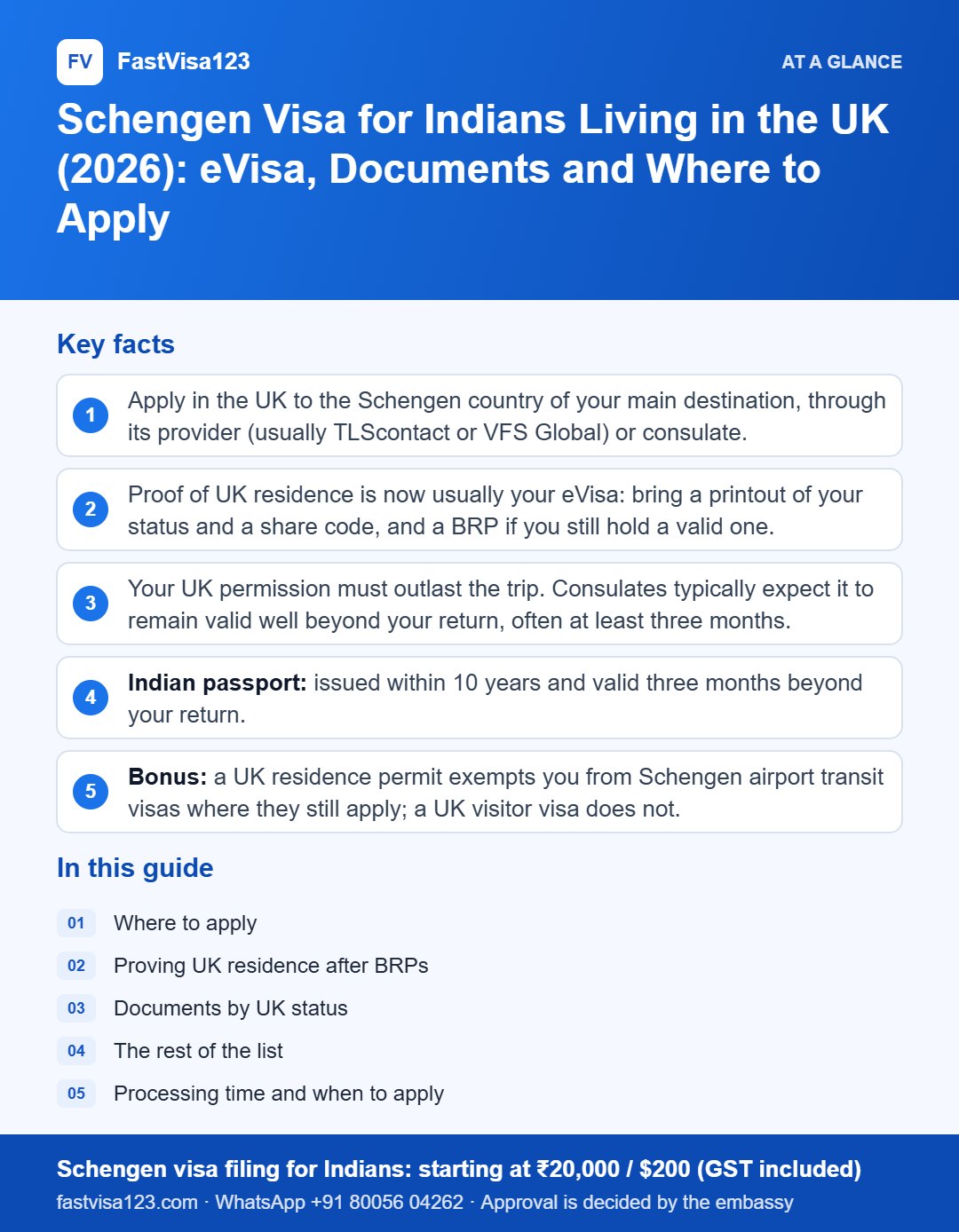
- Apply in the UK to the Schengen country of your main destination, through its provider (usually TLScontact or VFS Global) or consulate.
- Proof of UK residence is now usually your eVisa: bring a printout of your status and a share code, and a BRP if you still hold a valid one.
- Your UK permission must outlast the trip. Consulates typically expect it to remain valid well beyond your return, often at least three months.
- Indian passport: issued within 10 years and valid three months beyond your return.
- Bonus: a UK residence permit exempts you from Schengen airport transit visas where they still apply; a UK visitor visa does not.
Where to apply
Apply to the Schengen country where you spend the most nights (or first entry if equal), through that country’s centre or consulate covering your part of the UK. Each country chooses its own provider. In the UK, TLScontact and VFS Global run most Schengen centres in London, Manchester, Edinburgh and other cities. Use the provider listed on the official embassy site of your destination country.
Proving UK residence after BRPs
Most BRP cards expired at the end of 2024 and the UK moved to digital eVisas. Not every Schengen consulate can check UK digital records itself, so prepare:
- A printout or screenshot of your eVisa status from your UKVI account showing your name, status type and expiry date.
- A share code (“prove your immigration status for any other purpose”), generated close to your appointment date.
- Your BRP, if you still have a valid one, and any Home Office decision letter.
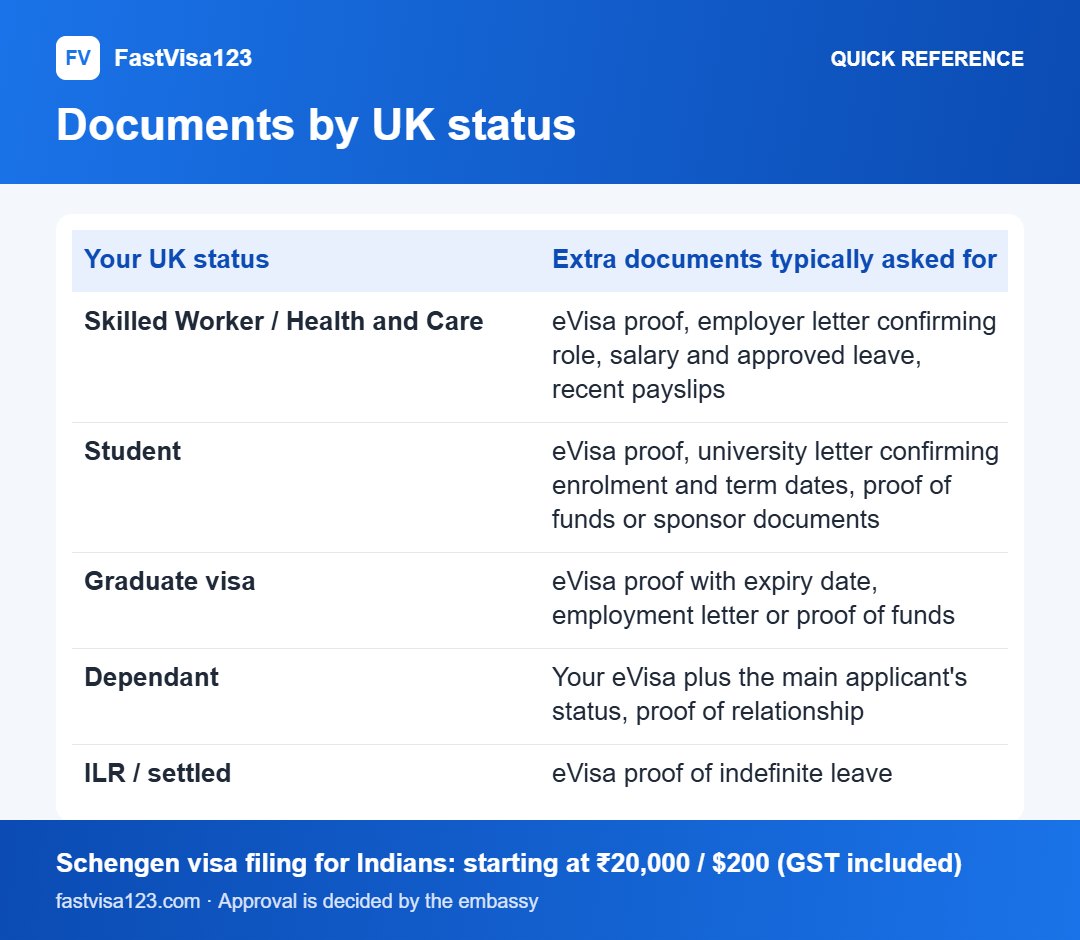
Documents by UK status
| Your UK status | Extra documents typically asked for |
|---|---|
| Skilled Worker / Health and Care | eVisa proof, employer letter confirming role, salary and approved leave, recent payslips |
| Student | eVisa proof, university letter confirming enrolment and term dates, proof of funds or sponsor documents |
| Graduate visa | eVisa proof with expiry date, employment letter or proof of funds |
| Dependant | Your eVisa plus the main applicant’s status, proof of relationship |
| ILR / settled | eVisa proof of indefinite leave |
The rest of the list
- Schengen application form, two photos (35×45 mm), passport and copies of previous visas.
- Return travel reservations and accommodation for every night.
- Travel medical insurance with at least €30,000 cover across Schengen.
- UK bank statements (usually three months) showing sufficient funds.
- Cover letter with itinerary.
Processing time and when to apply
15 days is the decision standard (up to 45 in individual cases). UK centres get very busy before Easter, summer and Christmas, when many UK residents travel. You can apply up to six months ahead. Frequent travellers with a good visa history may receive longer multiple-entry visas at the consulate’s discretion: under the general EU rules, three lawfully used visas in two years can lead to a one-year visa. (The more generous India-specific cascade applies to applications made in India.)
Sources
- EU Visa Code, Articles 5 and 6 (competent member state; residence-based jurisdiction)
- UK Home Office: eVisa and share code guidance
- EU Visa Code, Article 3 (airport transit exemptions for UK residence permit holders)
- Requirements vary by consulate; follow the checklist on the official site of the country you apply to.
Living in the UK and planning Europe?
We build the complete file for your UK-based application, including eVisa evidence, employer or university letters, itinerary and cover letter. Starting at ₹20,000 / $200 (GST included).
Frequently asked questions
Can Indians living in the UK apply for a Schengen visa from the UK?
Yes. You apply in the UK to the Schengen country of your main destination, through its visa centre or consulate. Source: EU Visa Code (Regulation 810/2009), Articles 5 and 6.
Which visa centres handle Schengen applications in the UK?
TLScontact and VFS Global run most Schengen visa centres in the UK. Each country chooses its own provider, so use the one listed by your destination’s embassy. Source: DavidsonMorris, Schengen visa from the UK (February 2026).
How do I prove UK residence without a BRP?
Bring a printout of your eVisa status from your UKVI account and a share code, plus your BRP if you still hold a valid one. Source: UK Home Office eVisa and share code guidance.
Do Schengen consulates accept the UK eVisa?
Not every consulate can check UK digital records itself, so bring a printout or screenshot showing your status, expiry date and identifiers, along with a share code. Source: DavidsonMorris, Schengen visa from the UK (February 2026).
How long must my UK visa be valid?
Your UK permission must be valid when you apply and for the period the consulate requires, often well beyond your return. If it expires soon after the trip, you may be refused or given a shorter visa. Source: DavidsonMorris, Schengen visa from the UK (February 2026).
Which country should I apply to for a multi-country trip?
The country where you spend the most nights, or the country of first entry if nights are equal. Source: EU Visa Code (Regulation 810/2009), Articles 5 and 6.
How long does a Schengen visa take from the UK?
Usually 15 calendar days from a complete application, extendable to 45. You can apply up to six months before travel. Source: EU Visa Code, Articles 9 and 23.
Do I need travel insurance?
Yes. Travel medical insurance with at least €30,000 cover valid across the Schengen Area for the whole trip. Source: EU Visa Code, Article 15.
How long must my Indian passport be valid?
Issued within the last 10 years and valid at least three months beyond your planned departure from Schengen. Source: EU Visa Code, Article 12.
Can I get a multi-year Schengen visa as a UK resident?
Possibly, at the consulate’s discretion. Under the general EU rules, applicants who obtained and lawfully used three visas in the previous two years can get a one-year multiple-entry visa, then two years, then up to five. The more generous India-specific cascade applies to applications made in India. Source: EU Visa Code, Article 24(2) (as amended by Regulation 2019/1155); EU Delegation to India.
Does a UK visa exempt me from a Schengen transit visa?
A UK residence permit does, in the countries that still require an airport transit visa for Indians. A UK visitor visa alone does not. Source: EU Visa Code, Article 3 (airport transit exemptions).