On 27 January 2026, at the EU–India summit in New Delhi, the EU and India concluded their long-negotiated free trade agreement and signed a memorandum of understanding on mobility, officially an EU–India comprehensive framework of cooperation on mobility. A few weeks later, on 18 February 2026, the first European Legal Gateway Office opened in New Delhi. Headlines called it a “mobility pact” and some visa sites suggested Schengen tourist visas would become easier or faster.
They have not. This guide separates what the framework actually covers from what it does not, so you can plan a Europe trip on facts.
What it means for you, in one box
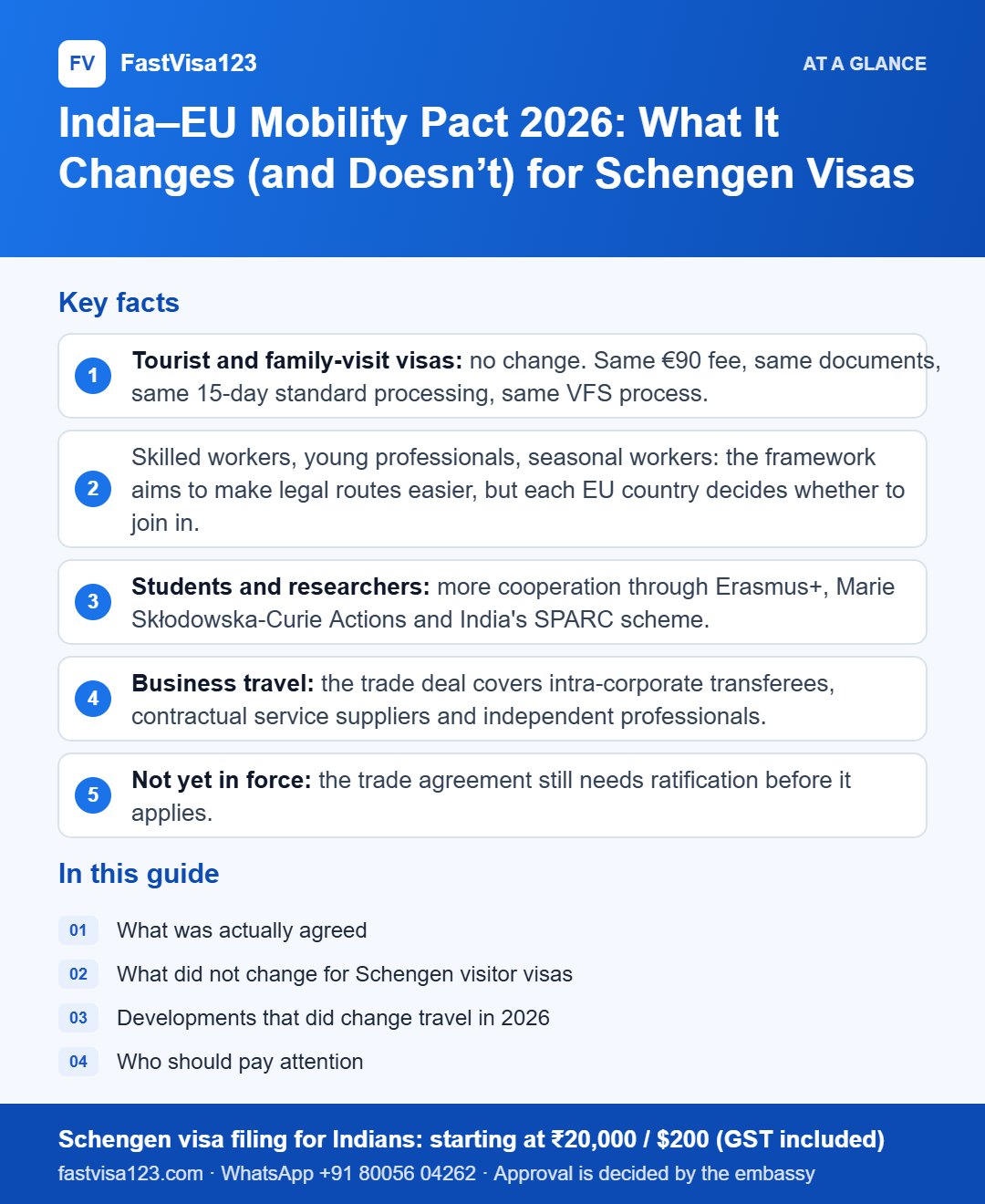
- Tourist and family-visit visas: no change. Same €90 fee, same documents, same 15-day standard processing, same VFS process.
- Skilled workers, young professionals, seasonal workers: the framework aims to make legal routes easier, but each EU country decides whether to join in.
- Students and researchers: more cooperation through Erasmus+, Marie Skłodowska-Curie Actions and India’s SPARC scheme.
- Business travel: the trade deal covers intra-corporate transferees, contractual service suppliers and independent professionals.
- Not yet in force: the trade agreement still needs ratification before it applies.
What was actually agreed
1. A framework for skilled and legal migration
The memorandum aims to facilitate the movement of skilled workers, young professionals and seasonal workers into sectors with shortages, along with work on comparing skills and qualifications, especially in tech. Because labour migration is a national competence in the EU, these measures only apply in member states that choose to take part. There is no single “EU work visa” for Indians.
2. The European Legal Gateway Office in New Delhi
Inaugurated on 18 February 2026 in the presence of External Affairs Minister S. Jaishankar, the office is a pilot meant to help Indian workers, students and researchers find legal opportunities in the EU, starting with the ICT sector, alongside the EU Talent Pool platform. It is an information and matching office. It does not issue Schengen visas and does not replace VFS or the consulates.
3. Students and researchers
The framework strengthens exchanges through EU programmes such as Erasmus+ and the Marie Skłodowska-Curie Actions, and India’s SPARC scheme, and explores associating India with Horizon Europe. Study visas themselves remain national long-stay (type D) visas issued by each country.
4. Business mobility under the trade agreement
The free trade agreement includes commitments on intra-corporate transferees, contractual service suppliers and independent professionals, with access for Indian providers in dozens of service sub-sectors. These provisions apply once the agreement is ratified and in force.
5. Social security
Both sides stated an intention to work towards social security agreements with all EU member states within five years, which would stop Indian professionals paying into two systems.
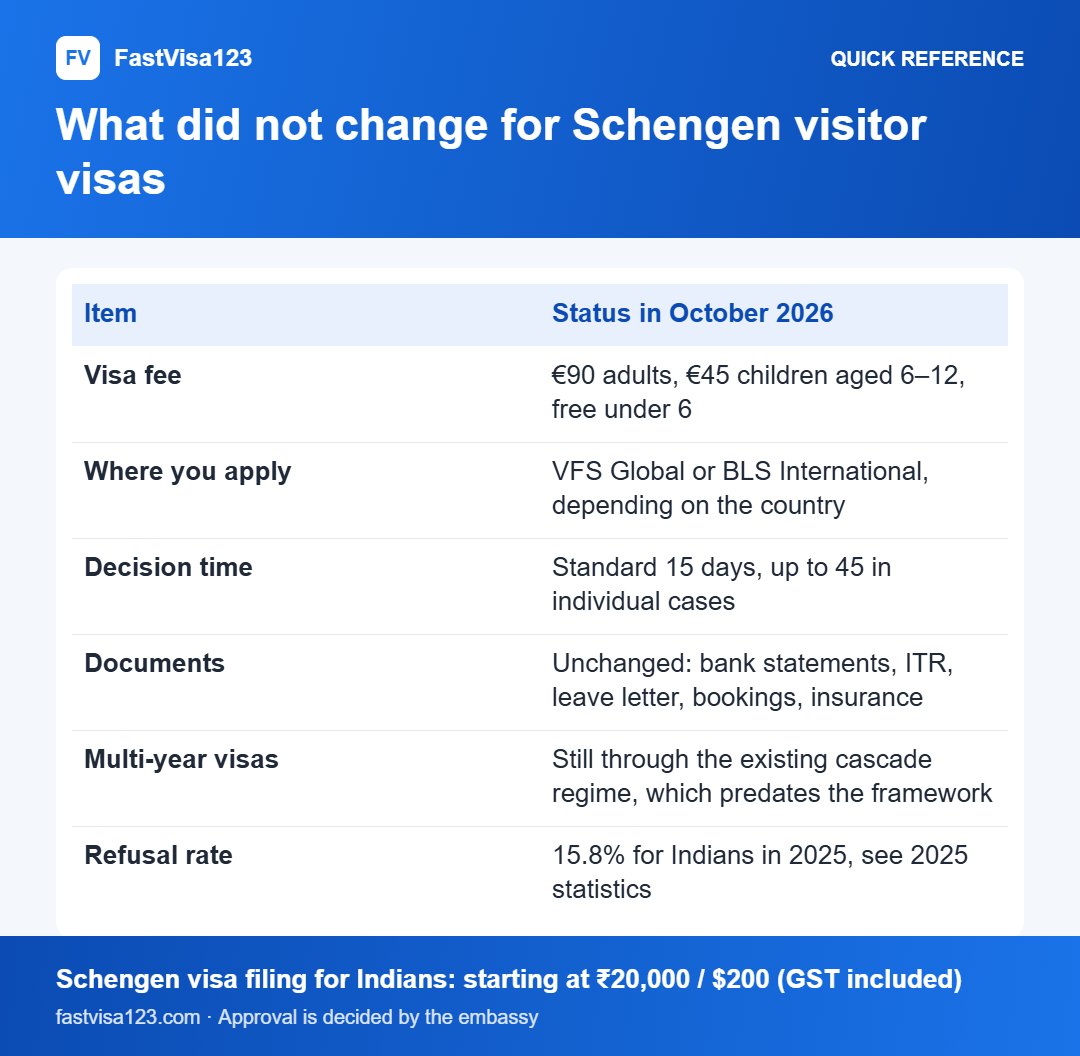
What did not change for Schengen visitor visas
| Item | Status in October 2026 |
|---|---|
| Visa fee | €90 adults, €45 children aged 6–12, free under 6 |
| Where you apply | VFS Global or BLS International, depending on the country |
| Decision time | Standard 15 days, up to 45 in individual cases |
| Documents | Unchanged: bank statements, ITR, leave letter, bookings, insurance |
| Multi-year visas | Still through the existing cascade regime, which predates the framework |
| Refusal rate | 15.8% for Indians in 2025, see 2025 statistics |
Developments that did change travel in 2026
Separate from the framework, three real changes this year are worth knowing:
- Airport transit visas: Spain, France and Germany dropped the transit visa requirement for Indians in 2026. See our transit visa guide.
- EES: the EU Entry/Exit System became fully operational at all external borders on 10 April 2026. See our EES guide.
- Digital visa: the EU’s online application platform is being prepared. See the digital Schengen visa.
Who should pay attention
- IT and tech professionals considering an EU job: follow the Legal Gateway Office and the EU Talent Pool.
- Students planning a year or more of study in Europe.
- Companies sending staff on transfers or service contracts, once the trade agreement enters into force.
- Tourists: nothing to do differently. A well-prepared file is still what gets visas approved.
Sources
- Council of the EU: Joint statement, EU–India summit, 27 January 2026
- All India Radio News: First-ever European Legal Gateway Office inaugurated in New Delhi (18 February 2026)
- The Local: What the mobility deal between the EU and India will mean (7 February 2026)
Planning a Europe trip under the current rules?
Visitor visa rules have not changed, and a complete, consistent file is still what gets approved. We build it end to end. Starting at ₹20,000 / $200 (GST included).
Frequently asked questions
What is the India–EU mobility pact?
It is the EU–India comprehensive framework of cooperation on mobility, a memorandum of understanding signed alongside the trade agreement at the EU–India summit on 27 January 2026. It covers skilled workers, students, researchers and business mobility. Source: The Local, 7 February 2026.
Does the mobility pact make Schengen tourist visas easier?
No. Visitor visa fees, documents, VFS procedures and the 15-day processing standard are unchanged. Source: The Local, 7 February 2026.
Did the Schengen visa fee change in 2026?
No. It remains €90 for adults and €45 for children aged 6 to 12, and free under 6. Source: VFS Global India fee schedules.
What is the European Legal Gateway Office in New Delhi?
A pilot office, inaugurated in February 2026, to help Indian workers, students and researchers find legal pathways to the EU, starting with the ICT sector. It does not issue visas. Source: All India Radio News, 18 February 2026.
Can the Legal Gateway Office help me get a Schengen visa?
No. Visas are still issued by each country’s consulate through VFS or BLS. The office provides information and matching for work and study opportunities. Source: The Local, 7 February 2026.
Is there a new EU work visa for Indians?
No single EU work visa exists. Labour migration is decided by each member state, and the framework applies only where a country opts in. Source: The Local, 7 February 2026.
What does the pact mean for Indian students?
More cooperation through Erasmus+, the Marie Skłodowska-Curie Actions and India’s SPARC scheme. Study visas remain national long-stay visas issued by each country. Source: The Local, 7 February 2026.
Is the India–EU free trade agreement in force?
It was concluded at the 27 January 2026 summit but must be ratified before it applies. Its business mobility provisions start once it enters into force. Source: Council of the EU, EU–India summit joint statement (27 January 2026).
Does the pact give Indians multi-year Schengen visas?
No. Multi-year visas come from the separate cascade rules the EU adopted for Indians in April 2024, which still apply. Source: EU Delegation to India (April 2024).
Will the pact reduce Schengen visa refusals?
Not directly. Visitor visas are still assessed on the same criteria. In 2025, 15.8% of Indian applications were refused. Source: European Commission visa statistics 2025.